


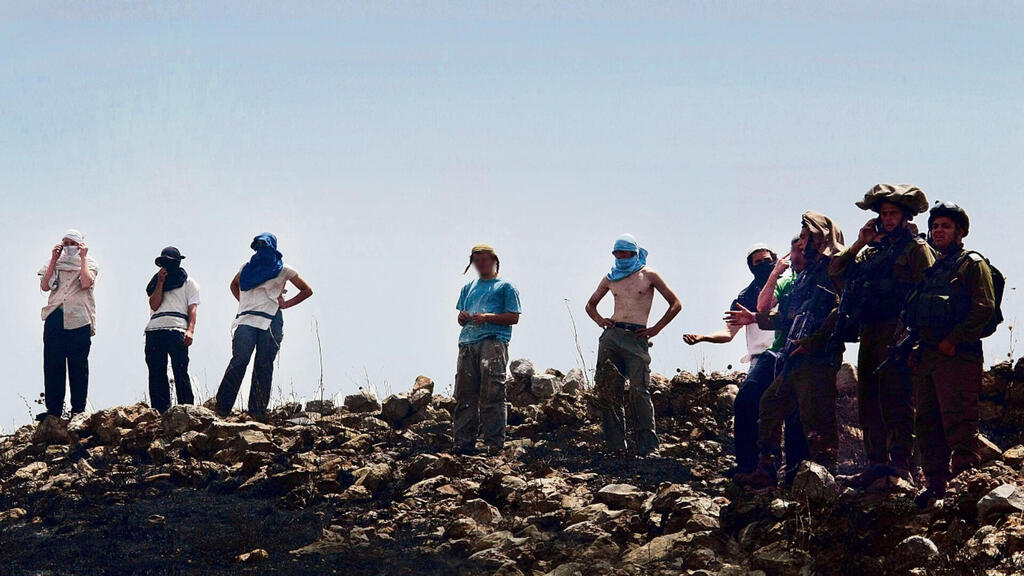
Israeli security officials are expressing growing concern over a recent rise in nationalist crime carried out by Jewish extremists in the West Bank, as attacks against Palestinians and their property become more frequent and openly publicized.
Data obtained by Ynet show a sharp increase in violent incidents in recent weeks, including assaults, arson, and vandalism in Palestinian villages. The IDF and the Shin Bet internal security agency have voiced frustration at what they describe as weak and infrequent condemnations from settlement leaders, while police officials acknowledge their limited ability to prevent such incidents in advance.
(Photo: AFP)
Unlike in previous years, members of the so-called “hilltop youth” — extremist young settlers, many living in unauthorized outposts — are increasingly encouraging one another and sharing details of their attacks on social media. According to the report, they have created WhatsApp and Telegram groups where they maintain a “logbook” of attacks. In one message, participants boasted, “Happy Jews set fire to a house and a building in a village.”
Defense Ministry data show that 154 nationalist crimes were recorded in October 2022, 113 in October 2023, and 60 in October 2024. This October, the figure rose to 97 incidents. In 2025, security officials say there has been a clear uptick over the past two months: 56 incidents in August, 60 in September, and 97 in October.
The recent wave includes 21 confrontations between settlers and Palestinians (not including cases where Jewish shepherds were injured), 14 arsons, 5 incidents of vandalism, 46 cases of stone-throwing, and 11 assaults.


The army’s Central Command had prepared for a tense olive harvest season but remains frustrated by the frequency and severity of the attacks. Police officials say their role is mostly investigative, after incidents occur, and that they lack tools to prevent them ahead of time. Both the Shin Bet and the IDF have called for stronger cooperation from settlement leaders.
Security sources also report that the violence is spreading southward — into the Gush Etzion area and the southern Hebron Hills — regions that until recently were less affected. Many of the incidents have occurred without prior clashes or provocation from Palestinians and not in response to Palestinian attacks.
In addition to attacks on Palestinians, extremist settlers have been involved in illegal construction activity in the West Bank. Some groups have sought to establish new outposts on land that is not state-owned, and in some cases privately owned by Palestinians, to provoke confrontation. More than 10 such outposts are located in Area B and are periodically evacuated, according to enforcement data.
Security officials say violent activists in these outposts carry out attacks on nearby Palestinian communities as part of an effort to “deter” Palestinians. Legitimate agricultural farms in the area — unrelated to the violence — have also suffered consequences, as Jewish shepherds are frequently caught in clashes and sometimes injured, occasionally seriously.
About four months ago, a wave of attacks targeted Israeli security personnel and facilities, including an assault on a Shin Bet site. Several cases from that period remain under gag order. Following the incidents, police, the Shin Bet, and state prosecutors carried out a series of arrests, but all suspects were later released under various conditions, and none were indicted.
Officials say their operations are focused on a small core group of several dozen individuals, most of whom have been barred from entering the West Bank.
The violence has not only targeted Palestinians but also settlers who oppose the extremists’ actions. Some of the victims are residents of outposts who were once part of the same movement.
Security officials warn that the ongoing violence undermines the image of the broader settlement community, whose members largely obey the law and reject vigilantism. Some rabbis and regional council heads have spoken out against the attacks, but officials say stronger and more public denunciations are needed.
“This is an extremely complex issue,” said a senior security official. “Not everyone wants to deal with it, and everyone is trying to tread carefully. Behind closed doors, people speak harshly — no one is comfortable with this situation, least of all the settlers. We only wish they would say publicly what they say privately.”