

Israel's Foreign Ministry on Friday evening urged Israeli citizens in France to exercise heightened caution and remain vigilant amid fears of renewed violent unrest across the country. The warning follows riots that erupted last weekend and continued into the past week, with further demonstrations and clashes feared around October 24 and November 5, 2026.
The ministry advised Israelis to avoid demonstrations, protests, large gatherings and areas affected by public disturbances, even when protests appear peaceful, warning that they could suddenly escalate into violent confrontations. It also urged travelers to leave areas where clashes occur immediately and safely, and not to gather nearby to watch or film the events. Israelis were advised to prepare for disruptions to public transportation, roadblocks and changes to traffic arrangements, and to check road and transport conditions before setting out.
The ministry also recommended paying attention to movement restrictions and nighttime curfews that have been imposed or may be introduced in certain parts of France, checking the regulations in force at their current location and planned destinations, monitoring local media and official French announcements, and following instructions from police and security forces. Travelers were advised to check security conditions at places they intend to visit and remain prepared for restrictions or changes introduced at short notice.
In an emergency, Israelis can contact the Foreign Ministry's 24-hour Situation Center at +972-2-530-3155, or the emergency hotline of the Israeli Embassy in France at +33-6-59-44-44-61. France's general emergency number is 112.
Preparing for renewed riots: Cultural institutions close to visitors
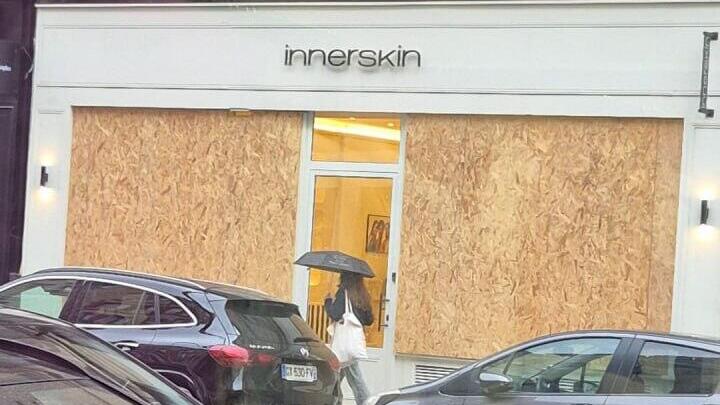
French authorities are preparing for major demonstrations against the country's economic situation over the weekend, amid fears that the protests could reignite the violent riots that swept through France, particularly Paris, last weekend. As part of the preparations, museums, cultural institutions and luxury stores announced that they would either close completely on Saturday or operate under restrictions.
Among the institutions announcing closures or reduced operations are the Louvre, the Musée d'Orsay, the Grand Palais, the Picasso Museum, the Musée de l'Orangerie, the Art Basel Paris international art fair, luxury retailers Cartier and Louis Vuitton, the National Library of France and affiliated institutions, and the Palace of Versailles.
Students block the entrance to the Louvre Museum earlier this week


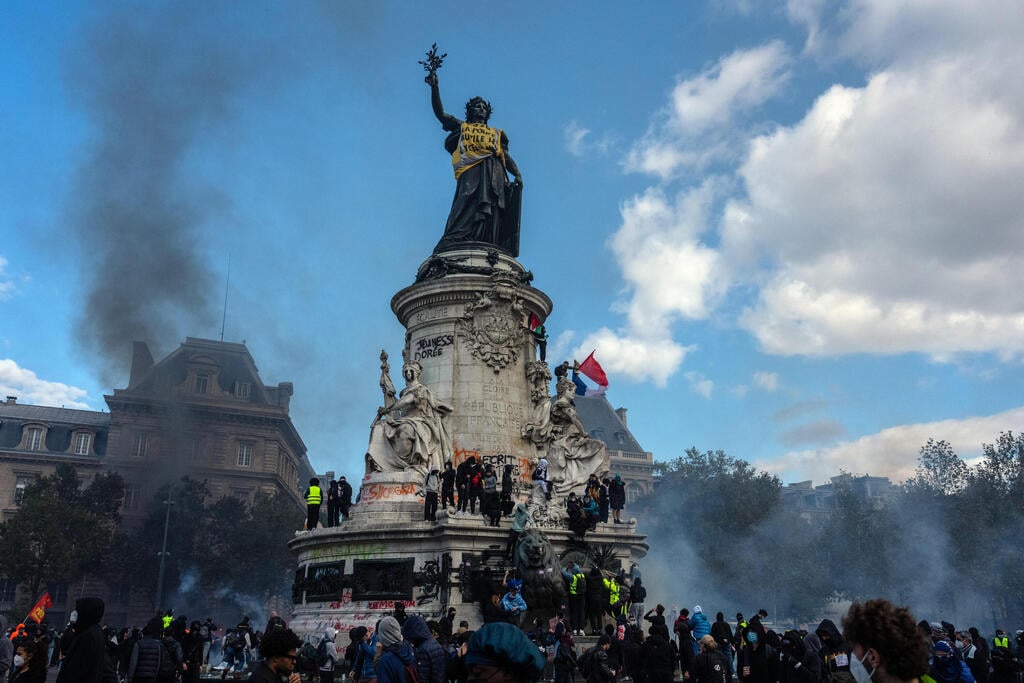
Statue of Marianne in Paris' Place de la République
(Photo: Carl Court/Getty Images)
At Versailles, restrictions will affect the palace and its surrounding estate. According to the palace's updated visitor information, the main building will admit only visitors who already hold tickets, until noon Saturday. The Trianon estate will remain closed throughout the day, while the gardens and park will close at 1 p.m.
On Thursday, French President Emmanuel Macron announced that authorities would prohibit demonstrations organized by groups he described as lacking legitimate authority, referring primarily to far-left organizations that the government accuses of responsibility for last weekend's violence.
Lyon announced restrictions on demonstrations across a broad area of its city center on Saturday. Authorities in Marseille initially announced a sweeping ban as well, but subsequently agreed to allow a union-organized march along an approved route. Protest organizers have challenged restrictions imposed in several cities, arguing that they infringe on the constitutionally protected right to demonstrate.
Among those calling for nationwide demonstrations Saturday are France's national student union, UNEF, and supporters of the Yellow Vest movement, which emerged in 2018 during protests against the cost of living and Macron's economic policies.
With fears that the demonstrations could once again deteriorate into widespread violence, the government has promised a massive police deployment, following the October 17 protests, which descended into chaos as rioters attacked police officers and government buildings and looted hundreds of businesses across France.
Macron's government acknowledged that it had been insufficiently prepared for the scale of the previous demonstrations, which drew hundreds of thousands of people, far exceeding official expectations. This time, authorities say the security response will be considerably stronger.
Military personnel will also assist with public security over the weekend, including soldiers from Operation Sentinelle, France's counterterrorism security mission, which has patrolled French cities since the wave of Islamic State attacks in France and elsewhere in Europe beginning in 2015. The soldiers will be assigned to protect sensitive locations, freeing additional police officers for crowd control and efforts to prevent looting.
Last weekend's riots followed large demonstrations against the rising cost of living and deteriorating conditions in educational institutions. The protests were led in significant part by radical-left groups and included substantial participation from immigrant communities.
Rioters attacked police officers, threw stones at them, assaulted passersby, set fire to garbage bins, vehicles and buildings, and looted or vandalized approximately 3,000 businesses in Paris, Marseille, Lyon, Nice, Nantes, Limoges and other cities.
More than 2,700 people were detained during the unrest, and nearly 1,000 police officers and other security personnel were injured, several seriously. Macron and Prime Minister Sébastien Lecornu acknowledged failures in intelligence preparations for the riots and said police had found themselves at a disadvantage against the rioters.
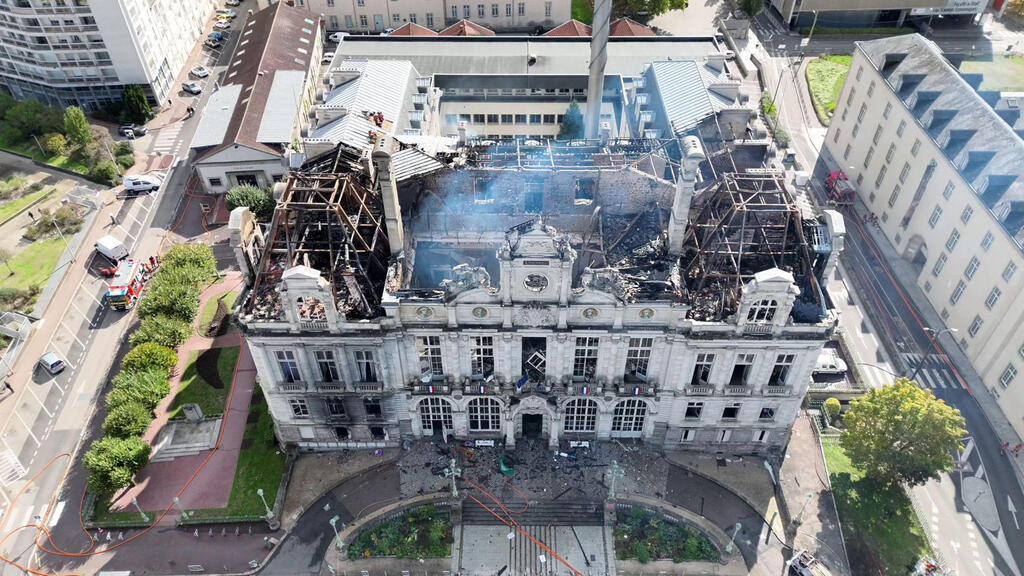
Limoges' historic City Hall
(Photo: SDIS 87 / AFP)
On Thursday, authorities in Paris again attempted to prevent demonstrations over fears that they could turn violent, but a court overturned a police ban on one protest. Following the ruling, thousands demonstrated in the capital, although the gathering remained stationary rather than proceeding as a march, as originally planned. No unusual incidents were reported.
One of the signs carried by protesters read: "We don't need tear gas for our future to look bleak."
Meanwhile, Macron convened a special security meeting at the Élysée Palace, where he again accused far-left organizations of orchestrating the violence in an effort to create anarchy in France.
"Last Saturday, we saw political and even seditious acts carried out by organized far-left groups seeking to bring down the Republic," Macron said.
Macron added that the strategy adopted by the authorities for the coming days would be to reject requests to hold demonstrations submitted by individuals or groups without legitimate authority.
"The rules are simple, and I think they're simply a matter of common sense," Macron said. "The general recommendation is that there should be no demonstrations in the coming days. For those who nevertheless wish to demonstrate, if they are trade unions, the prefects will propose alternative routes."
The president was referring to routes intended to pose less danger to businesses, whose owners fear further looting.
Justice Minister Gérald Darmanin, meanwhile, called for tough measures against those who violate protest bans, including stripping offenders of their voting rights. He also proposed restrictions on social media use by people involved in violence, looting or attacks on police officers.
In recent days, calm has largely returned to Paris and other French cities, partly because of partial curfews imposed in several areas. On Thursday evening, authorities in the capital announced an extension of the nighttime curfew covering Place de la République and the Les Halles district, from 11 p.m. to 6 a.m. local time, until Monday morning.
At the same time, the French Culture Ministry confirmed that several of Paris' most important museums, including the Louvre and the Musée d'Orsay, would remain closed on Saturday.
Shops looted in Marseille: Footage shows businesses damaged during last weekend's unrest
(Video: X)
The Grand Palais, Picasso Museum and Musée de l'Orangerie will also be closed. The Culture Ministry instructed institutions under its authority to take all necessary measures to ensure visitor safety, protect staff and preserve works of art.
Organizers of Art Basel Paris, the international art fair, also announced that the event would close for the weekend. Paris City Hall urged residents and visitors to exercise extreme vigilance Saturday because of the risk of further violence by rioters unaffiliated with the broader social protest movement.
Last Saturday's demonstrations brought together high school students, university students, labor unions and supporters of the Yellow Vest movement. The protests followed weeks of student demonstrations that began last month in schools in poorer suburbs north of Paris over teacher shortages and deteriorating educational conditions.
Those demonstrations were also accompanied by numerous violent incidents, and the protest movement has since spread to other European countries, including Belgium.
In France and abroad, some commentators have emphasized the involvement of immigrants and descendants of immigrants from African, Arab and Muslim countries in the demonstrations and violence. Such claims have circulated since the student protests began earlier this month.
U.S. President Donald Trump also suggested that the unrest was evidence of what he described as an attempt by Islam to take over France. Macron rejected that characterization as a "complete lie," instead emphasizing the role he believes far-left organizations played in the riots.
Prime Minister Lecornu and figures on the French right have also accused Jean-Luc Mélenchon, leader of the far-left France Unbowed party, of helping fuel the violence. They allege that the unrest is being used as a show of political strength ahead of next year's presidential election, in which Mélenchon and far-right leader Marine Le Pen are expected to be prominent figures.