

The British newspaper The Financial Times reported that Israel hacked into nearly all traffic cameras in Tehran, encrypting their footage and transmitting it to servers in Tel Aviv and southern Israel. As the security guards and skilled, loyal drivers of senior Iranian officials arrived for work near Pasteur Street in Tehran — the site where Supreme Leader Ayatollah Ali Khamenei was eliminated Saturday in an Israeli airstrike — Israeli operatives were already watching them.
According to one source who spoke to the newspaper, one camera provided an angle that proved especially useful, allowing analysts to determine where the men preferred to park their private cars. That gave Israel insight into work patterns in the routine section of the heavily secured compound. Complex algorithms, the report said, added details to the personal files of security team members, including their home addresses, duty hours, commuting routes and, most importantly, whom they were typically assigned to protect and drive. In this way, what intelligence officers call a “pattern of life” was built for each of them.
A rally of mourning was held in Tehran


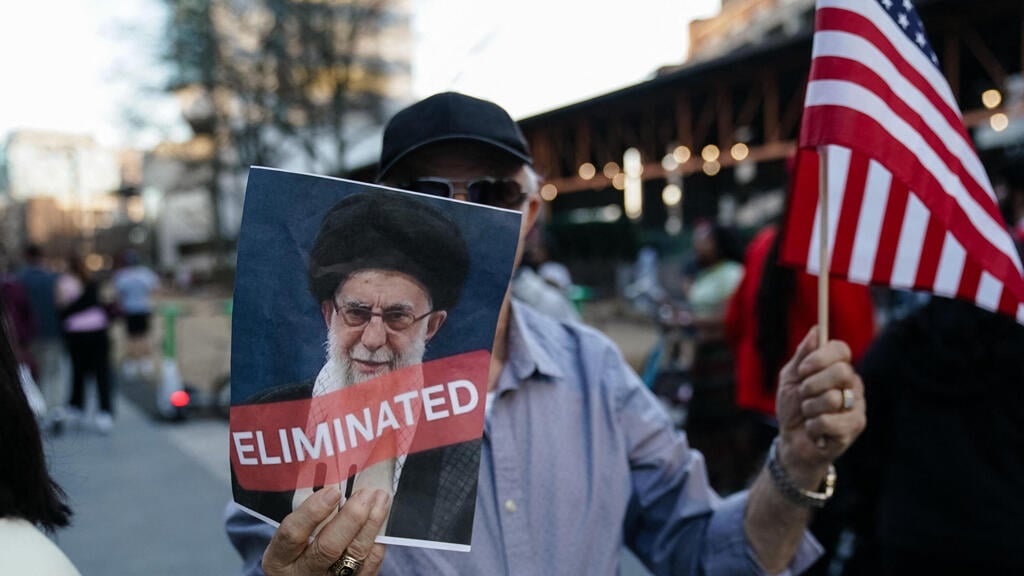
Members of the Iranian community in Virginia celebrate
(Photo: Elijah Nouvelage / AFP)
These capabilities were part of a yearslong intelligence campaign that helped pave the way for Khamenei’s killing, the newspaper reported. But the real-time data stream was only one of hundreds of intelligence flows. It was not the only way Israel and the CIA determined the precise hour the 86-year-old Khamenei would be in his office Saturday morning and who would join him.
The newspaper reported that Israel also managed to disrupt specific components in about 12 cellular antennas near Pasteur Street, causing phones to appear “busy” when dialed. In this way, Khamenei’s security team was unable to receive warnings about the impending strike.
Long before bombs fell on Khamenei, “we knew Tehran the way we know Jerusalem,” an Israeli intelligence officer told the newspaper. “And when you know a place like the street you grew up on, you notice every small thing that is out of place.”
'When war breaks out, it will be more difficult'
According to the report, the dense “intelligence picture” of the capital of Israel’s archenemy was the result of painstaking data collection enabled by Israel’s sophisticated technological intelligence Unit 8200, human assets recruited by the Mossad spy agency, and vast amounts of data processed by the Military Intelligence Directorate into daily briefings. According to a source familiar with the details, Israel used a mathematical method known as “network analysis” to sift through billions of data points, uncover unexpected decision-making hubs and identify new targets for surveillance and assassination. All of this fed what the report described as a “production line” with a single product: targets.
“In Israeli intelligence culture, target intelligence is the essential tactical issue that enables strategy,” retired Brig. Gen. Itai Shapira, who served for 25 years in the Military Intelligence Directorate, told the newspaper. “If the decision-maker decides someone must be eliminated, in Israeli culture the answer is: ‘We will provide the precise intelligence.’”
Opponents of the regime in Iran celebrate the killing of Khamenei
The newspaper noted that an example of Israel’s capabilities was evident at the outset of the 12-day war in June, which opened with an unprecedented neutralization of Iran’s air defenses through a combination of cyberattacks, drones and precision-guided munitions that destroyed the radar systems of Russian-made missile launchers. “We took away their eyes first,” an intelligence officer said.
The report said that both in the June war and now, Israeli pilots used a specific missile known as “Sparrow,” capable of striking a small target such as a dining table from a distance of more than 1,000 kilometers — far from Iran and outside the range of its air defenses.
“Not all details of the latest operation are known,” the newspaper said. “Some may never be published to protect sources and methods still used to track other targets. But the killing of Khamenei was a political decision, not only a technological achievement,” more than half a dozen current and former Israeli intelligence officers interviewed for the article said.
According to the newspaper, when the CIA and Israel determined that Khamenei would hold a Saturday morning meeting in his offices near Pasteur Street, the opportunity to kill him alongside much of Iran’s senior leadership was “particularly suitable.” Intelligence agencies assessed that tracking them once war began would be far more difficult, as the Iranians would quickly implement preplanned evasion methods, including moving into underground bunkers resistant to Israeli bombs.
No longer a Sisyphean task
According to the report, unlike his ally Hezbollah leader Hassan Nasrallah, Khamenei did not live in hiding. Nasrallah spent years in underground bunkers, evading several Israeli eliminations attempts until September 2024, when Israeli fighter jets dropped about 80 bombs on his hideout in Beirut, killing him. Instead, Khamenei publicly reflected on the possibility of being killed, dismissing his own life as insignificant compared with the fate of the Islamic Republic. In fact, several Iran experts said he expected to become a martyr. Still, in wartime, one interviewee said, he took some precautions.
“It was unusual for him not to be in his bunker. He had two — and if he had been there, Israel would not have been able to reach him with the bombs it had,” a source told the newspaper.
Even in June 2025, at the height of full-scale war, Israel made no known attempts to bomb Khamenei. Instead, it focused primarily on the leadership of the Islamic Revolutionary Guard Corps, missile launchers and stockpiles, and Iran’s nuclear facilities and scientists.
A person briefed on the operation said the attack on Iran had been planned for months, but officials coordinated it after U.S. and Israeli intelligence confirmed that Khamenei and his senior officials would meet at his compound in Tehran on Saturday morning.
Tracking individual targets was once a Sisyphean task requiring visual verification and the filtering of false reports, the newspaper said, but Israel’s algorithm-based data collection has automated the process in recent years. And for a high-value target such as Khamenei, failure was not an option.
IDF doctrine requires that two separate senior officers, operating independently, confirm with high certainty that a target is at the designated strike location and identify who is accompanying him. In this case, according to two sources familiar with the matter, Israeli intelligence had signals intelligence, including hacked traffic cameras and infiltrated cellular networks. One source said the information showed that the meeting with Khamenei was proceeding on schedule, with senior officials making their way to the site.
But the Americans, two sources familiar with the details said, had something even more tangible — a human source. That allowed Israeli aircraft, which had flown for hours to reach the correct location at the right time, to launch about 30 precision-guided munitions.
The IDF said the daytime strike had an advantage. “The decision to strike in the morning rather than at night enabled Israel to achieve tactical surprise for the second time, despite Iran’s high level of readiness,” it said.