

The decades-long hostile relationship between India and Pakistan has reached its most dangerous point in decades, as both nuclear-armed nations engage in an alarming escalation of violence. What started as cross-border skirmishes has now spiraled into missile strikes, drone attacks, and civilian casualties, sparking fears of a potential nuclear confrontation.
Early strikes and retaliation
The conflict intensified after India launched missile strikes on Wednesday, targeting what it claimed were terror infrastructure sites in Pakistan. This was a response to a terrorist attack in Indian-administered Kashmir last month, where 25 Indian tourists and a local guide were killed. India has accused Pakistan of being complicit in the attack, a claim Pakistan vehemently denies.
Destruction in Kashmir
(Video: Reuters)


In retaliation, Pakistan launched an operation named "Operation Bunyanun Marsoos"—an Arabic term meaning "Firm, United Structure." Early Saturday morning, Pakistan struck several Indian military targets, including the Pathankot airfield in Punjab, the Udhampur Air Force Station in Indian-administered Kashmir, and a missile storage site in the Beas region. Explosions were also reported in Srinagar and Jammu, with air raid sirens sounding across the regions.
Civilian casualties and regional impact
The violence has had a devastating impact on civilians. In Pakistan, densely populated areas near Rawalpindi, including the Nur Khan Air Force Base, experienced missile strikes from India, causing widespread panic. In India, officials reported five civilian deaths in the Jammu region due to Pakistani strikes. Explosions were also heard in the border cities of Amritsar and Fazilka, with Indian forces intercepting multiple Pakistani drones.
The clashes have not been limited to military targets. Reports from India claim that Pakistani drones carried out attacks on religious sites, including Sikh Gurdwaras and Christian churches. One civilian was injured in these attacks, prompting Indian Foreign Minister Vikram Misri to condemn Pakistan for targeting places of worship. Pakistan, however, has denied these allegations, maintaining that its strikes are only aimed at military infrastructure.
Fear of nuclear escalation
The situation has taken a particularly alarming turn with Pakistan announcing a meeting of its National Command Authority, the body responsible for overseeing the country’s nuclear arsenal. Analysts interpret this as a "soft nuclear signal," consistent with Pakistan's stated doctrine of a first-use nuclear policy in case of severe threats.
Ahsan Iqbal Chaudhary, Pakistan's Minister for Planning Development & Special Initiatives, described the escalation as a test for the international community, urging nations to prevent the situation from crossing the nuclear threshold. "We would hate to see that threshold breached," he stated in a televised interview.
Diplomatic efforts for de-escalation
Amid rising tensions, the United States and other global powers have called for restraint. U.S. Secretary of State Marco Rubio contacted Pakistan's Army Chief, General Asim Munir, urging both sides to de-escalate and offering U.S. assistance in initiating constructive dialogue. The Group of Seven (G7) nations also issued a statement calling for maximum restraint and encouraged both countries to engage in direct talks.
However, both sides appear to be doubling down on their military strategies. Pakistan claims Indian missiles targeted three air bases, including the Nur Khan Air Force Base in Rawalpindi, while India accuses Pakistan of launching over 400 drones into its territory. Indian forces have reportedly shot down several drones over Punjab and Rajasthan.
Military deployments and rising tensions
The clashes have escalated to aerial battles, with Pakistan deploying over 100 aircraft in response to Indian strikes. According to the Pakistani military, its air defenses intercepted most of the missiles launched by India, though some managed to hit non-critical areas. Meanwhile, debris from at least three Indian fighter jets, including a French-made Rafale, has been found in Indian-administered Kashmir and Punjab.
Pakistan also claimed to have targeted India's BrahMos missile storage site, signaling a direct threat to India's strategic weaponry. Loud explosions were reported in Indian cities close to the border, including Srinagar and Jammu. On the Pakistani side, cities like Lahore and Peshawar also reported sounds of explosions, as fears grew that the conflict could expand further.
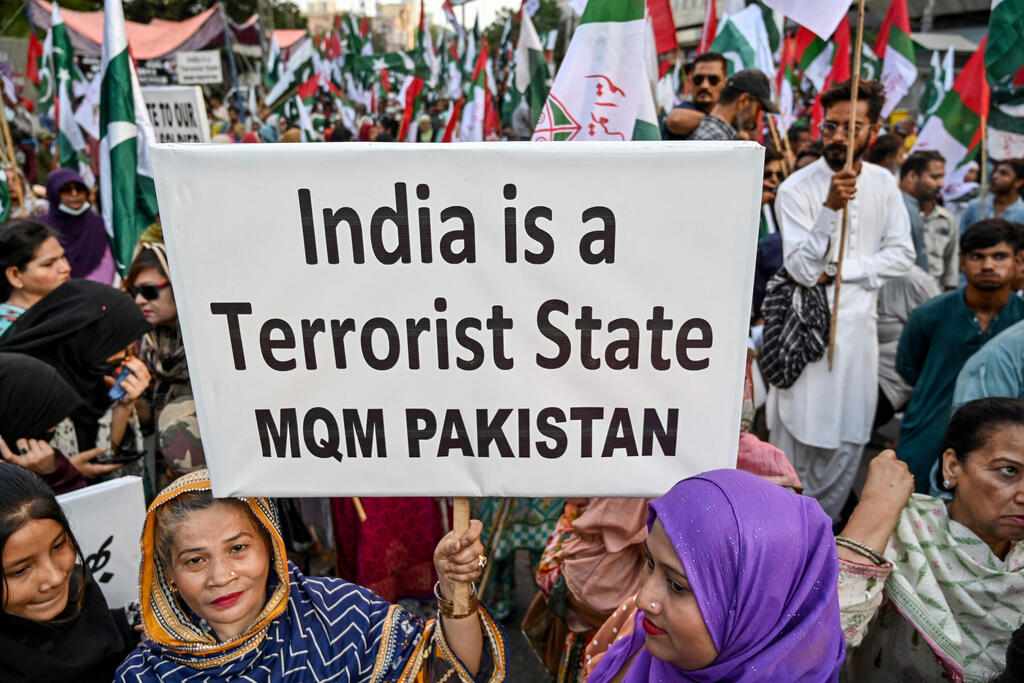
Demonstrtion in Karachi
(Photo: Asif HASSAN / AFP)
The conflict has already claimed at least 48 lives on both sides, according to unverified casualty reports. Civilians in both countries are stocking up on supplies as fears of further escalation grow. The United Kingdom’s High Commissioner to Pakistan, Jane Marriott, stated that her government is monitoring the situation closely, reflecting the global concern surrounding the conflict.
<< Get the Ynetnews app on your smartphone: Google Play: https://bit.ly/4eJ37pE | Apple App Store: https://bit.ly/3ZL7iNv >>
The path ahead
As tensions continue to rise, the prospect of a full-scale war between India and Pakistan looms larger than ever. The long-standing Kashmir dispute, coupled with recent provocations, has brought the two nations dangerously close to conflict. With both sides exchanging missiles, drones, and accusations, the world watches anxiously, hoping for diplomatic intervention to prevent a catastrophic outcome.
For now, the region remains on edge, with the possibility of nuclear escalation casting a dark shadow over South Asia. Both countries face immense pressure to step back from the brink and engage in dialogue, but with emotions running high and hostilities deepening, the path to peace remains uncertain.