

At just 17, Elwan is too young to vote in France's presidential election, but he has already become one of the most recognizable faces of a student revolt shaking the country. Wearing a Palestinian keffiyeh, passionately defending the protesters' demands and expressing understanding for violence in disadvantaged neighborhoods, the Paris high school student has captured millions of views on social media and attracted national television attention.
One of his videos has surpassed 10 million views on X, while footage of him kissing far-left leader Jean-Luc Mélenchon during a demonstration in Paris on Tuesday further accelerated his rise to prominence. Mélenchon shared the encounter on his own account, writing: "All together, to win!"
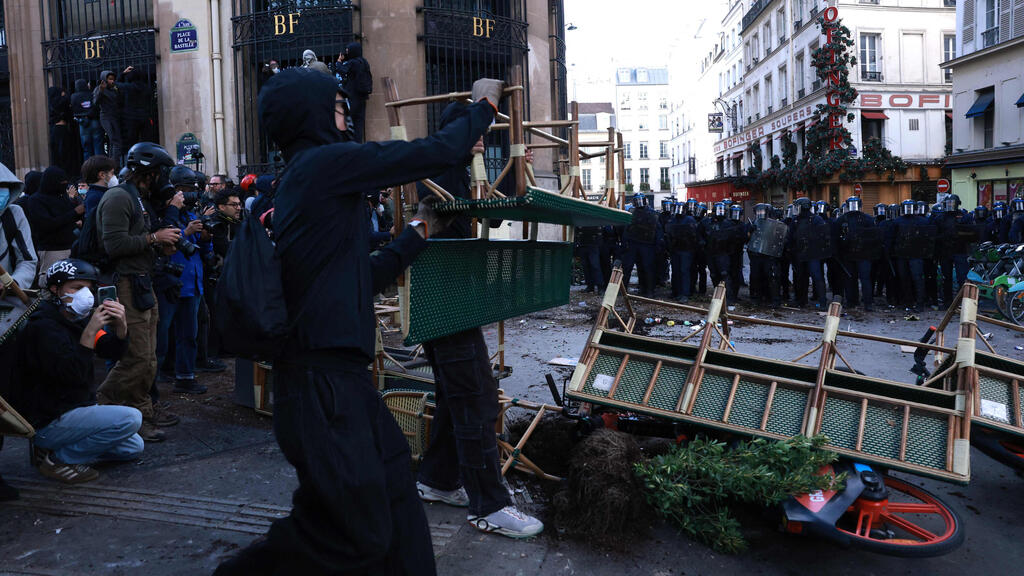
Clashes during student protests at Place de la Bastille in Paris, France


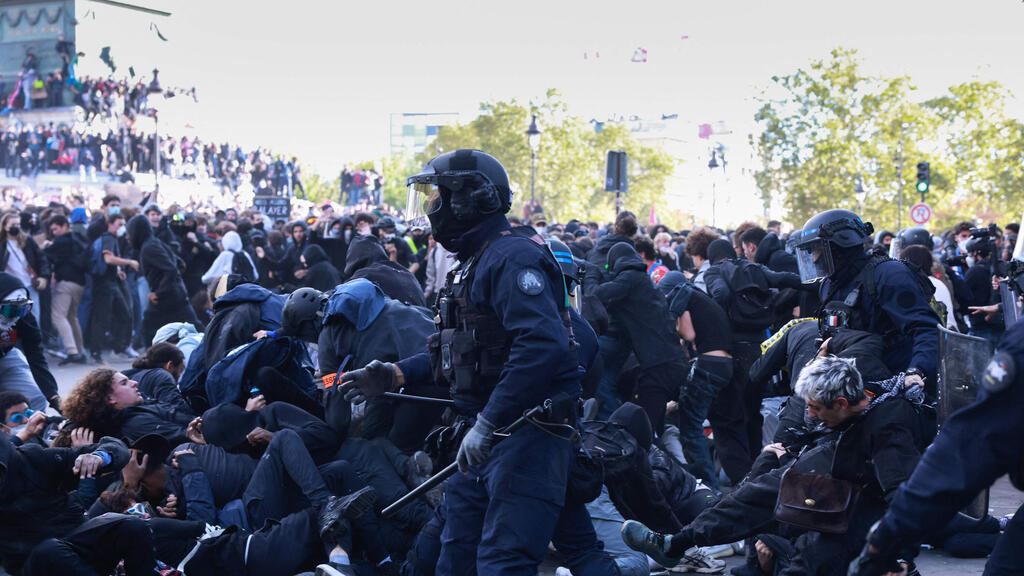
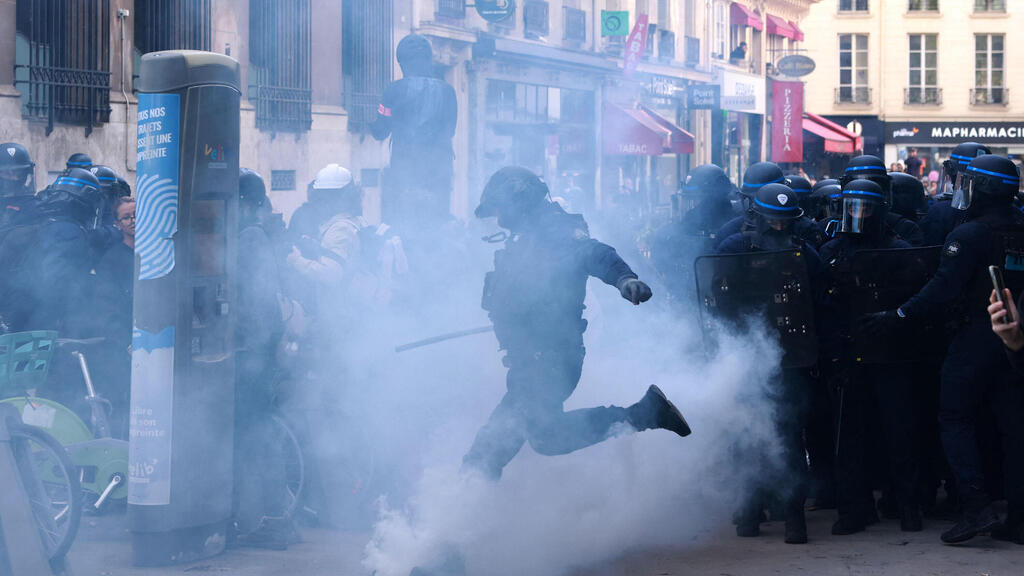
Elwan's sudden celebrity comes as France confronts an increasingly violent wave of student demonstrations. On Thursday, clashes erupted at Paris' historic Place de la Bastille, where riot police fired tear gas and water cannon at protesters. Across the country, 504 people were arrested and 48 police officers and gendarmes were injured, according to the Interior Ministry.
The unrest also brought an arson attack on a police station in Bordeaux, the ransacking of a nearby high school and an assault on a deputy principal in Marseille. Student leaders, meanwhile, have rejected government promises of educational reforms and vowed to continue their campaign until their demands are met.
Gallery
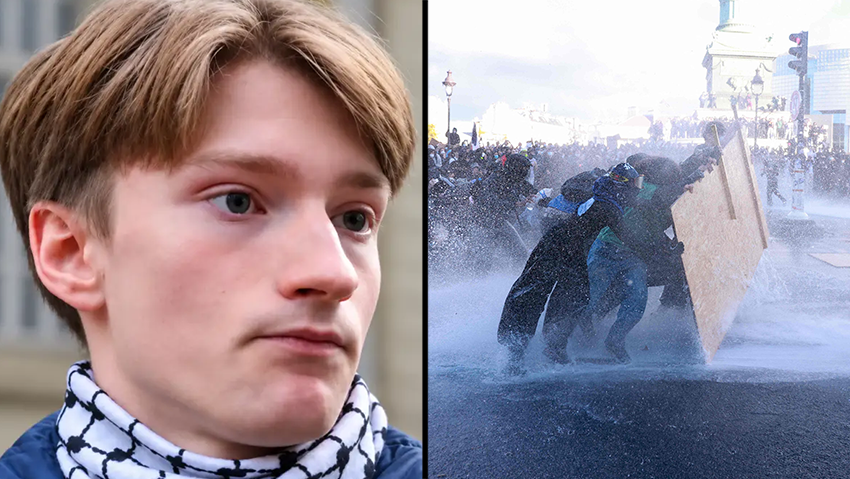
From a school blockade to 10 million views: the teenager becoming the face of France’s revolt
(Photo: Kenzo TRIBOUILLARD / AFP)
A teenager, a keffiyeh and 10 million views
Elwan, a high school senior in Paris, first attracted widespread attention through an interview filmed Sunday while he was participating in a blockade of his school in the capital's ninth arrondissement.
Before speaking to Vincent Lapierre, a YouTuber associated with the far right, he produced a document confirming that his parents had authorized him to give interviews.
With a Palestinian keffiyeh wrapped around his neck, Elwan launched into an impassioned explanation of the social inequalities he believes are driving the student uprising.
"In the suburbs, violence pays off much more for people because they have nothing," he said.
He argued that France suffers from deep social discrimination, with sharp disparities between neighborhoods and unequal attention from the government.
Windows smashed, fires set: The high school ransacked near Bordeaux, France
"There is one neighborhood that's good and another that's bad, and the government doesn't care about the first but cares very much about the second!" he said.
Elwan also described the conditions faced by students in disadvantaged suburbs of Paris, where he said inadequate school facilities make everyday learning difficult.
"In many schools in the Paris suburbs, students don't have enough resources to keep warm in winter or cool in summer," he said. "They can't even attend classes regularly, even though they're students just like us here."
The teenager went on to outline the protesters' demands and expressed hope that Mélenchon's France Unbowed party would eventually take power.
"Macron, Lecornu, we don't want them anymore. And that other guy... what's his name, Geffray? I don't know what," he said, referring dismissively to Education Minister Édouard Geffray.
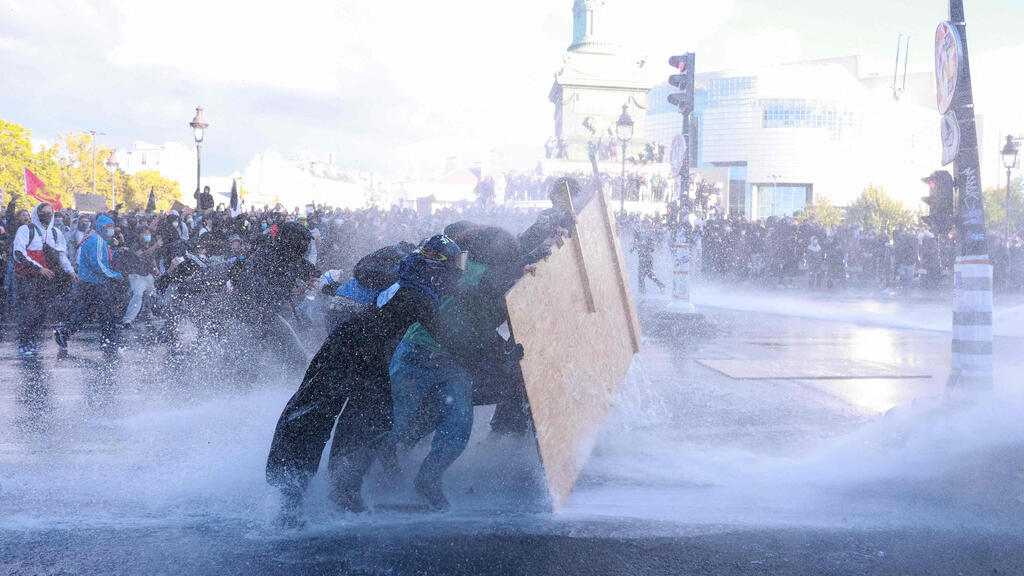
Protesters use wooden boards to shield themselves from water cannon during clashes at Place de la Bastille in Paris
(Photo: Kenzo TRIBOUILLARD / AFP)
(Photo: Kenzo TRIBOUILLARD / AFP)
In another television interview, Elwan said he hoped Mélenchon would win the presidential election, even though he himself is still too young to cast a ballot.
"France Unbowed will save the youth," he declared.
Asked about his sudden rise to fame, the teenager said he did not want to get carried away by the attention. Instead, he urged journalists to "give more space to minorities" and interview "people from the suburbs."
During another television appearance Thursday evening, Elwan again addressed the violence accompanying the demonstrations.
"I can understand a certain degree of violence," he said. "When you come from very tough neighborhoods."
‘The Bastille has been retaken’
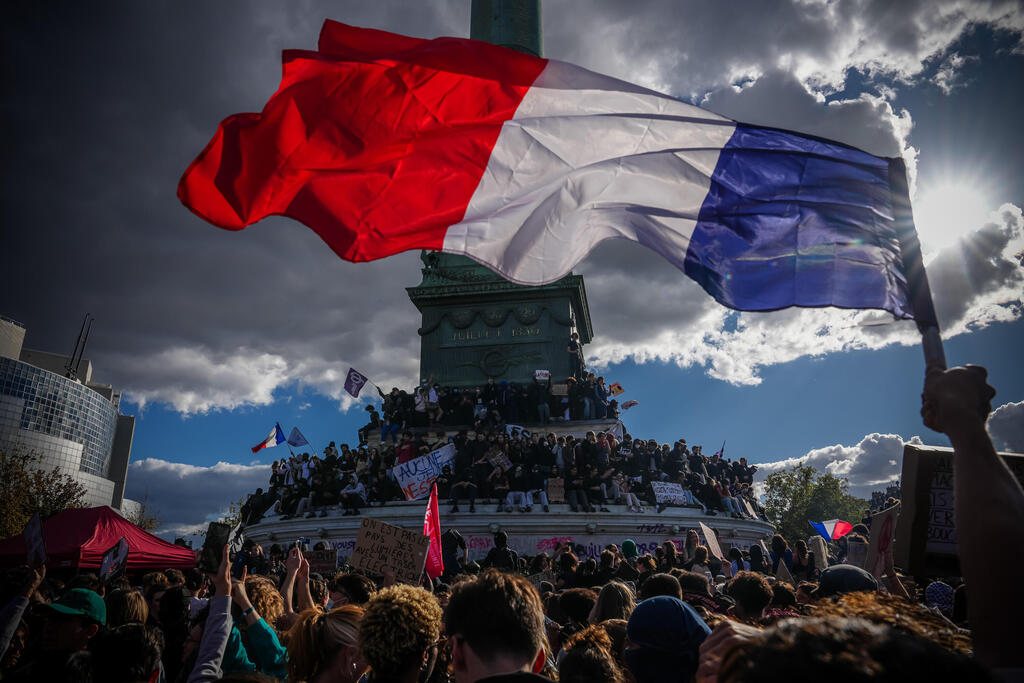
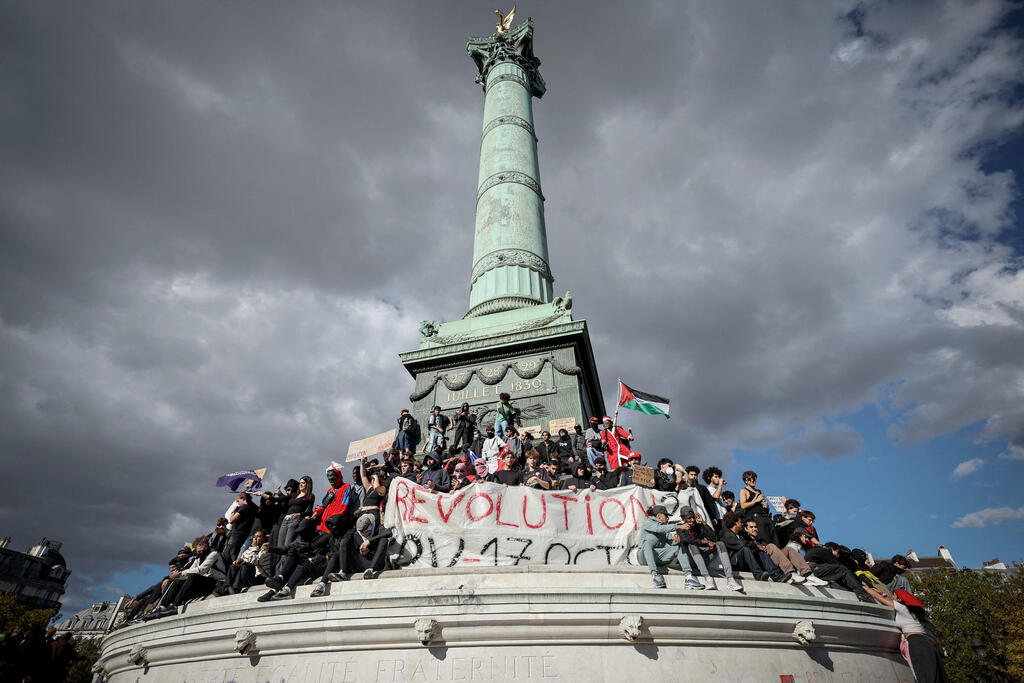
The protests reached another flashpoint Thursday at Place de la Bastille, one of Paris' most recognizable landmarks and a historic symbol of the French Revolution.
Thousands of demonstrators gathered in the square, with some climbing the July Column monument at its center.
As the demonstration escalated, riot police used tear gas and water cannon in an attempt to disperse the crowds. Reports said demonstrators threw objects at officers, who at one point charged toward groups of protesters.
(Photo: Kenzo TRIBOUILLARD / AFP)
(Photo: Kenzo TRIBOUILLARD / AFP)
Images from the square showed chaotic confrontations, with many demonstrators wearing masks or covering their faces and shielding themselves from water cannon behind large wooden boards.
Some reports suggested that police also used stun grenades, despite indications that their use had been suspended following an incident Tuesday in which a teenager lost his hand after picking one up.
Mélenchon, whose France Unbowed party has actively encouraged the student movement, shared aerial footage of the crowds on X.
"The Bastille has been retaken," he wrote. "An impressive show of strength by young people, who are putting forward their demands in the most beautiful way possible! Immense pride."
Although the demonstrations began with demands for better conditions in France's schools, they have been accompanied by serious incidents of violence since last week. Politicians from the center and right have accused the far left of encouraging the unrest to demonstrate political strength ahead of the 2027 presidential election.
According to police, at least 71,000 people participated in marches and demonstrations across France on Thursday, while another 55,000 took part in protest actions outside high schools.
Hundreds of schools were again blockaded, although the number fell from previous days to 375 out of approximately 3,700 nationwide.
(Photo: AP Photo/Aurelien Morissard)
(Photo: SIMON WOHLFAHRT / AFP)
Earlier Thursday, clashes were also reported outside Hélène Boucher High School in eastern Paris, where students overturned garbage bins and erected barricades.
The Interior Ministry said a total of 504 people were arrested nationwide during the day, while 48 police officers and gendarmes were injured.
The ministry strongly condemned the violence and praised the police response, amid growing allegations from students and their supporters that officers have been using excessive force.
Police station set ablaze, high school ransacked
Outside Paris, some of the most serious violence occurred in and around Bordeaux in southwestern France.
French prosecutors announced an investigation after a police station in the city's Capucins district was targeted in an arson attack.
According to prosecutors, masked individuals set fire to garbage bins outside the station's main entrance, and flames spread to the building.
Three police officers inside were forced to flee through an emergency exit.
Le Parisien reported that the station had also been pelted with stones and that two officers were targeted by stone throwers before escaping.
Initial reports did not indicate whether any suspects had been arrested.
In nearby Lormont, a suburb of Bordeaux, a group of masked intruders stormed Les Iris High School, stealing equipment, setting fires and vandalizing classrooms. Videos documenting the destruction later circulated on social media.
The school's principal, Thierry Malewicz, said the attack occurred in the morning while hundreds of students were present, shortly after a discussion with students that he described as having gone "very well."
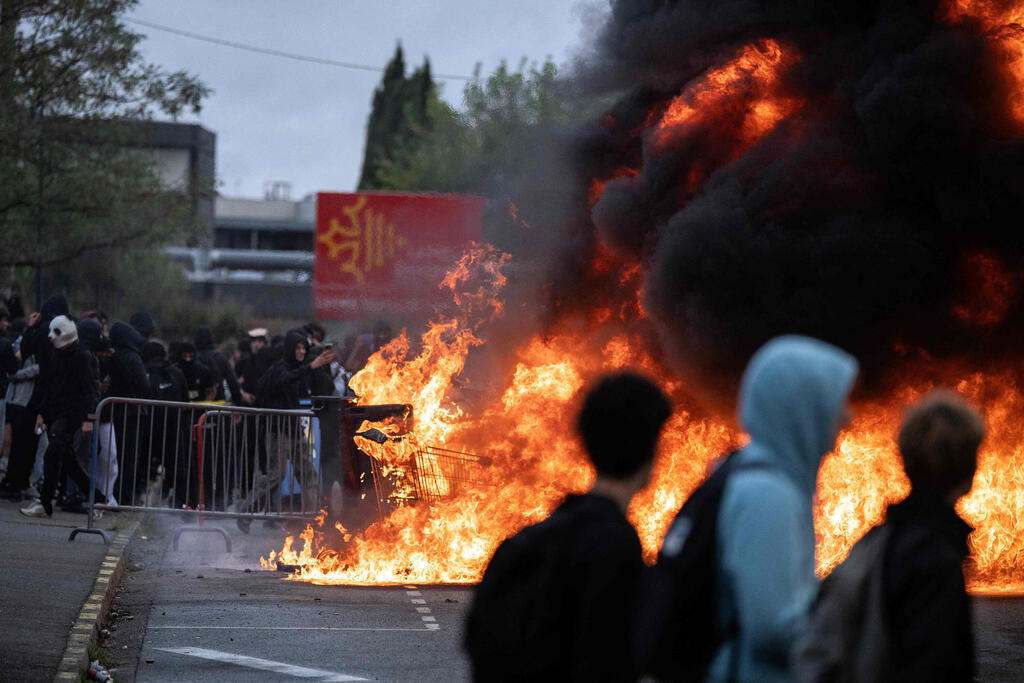
Student protesters rioting in Toulouse, France
(Photo: Lionel BONAVENTURE / AFP)
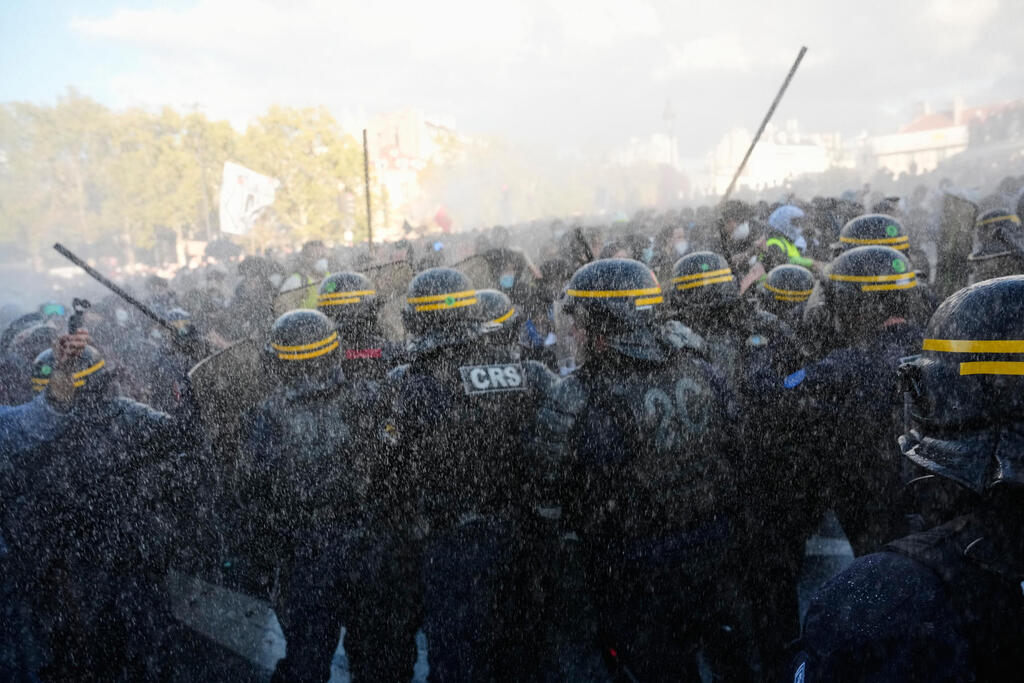
הפגנה פריז כיכר הבסטיליה מחאת תלמידים צרפת
(Photo: AP Photo/Teresa Suarez)
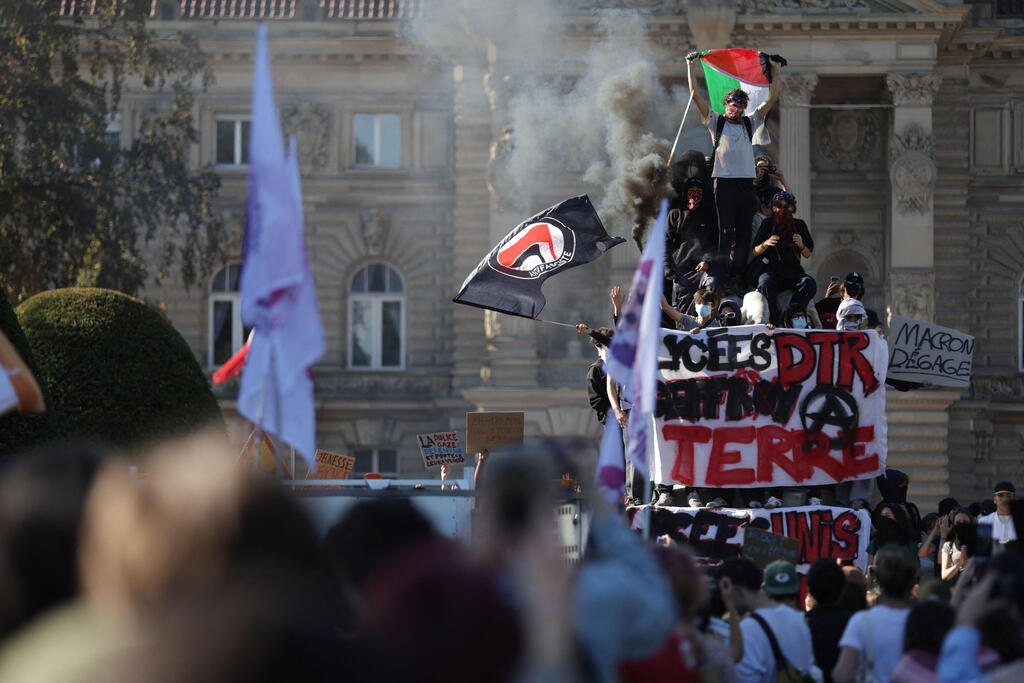
(Photo: ROMEO BOETZLE / AFP)
According to Malewicz, the intruders stole about 10 computers, set fire to a stockpile of expensive paper used by the school's graphic arts department and smashed windows and classroom equipment.
He estimated the damage at at least 100,000 euros, warning that the final figure could be twice as high.
"I had a group of agitated people outside, wearing balaclavas and masks, throwing stones at the police," Malewicz told reporters.
He said police officers subsequently left the area to respond to another demonstration in Bordeaux, allowing the masked intruders to enter the school and cause extensive damage.
Another violent incident was reported in Marseille, where the deputy principal of a high school was assaulted early Thursday morning.
Police said his injuries were serious enough to require him to miss at least nine days of work.
"He was beaten by several people while trying to extinguish a burning pile of garbage with a fire extinguisher," said Corinne Simon, a senior police official in the Bouches-du-Rhône department.
Simon stressed that investigators had so far received only the school official's version of events and that an investigation had been launched.
Other witnesses claimed the deputy principal was attacked by students as he attempted to retrieve the extinguisher.
Despite the assault, Simon said the remaining demonstrations in the area had gone relatively well.
Thousands arrested as France's education crisis deepens
The student movement began on September 17 and gathered momentum last week as students at hundreds of schools, particularly in economically disadvantaged working-class suburbs such as Saint-Denis outside Paris, began blocking school entrances.
Students say they are protesting neglected school infrastructure, overcrowded classrooms and chronic teacher shortages.
In some areas, demonstrations have escalated into road blockades, burning garbage bins and attacks on police officers and passersby.
The unrest comes as the French government attempts to pass its 2027 budget, which aims to reduce the country's deficit.
Since the demonstrations began, dozens of schools have been set on fire or looted.
Approximately 800 police officers, more than 200 teenagers and 85 education workers have been injured during the protests, according to figures cited by French authorities.
At least 6,600 people have been arrested nationwide since the movement began, most of them teenagers.
The Justice Ministry said earlier this week that at least 1,800 of those detained would face prosecution, including 1,483 minors.
Property damage from the unrest has been estimated at tens of millions of euros.
Opponents of the demonstrations have accused Mélenchon's France Unbowed party of inciting violence and fueling the unrest for political purposes.
Some critics have also highlighted the involvement of immigrants and their descendants in street clashes.
Palestinian flags and keffiyehs have become a visible feature of many of the demonstrations, including Thursday's protest in Paris.
U.S. President Donald Trump also intervened in the debate Tuesday, claiming in a social media post that the unrest was not genuinely about conditions in French schools but instead reflected uncontrolled immigration and an attempt by Islam to take over France.
Despite the violence, public support for the students' underlying demands remains strong.
A survey conducted by polling institute Elabe for BFM TV found that 72% of French respondents considered the students' demands legitimate.
At the same time, 55% believed the demonstrations should be brought to an end.
Government promises reforms, but students refuse to back down
French Prime Minister Sébastien Lecornu has accused Mélenchon's party of attempting to "sow chaos" ahead of the presidential election scheduled for April and May 2027.
The political confrontation is intensifying as France approaches an election in which Mélenchon and far-right leader Marine Le Pen are prominent figures.
Lecornu has nevertheless pledged to address the students' concerns and instructed government ministers to present proposals for improving the education system by the end of October.
On Thursday, Education Minister Édouard Geffray met with representatives of the protest movement before announcing an emergency plan.
The measures include ensuring that absent teachers are replaced and reviewing the demanding school schedules faced by French students, whose days can sometimes run from 8 a.m. until 6 p.m.
Geffray also promised improvements to Parcoursup, France's national online university admissions platform, which has faced widespread criticism for being confusing and stressful for applicants.
Student leaders, however, said the proposed measures did not go far enough.
They called for another nationwide day of demonstrations on Tuesday, October 13, following a previous day of mass mobilization earlier this week.
"Our demands must be heard. Yesterday, Lecornu did a lot of talking and offered nothing concrete," said Ryad Rani, one of the student leaders.
"The protest will continue. We are not backing down on any of our demands."
Student representatives in Marseille delivered a similar message following their own meeting with government officials.
According to Le Monde, one representative declared at a news conference: "They asked us how long the movement would continue. It will continue until Macron surrenders and responds to all our demands."
The mayor who became a human shield
Another prominent figure in the uprising is Bally Bagayoko, the mayor of Saint-Denis, a working-class Paris suburb that has emerged as one of the centers of the protest movement.
A member of Mélenchon's France Unbowed party, Bagayoko has repeatedly marched alongside students and publicly defended their demonstrations.
Saint-Denis Mayor Bally Bagayoko shields teenagers in Paris, shouting at police: “Stop!”
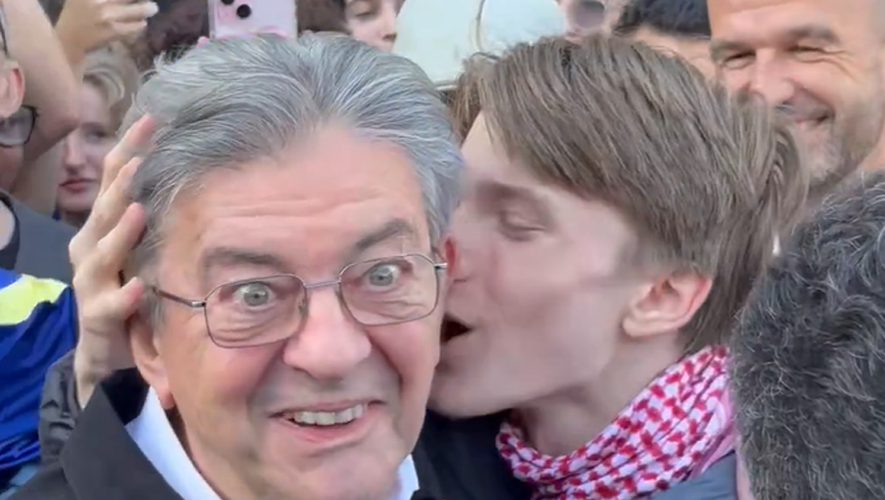
French teenager Elwan, one of the stars of France’s student protests, kisses Jean-Luc Mélenchon
He became a symbol of the movement after footage circulated Tuesday showing him standing between young demonstrators and police officers during a confrontation in Paris.
In the video, the mayor spread his arms to shield the students while shouting at officers: "Stop!"
The footage quickly went viral.
Bagayoko later insisted that the students he had been protecting were not violent and claimed police had nevertheless fired tear gas at the group, including at him, despite his attempts to intervene.
His opponents have accused him of encouraging violence, pointing to earlier remarks in which he appeared to suggest that violence could sometimes be justified.
Bagayoko has maintained that his comments were taken out of context.
He again joined young protesters in Paris on Thursday.
"We are here to show solidarity with high school students," he said. "Our students have been injured, our children have been injured, and the president of our republic is incapable of apologizing to their families."
Speaking to BFM TV as the movement began spreading to neighboring Belgium, Bagayoko predicted that the unrest could inspire young people beyond France.
"There will be an awakening beyond France as well, because the youth of the world are mobilizing," he said.
The protesters' allegations of excessive police force have also prompted concern from international organizations.
UNICEF's French branch called Thursday for restraint and measures to protect minors during demonstrations.
"Young people have the right to be heard, to participate in decisions that affect them and to demonstrate peacefully," the United Nations children's agency said.
UNICEF urged a reduction in violence and greater protection for children and teenagers caught up in the confrontations.
For Elwan, the teenager whose interviews and demonstrations have made him a recognizable face of the movement, the sudden attention has provided a platform to speak about the social inequalities he believes lie behind the unrest.
Although he has expressed hope for a Mélenchon victory and defended the frustrations of young people in disadvantaged neighborhoods, he has also insisted that the attention should not be focused solely on him.
He urged the media to give more space to minorities and people from the suburbs, while acknowledging that he did not want to become overwhelmed by his newfound fame.
And as France continues to debate whether its student uprising represents a legitimate demand for educational reform or a protest movement increasingly overtaken by violence, Elwan has continued to defend his understanding of the anger behind it.
"I can understand a certain degree of violence," he said. "When you come from very tough neighborhoods."