


Classified Knesset Foreign Affairs and Defense Committee documents reveal that Yitzhak Rabin anticipated the Entebbe scenario months before the hijacking.
About four months before the crisis in Uganda, the then-prime minister warned in a closed Knesset discussion of a possible “hostage-bargain attack” intended to secure the release of terrorists arrested in Kenya. One of the demands later made by the hijackers of the Air France flight was the release of those same detainees.
Gallery
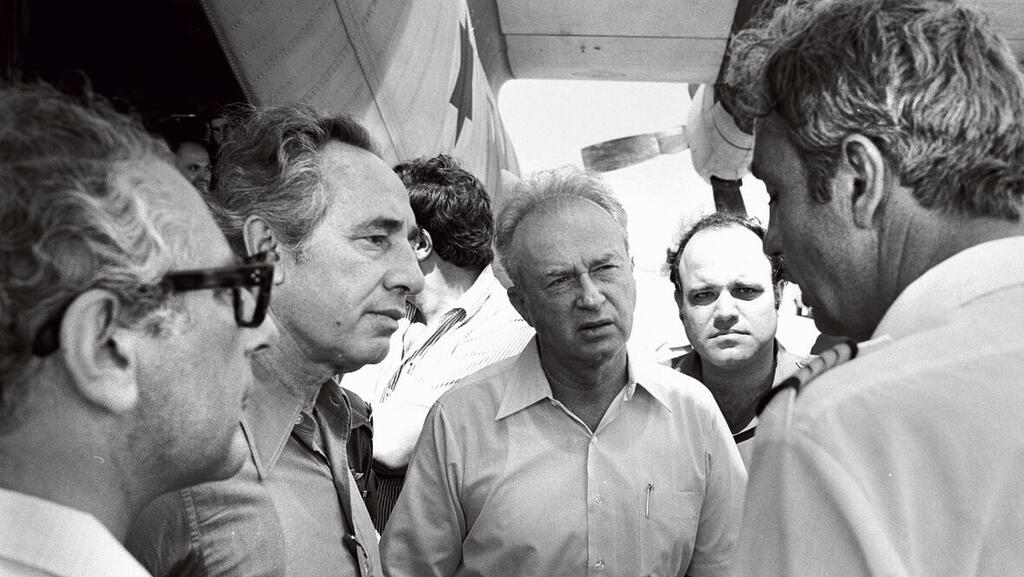
Rabin and Defense Minister Shimon Peres after the return from Entebbe
(Photo: Courtesy of IDF Archive )
Marking 50 years since Operation Entebbe, the Knesset Archive is releasing for the first time classified protocols from Foreign Affairs and Defense Committee meetings, offering a rare look at the drama that unfolded behind the scenes in the months before the hijacking and one of the most daring rescue missions in Israeli history. Beginning next week, the public will also be able to view the documents at the Knesset.
The documents show that on March 19, 1976, Rabin appeared before committee members and briefed them on a highly classified operation that later became known as Operation Heartburn. In that operation, the Shin Bet and Mossad thwarted a plan to shoot down an El Al plane carrying 140 passengers as it was about to land in Nairobi, Kenya. The plot was led by Wadie Haddad, a senior figure in the Popular Front for the Liberation of Palestine.
“According to the protocols now being released,” said Natan Last, head of classified-material disclosure at the Knesset Archive, “Rabin revealed that five terrorists, three Palestinians and two Germans from the Baader-Meinhof terror group, were arrested in Kenya during the final preparations to fire a shoulder-launched missile at an Israeli plane.”
In that same discussion, Rabin issued a warning that now sounds almost prophetic. “My concern,” he told the Foreign Affairs and Defense Committee, “is that there will be an attempt at a ‘hostage-bargain attack’ against the Kenyans, and then they will pressure us to extradite them.”
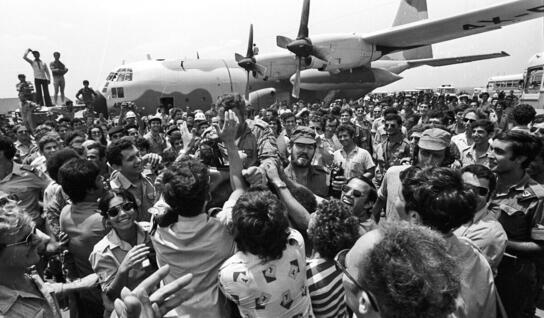
The hostages disembark from the plane
(Photo: David Rubinger)
Three months later, on June 27, 1976, an Air France plane was hijacked to Entebbe by Haddad’s organization. Among the hijackers’ demands was the release of the five terrorists arrested in Kenya, the same detainees Rabin had reported to the committee three months earlier.
The following day, in another Foreign Affairs and Defense Committee discussion published here for the first time, Rabin detailed the hijackers’ demands and warned against exposing the Kenya operation.
“If Israeli chatter does not break this thing, we will be able to withstand it. If not, woe to us,” he warned.
The protocol also shows that the Kenyan government officially denied the existence of the detainees. Israel feared that any publication could entangle the African country and harm efforts to free the hostages.
“I ask that great caution be exercised regarding the special problem of the African state, because our lives depend on it,” Rabin said at the time. “I am sorry to say that I rely more on their resilience than on our ability to keep our mouths shut.”
The newly released documents also shed light on the uncertainty that prevailed among Israel’s leadership in the first days of the crisis. In Foreign Affairs and Defense Committee discussions before the rescue operation, Rabin said: “We have no way of reaching an Israeli presence in Uganda at this stage.”
Justice Minister Shmuel Tamir voiced doubt about the ability to carry out a military operation in a country so far away. Rabin responded with a candor preserved in the protocol: “To get there, yes. To return? I don’t know.”
Knesset Director General Moshe “Chico” Edri said the documents open “a window into the vault of secrets of the Knesset Archive for the public, which is invited to touch the secret documents and see the events with its own eyes.”
The Knesset Visitor Center will hold special tours next week, during which visitors will receive a special copy of the protocols released by the Knesset and meet one of the fighters who took part in the operation to rescue the French Airbus.