


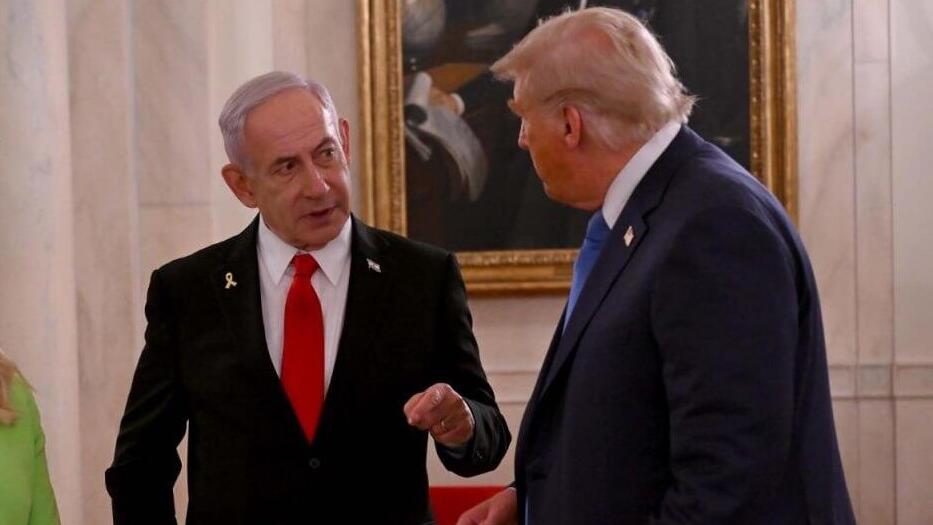
Prime Minister Benjamin Netanyahu told U.S. President Donald Trump during their White House meeting this week that Israel will strike Iran again if Tehran resumes efforts to develop nuclear weapons, according to a report published Friday night by The Wall Street Journal.
Senior officials from both countries said Trump expressed a preference for a diplomatic solution but did not object outright to Netanyahu's warning.
Trump: I can't imagine wanting to attack Iran. They want to meet
(Video: Reuters)


Their private exchange came shortly after Trump publicly stated his hope that additional U.S. strikes on Iran would not be necessary. “I can’t imagine wanting to do that,” he told reporters. According to the Journal, Netanyahu’s comments underscore the differing calculations between Israel, the United States and Iran over the scope of damage inflicted on Iran’s nuclear program in recent joint military operations.
While Trump still aims to negotiate a deal that would compel Iran to abandon its nuclear ambitions, Israeli officials are skeptical that diplomacy can prevent Tehran from covertly advancing its weapons program. Meanwhile, Iran has reportedly demanded guarantees that it will not be attacked again as a precondition for returning to talks with Washington.
A senior Israeli official told the Journal that Israel would not necessarily seek explicit U.S. approval before launching another strike but acknowledged Netanyahu could face opposition from Trump if Iranian activity is not deemed significant enough to justify abandoning diplomacy.
The report also noted that Iran faces significant risk if its leaders continue rejecting Trump’s demands to halt uranium enrichment and restart nuclear development. Israeli and possibly even U.S. military responses could threaten the stability of the Iranian regime.
Prior to the Operation Rising Lion strikes last month, Israeli intelligence assessed that Iran could produce a rudimentary nuclear device within months and a deployable weapon within a year. Israeli and Pentagon officials now estimate the recent strikes set Iran’s program back by up to two years. However, enriched uranium at Iran’s Isfahan facility appears to have survived the strikes and could be recoverable, a senior Israeli official said.
The official added that Iran is unlikely to retrieve uranium from the heavily damaged Fordow and Natanz facilities due to the impact of American bunker-buster bombs. Still, Israel believes any renewed Iranian effort to extract uranium from Isfahan or restart its weapons program would be detected swiftly.
Dennis Ross, who served as a senior official on Middle East issues during Democratic and Republican administrations, told the Journal that Tehran is likely to tread carefully. “The Iranians are going to be extremely cautious. They are going to take the threats the Israelis make very seriously,” he said.
The Israeli official noted that Israel could continue delaying Iran’s nuclear progress through covert operations, including the assassinations of nuclear scientists and senior regime figures.
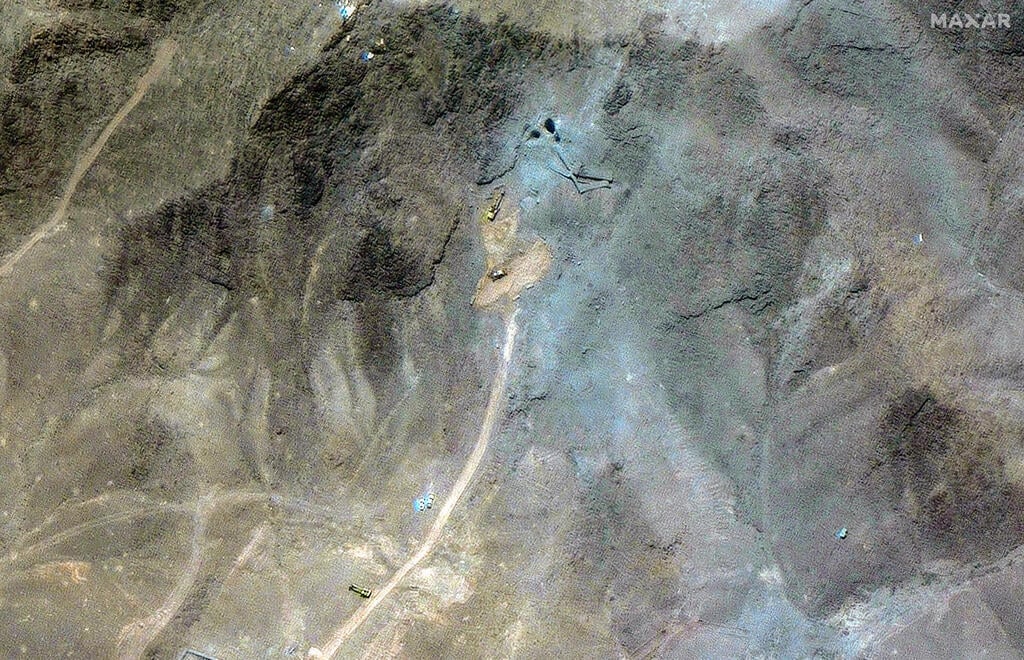
The nuclear facility at Fordow
(Photo: Maxar Technologies/Handout via REUTERS)
Meanwhile, satellite images analyzed by The Associated Press show that the Iranian attack on an air base in Qatar that's key to the U.S. military hit a geodesic dome housing equipment used by the Americans for secure communications.
In response to the report, Pentagon spokesperson Sean Parnell acknowledged that an Iranian ballistic missile had hit the dome. Qatar did not respond to requests for comment about the damage.
The Iranian attack on Al Udeid Air Base outside of Doha, Qatar's capital, on June 23 came as a response to the American bombing of three nuclear sites in Iran — and provided the Islamic Republic a way to retaliate that quickly led to a ceasefire brokered by U.S. President Donald Trump ending the 12-day Iran-Israel war.
The Iranian attack otherwise did little damage, likely because of the fact that the U.S. evacuated its aircraft from the base, which is home to the forward headquarters of the U.S. military's Central Command, before the attack.
Trump also has said that Iran signaled when and how it would retaliate, allowing American and Qatari air defense to be ready for the attack, which briefly disrupted air travel in the Middle East, but otherwise didn't tip over into the regional war long feared by analysts.
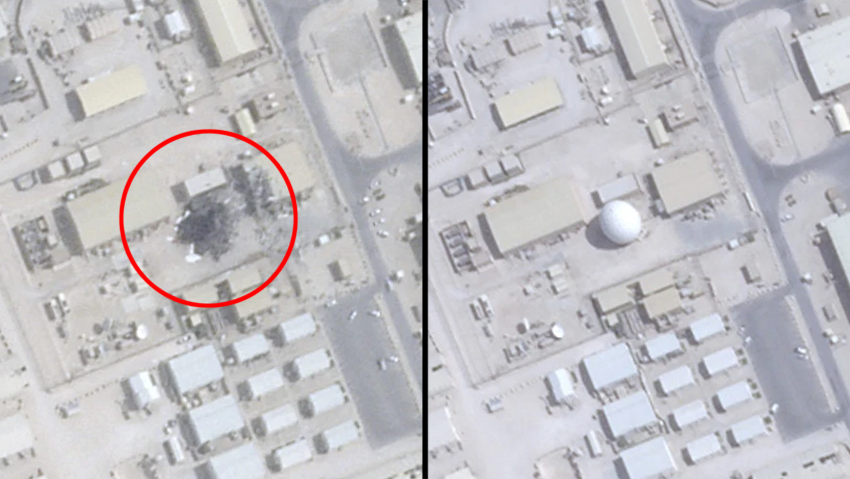
Al Udeid Air Base in Qatar
(Photo: Planet Labs PBC via AP)
Satellite images from Planet Labs PBC show the geodesic dome visible at the Al Udeid Air Base on the morning of June 23, just hours before the attack.
The U.S. Air Force's 379th Air Expeditionary Wing, which operates out of the base, announced in 2016 the installation of the $15 million piece of equipment, known as a modernized enterprise terminal. Photos show a satellite dish inside the dome, known as a radome.
Images taken June 25 and every day subsequently show the dome is gone, with some damage visible on a nearby building. The rest of the base appears largely untouched in the images.
Get the Ynetnews app on your smartphone: Google Play: https://bit.ly/4eJ37pE | Apple App Store: https://bit.ly/3ZL7iNv
In a statement, Parnell said the missile strike "did minimal damage to equipment and structures on the base."
"Al Udeid Air Base remains fully operational and capable of conducting its mission, alongside our Qatari partners, to provide security and stability in the region," he added.
The London-based satellite news channel Iran International first reported on the damage, citing satellite photos taken by a different provider.
Iranian missiles fired toward Qatar
In the U.S., Trump described the Iranian attack as a "very weak response." He had said that Tehran fired 14 missiles, with 13 intercepted and one being "set free" as it was going in a "nonthreatening" direction.
"I want to thank Iran for giving us early notice, which made it possible for no lives to be lost, and nobody to be injured," he wrote on his website Truth Social.
The White House had no immediate comment after Parnell's acknowledgment Friday. Trump visited Al Udeid Air Base on May 15 as part of his Mideast tour.
After the attack, Iran's paramilitary Revolutionary Guard insisted that the air base had been the "target of a destructive and powerful missile attack." Iran's Supreme National Security Council also said that the base had been "smashed," without offering any specific damage assessments.
Potentially signaling that he knew the dome had been hit, an adviser to Iranian Supreme Leader Ayatollah Ali Khamenei separately said that the base's communications had been disconnected by the attack.
"All equipment of the base was completely destroyed and now the U.S. command stream and connection from Al Udeid base to its other military bases have been completely cut," said Ahmad Alamolhoda, a hard-line cleric.