


A former senior IDF official who oversaw hostage negotiations criticized the government's handling of talks to free captives held in Gaza, saying Wednesday that earlier opportunities for comprehensive agreements were rejected in favor of continued fighting.
Maj. Gen. (res.) Nitzan Alon, the former head of the IDF Hostages and Missing Persons Directorate, said the Security Cabinet and political leadership had turned down broader agreements in pursuit of what Prime Minister Benjamin Netanyahu has called “total victory” over Hamas.
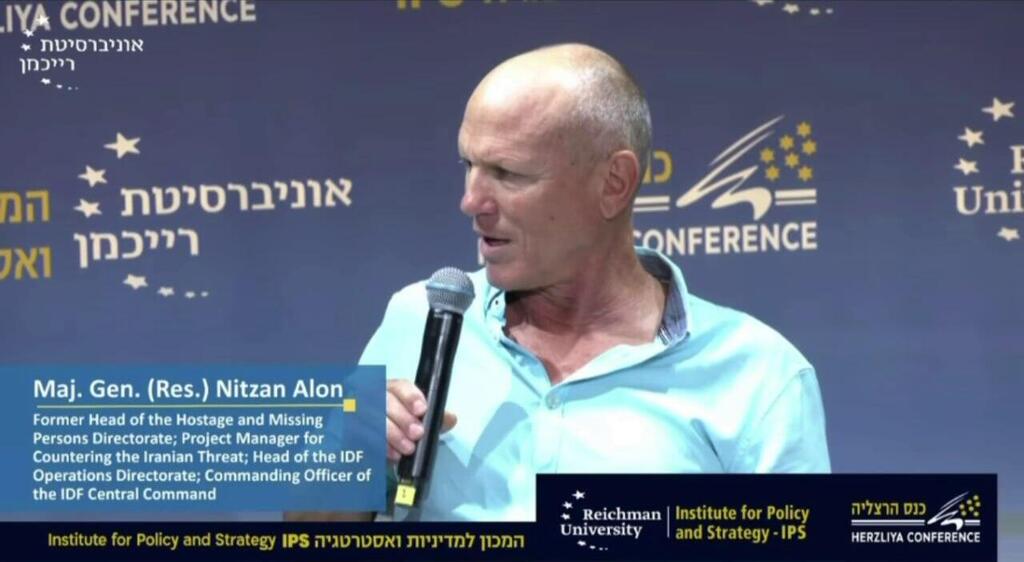
Maj. Gen. (res.) Nitzan Alon
(Photo: IPS)
“The Cabinet and the political leadership refused earlier, comprehensive deals in the name of that same ‘total victory,’ which I believe was a falsehood,” Alon said during an interview at the Herzliya Conference at Reichman University.
Alon said government leaders repeatedly favored partial agreements that allowed military operations to continue instead of pursuing broader deals that could have secured the release of all hostages.
“There was some logic to that,” he said. “But strategically, to manage the war for more than two years until, in effect, an American administration forced us to end it was not the optimal path — not in terms of the length of the war or the price we paid in every respect.”
Alon said the war could have ended at least a year earlier. “When we speak about returning all the hostages, we must remember that about 40 hostages who were abducted alive died in captivity,” he said. “I don't forget that. In some cases, with different decisions or different negotiations, perhaps we could have brought them home alive.”
Alon also rejected comments by Finance Minister Bezalel Smotrich, who said this week that “thanks to me, all the hostages are here” and claimed to have had a decisive influence on the conduct of the war.
“I don't think Minister Smotrich, who opposed some of the agreements at different stages, can take credit for bringing back all the hostages,” Alon said.
Smotrich, speaking earlier this week on a podcast hosted by journalist Nadav Perry, said that without his influence the war would have ended before Israeli forces captured Rafah, the southern Gaza border city that became a major military objective.
“I think that without me the war in Gaza would have stopped even before Rafah,” Smotrich said. “Despite attempts to portray me as someone who doesn't care about the hostages, I think that thanks to me all the hostages are here.”
Smotrich voted against all but the first hostage release agreement reached in November 2023. He also opposed later agreements, including a broader deal negotiated in early 2025 that was intended to secure the release of all remaining hostages. At the time, he conditioned his continued participation in Netanyahu's governing coalition on the resumption of military operations and opposed moving to the second phase of the agreement, which called for the release of the remaining living hostages and later the bodies of those who had died.
The government has argued that sustained military pressure helped force Hamas back to the negotiating table, while critics have said earlier agreements could have secured the release of more hostages before they died in captivity.