


Former prime minister Naftali Bennett said Monday that, if elected again, he would formally designate Qatar as an enemy state.
Speaking at the ynet and Yedioth Ahronoth National Security Conference in partnership with the Institute for National Security Studies, Bennett said that while serving as prime minister he had been shown intelligence indicating that Doha also funded Iran’s Revolutionary Guards.


He added that Prime Minister Benjamin Netanyahu was aware of the same information.
“If I am elected prime minister, I will immediately declare Qatar an enemy state, clearly and unequivocally,” Bennett said.
He described Qatar as “a violent antisemitic cancer that sends its metastases throughout the West, even into the office of the prime minister of Israel, with the aim of destroying Israel.”
“There is nothing complicated here after October 7,” he added. “Qatar is an enemy. It is that simple.”
Bennett argued that Qatar had spent years building an international influence network, including by funding American universities and operating the Al Jazeera media network.
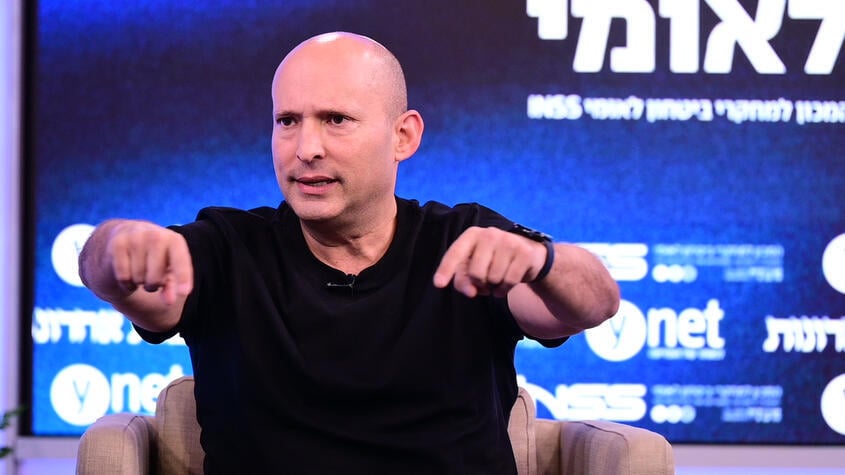
“Qatar directly funded Hamas with a billion dollars in Netanyahu’s cash suitcases,” he said. “When I was prime minister, I received intelligence that Qatar also funded Iran’s Revolutionary Guards.”
Asked whether Netanyahu had seen the same intelligence, Bennett replied: “Absolutely.”
He also accused Qatar of funding Hamas and Jabhat al-Nusra, and criticized Israel’s continued ties with Doha.
“How can we confront an enemy if we do not call it an enemy?” he said. “As prime minister, I will officially declare Qatar an enemy of the State of Israel.”
‘If I need to be a wheel, I’ll be a wheel’
In the political portion of the interview, Bennett addressed comments by former IDF chief of staff Gadi Eisenkot, who said a small party could not demand the premiership.
Bennett identified Eisenkot, Yisrael Beytenu chairman Avigdor Liberman and Democrats leader Yair Golan as potential partners in forming the next government.
He said he would also be willing to bring Likud into such a coalition, but without Netanyahu.
“He has to go home,” Bennett said.
Bennett stopped short of insisting that he must lead the next government.
“I am committed to replacing this government and delivering victory at any cost,” he said. “I am not obsessed with the position. I am obsessed with repairing the State of Israel.”

Yedioth Ahronoth Group National Security Conference in partnership with the Institute for National Security Studies (INSS)
(Photo: Yuval Chen)
Quoting Zionist leader Joseph Trumpeldor, Bennett said that if Zionism needed him to be a wheel, he would be one.
“If, in order to replace this terrible government, the government of the massacre, the failure and draft evasion, I need to be a wheel, then I will be a wheel,” he said. “That is secondary. We will work it out.”
‘Accelerate the fall of Iran’s regime’
Turning to Iran, Bennett reiterated the “octopus doctrine” he says he has promoted since 2017.
Under that approach, Israel should focus on Tehran, the “head of the octopus,” rather than limiting itself to fighting Hamas, Hezbollah and the Houthis, which he described as the regime’s arms.
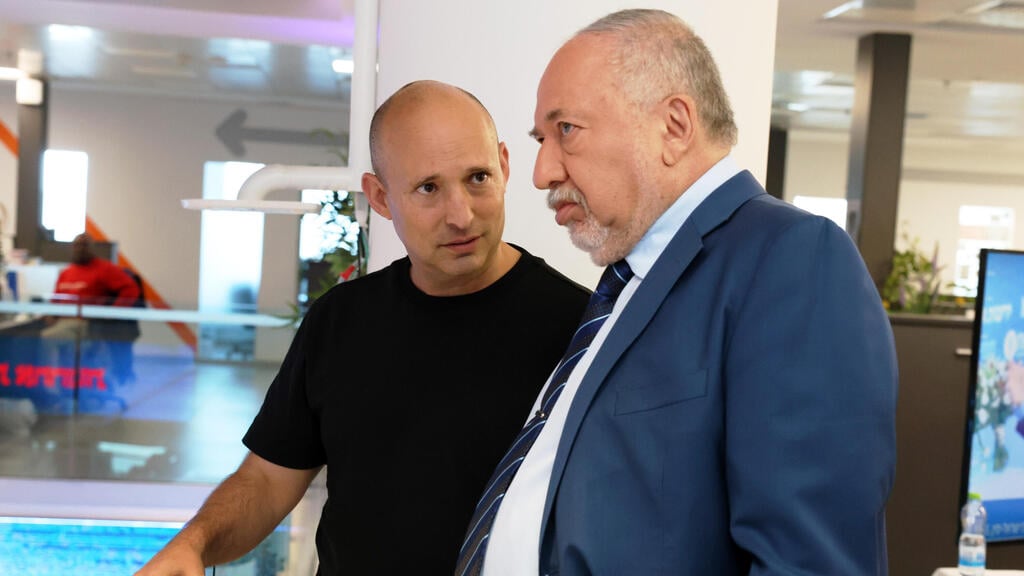
Naftali Bennet and Avigdor Liberman meeting at the ynet-INSS conference
(Photo: Shaul Golan)
“Israel made a mistake for decades by constantly fighting and bleeding against the arms instead of focusing on weakening and ultimately toppling the head of the octopus in Iran,” Bennett said.
“We must do everything possible to accelerate the fall of the Iranian regime, and until then block and prevent Iran from obtaining a nuclear weapon.”
Bennett said the regime would eventually collapse because it was corrupt, detached from the public and unsustainable.
“The citizens of Iran hate this regime, and for many reasons it will not exist in 30 years,” he said.
He stressed that bringing about its fall did not have to rely solely on military attacks, comparing the campaign to the economic and diplomatic pressure the United States applied against the Soviet Union during the Cold War.
Bennett also said Netanyahu’s government had missed an opportunity to assist protesters in Iran, partly because it had failed to prepare technological tools that could preserve internet access when authorities shut down the network.
“This could have been addressed in advance with technological tools, and it was not done,” he said.
Troop shortages in the West Bank
Addressing tensions in the West Bank, Bennett said Israel’s central mission was to protect the roughly 550,000 Israelis living there.
He argued, however, that the IDF lacked sufficient manpower and that the government repeatedly recalled reservists shortly after releasing them.
“This government is preventing security because it is denying the IDF soldiers by refusing to draft the ultra-Orthodox,” he said.
“You can talk about a million strategies, but without soldiers, you cannot implement them.”
Bennett said Israel should maintain security control in Area C and allow “settlement in accordance with the law,” while Palestinians should manage their own lives in Areas A and B.
“I have no interest in running their lives,” he said, while adding that he opposed withdrawals or territorial concessions.
From ‘villa in the jungle’ to ‘gorilla in the jungle’
Bennett criticized what he called the Netanyahu governments’ “villa in the jungle” security doctrine, which he described as retreating behind fences and walls while ignoring developments beyond them.
He said that approach had enabled Hamas and Hezbollah to grow stronger and contributed to the October 7 failure.
“We need to move from a villa in the jungle to a gorilla in the jungle,” Bennett said.
“We must not be passive. We must take the initiative, shape the region, advance diplomatic initiatives and, when necessary, use force.”
Israel, he said, should seek short, decisive campaigns on each front rather than become trapped in prolonged wars.
Bennett also said normalization with Saudi Arabia could advance without establishing a Palestinian state or even a path toward one.
Countries including Saudi Arabia and Indonesia are interested in economic ties, he argued, but avoid cooperating with the current government because of statements by ministers such as Itamar Ben-Gvir and Bezalel Smotrich.
Near the end of the interview, Bennett was asked about replacing suits and ties with T-shirts and sneakers.
“It is fun,” he said. “I ran an experiment and discovered that even when I dress like this, people ask me exactly the same questions.”
Asked whether the change carried a political message, Bennett replied: “I am not in politics right now. When I am, you have to wear suits. Let me enjoy the final months before we return to government.”