

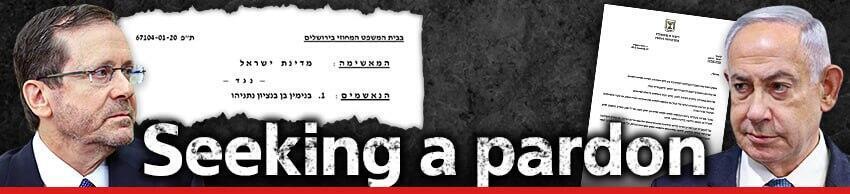

The only department expected, for now, to begin handling Prime Minister Benjamin Netanyahu’s request for a pardon in his ongoing corruption trial is the Justice Ministry’s Pardons Department. Every citizen seeking a pardon goes through a standard protocol before the request is sent to the justice minister, who provides a “confirmation signature” — a kind of legal validation of the acceptance or rejection of the pardon — which is then forwarded to the president as a recommendation.
“It appears Netanyahu does not meet the overwhelming majority of the usual criteria applied to a convicted person in Israel, and if he is granted a pardon, it will in effect be a political pardon," a senior legal source told ynet.
Gallery

Prime Minister Benjamin Netanyahu’s request and his attorney Amit Hadad in court
(Photo: Miriam Elster)
The source compared Netanyahu’s request to the Bus 300 affair — a 1984 case in which Shin Bet agents killed two captured Palestinian terrorists after hijacking a bus, and later received presidential pardons meant to head off a wider institutional scandal.
"If it is granted, it would fall outside the usual framework, similar to the precedent of the Bus 300 pardon, which involved exceptional national and security considerations," he added. "And the fact is that since 1986, even after the High Court affirmed the legal validity of that pardon, neither the justice system nor the political system has ever repeated such a case.”
The justice minister’s decision is based on the factual and legal analysis provided by the Pardons Department, which relies on law, established practice and High Court rulings that have addressed earlier precedent-setting pardons. When a citizen requests a pardon, a file is opened collecting the facts of the case from before the request was submitted through the date it was filed.
This includes the verdict in the applicant’s trial, along with all appeals until the ruling became final, since ordinary citizens do not request pardons while their court proceedings are still underway, except in rare cases such as terminal illness. If there are additional defendants in the case who did not request a pardon, the prosecution must provide an opinion on how granting the pardon would affect the remaining defendants.

Netanyahu and President Isaac Herzog
(Photo: GPO)
As part of the procedure, the Pardons Department asks police to determine whether the applicant has a criminal record. Minor offenses generally carry no negative weight. But if the applicant is, for example, a convicted sex offender, someone who abused vulnerable individuals, a violent offender or a person whose crimes are considered serious, there are often standing policy guidelines — set by the president, the justice minister or the State Attorney’s Office — against granting pardons for such offenses. When the applicant is already serving time, the Israel Prison Service is required to submit an assessment of the inmate’s behavior toward fellow prisoners and toward the facility itself.
The department also requests a full medical evaluation, addressing both physical and mental health. Age is considered as well. If the applicant has made notable contributions to the state — such as a discharged soldier who played a significant role in a military operation or war — that factor can work in the applicant’s favor.
Welfare authorities are asked to prepare a social services report mapping the applicant’s circumstances or those of the applicant’s family. If the individual is a sole breadwinner, or if a spouse or child faces significant medical or social hardship and the person’s release would substantially assist the family, that is taken into account. The Enforcement Authority also checks whether the applicant owes debts to the state, including fines or other financial penalties.
In parallel, the Pardons Department gathers legal material on past practice: how the state has treated similar offenses, what its policy is on pardons for such crimes and what relevant precedents exist. The prosecution provides an updated assessment of the case’s legal status. As a matter of law and practice, a pardon applicant is generally expected to be a person who has been convicted, has acknowledged the offenses and provides assurances that they will not be repeated.
Most of these criteria, however, do not align with Prime Minister Netanyahu’s petition. He has not been convicted by a final judgment, his trial remains ongoing and he may still be acquitted. He has not admitted to any wrongdoing, including in the context of his pardon request. He has no criminal record, his health issues are typical for his age, his family is not considered vulnerable and he does not require rehabilitation.
Prosecutors may ultimately argue that Netanyahu is ineligible for a pardon because his request, both in its rationale and in its unprecedented nature, runs contrary to the principle of equality before the law. The core question is whether this is a case in which the state would depart from the precedents that apply to every other citizen.