

An Israeli historian who described Israel’s actions in Gaza as genocide days after the October 7 massacre will receive $250,000 from the University of Minnesota after the institution withdrew an offer for him to lead its Holocaust and genocide studies center, The Guardian reported.
Prof. Raz Segal was selected in June 2024 to head the university’s Center for Holocaust and Genocide Studies after a search committee recommended him almost unanimously and praised his candidacy. Five days after he accepted the offer, however, the university reversed course, saying it had received additional “perspectives” from members of the community.
The controversy centered on an article Segal published on October 13, 2023, six days after the Hamas-led massacre in Israel, in which he described Israel’s actions in Gaza as “a textbook case of genocide.”
Critics accused Segal of justifying Hamas’ crimes in the article, whose headline used that phrase. Segal rejected the accusation, and in the piece itself described the October 7 attack as a “mass killing” and a war crime.
More than two years after his appointment was withdrawn, Segal and the university reached a settlement last week. The $250,000 payment does not constitute an admission of liability by the university, which did not respond to The Guardian’s request for comment.
Segal said he hoped the settlement would encourage other academics who had faced professional consequences for criticizing Israel to “fight back.” Segal was among the earliest scholars to describe Israel’s campaign in Gaza as genocide. “I really hoped I was wrong, but unfortunately, I wasn’t,” he said recently.
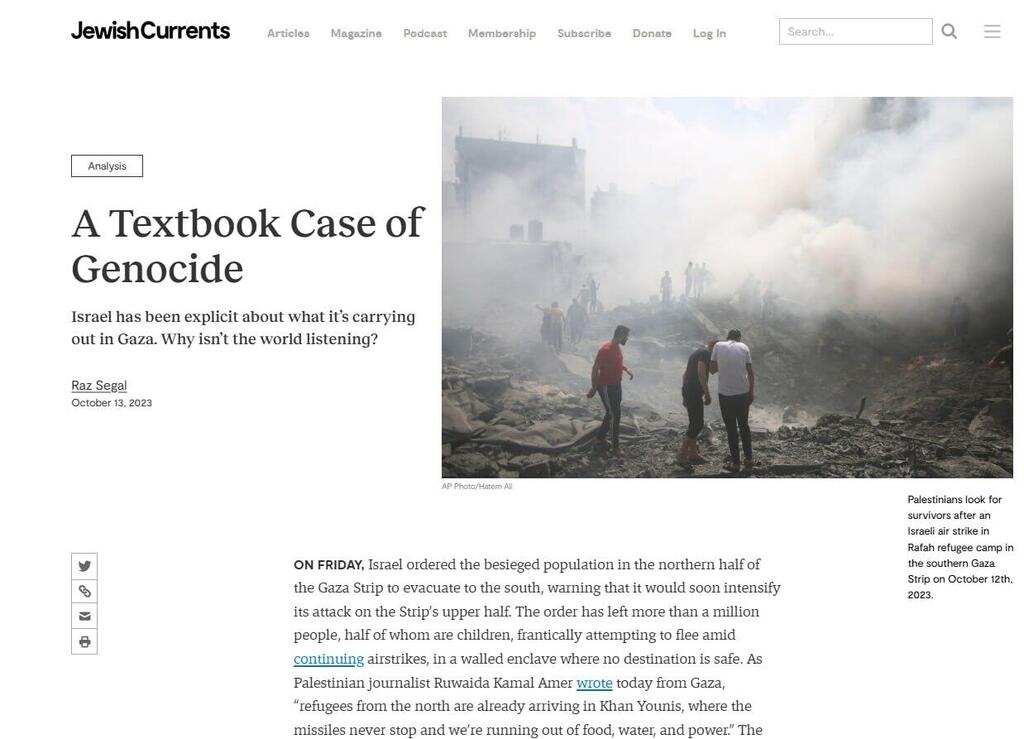
Prof. Segal’s article, published on October 13
(Photo: 'JewishCurrents')
According to The Guardian, internal documents obtained by Segal showed that his appointment became the target of pressure from pro-Israel activists, lawmakers who contacted university administrators and donors who threatened to withdraw financial support.
“We cannot allow someone like Raz Segal, a clear anti-Zionist, to lead the Holocaust Studies department,” one donor wrote to the chair of the university’s board of regents, according to the report. “There are many who will cancel their commitments to donate to the university if this issue is not addressed,” the donor added.
Segal said hundreds of nearly identical messages were sent to the university opposing his appointment, which he argued indicated a coordinated campaign. The university initially considered defending the decision to hire Segal but backed away as pressure intensified, according to the report.
In one internal exchange, a senior communications official reportedly warned that defending Segal was “too risky.” A sentence stating that the university did not use “political litmus tests” in hiring was later removed from a draft response to the media.
Segal, who is Jewish and the grandson of four Holocaust survivors, said university administrators effectively decided that he was “the wrong kind of Israeli and the wrong kind of Jew.”
He said he had hoped to be reinstated to the position rather than receive financial compensation, but was told that returning to the role was not an option. Segal is currently a full professor at Stockton University in New Jersey, where he directs the graduate program in Holocaust and Genocide Studies.