

Bahrain’s king, Hamad bin Isa Al Khalifa, emerged during the war with Iran as a highly active and at times colorful figure in his conduct with regional and global leaders — and not only on the diplomatic front. He donned military uniform while visiting Bahraini forces, met with those wounded in Iranian strikes, and took an active role in explaining the situation to the public, with each appearance marked by a distinctly different look.
On March 8, during the war, the king delivered an address to the nation marking the final 10 days of the Muslim holy month of Ramadan. “We are saddened by the unprecedented and unjustified attacks carried out by Iran against our beloved country, against our Arab sister states and friendly nations,” he said.
(Video: Lior Sharon)


“Bahrain has always been and will remain a country of peace. It has never initiated aggression and has followed only the path of cooperation and good neighborliness. We greatly value the readiness, vigilance and national responsibility demonstrated by our forces. Bahrain will remain steadfast and will carry out its duties toward its Arab neighbors and the international community with confidence and caution.”
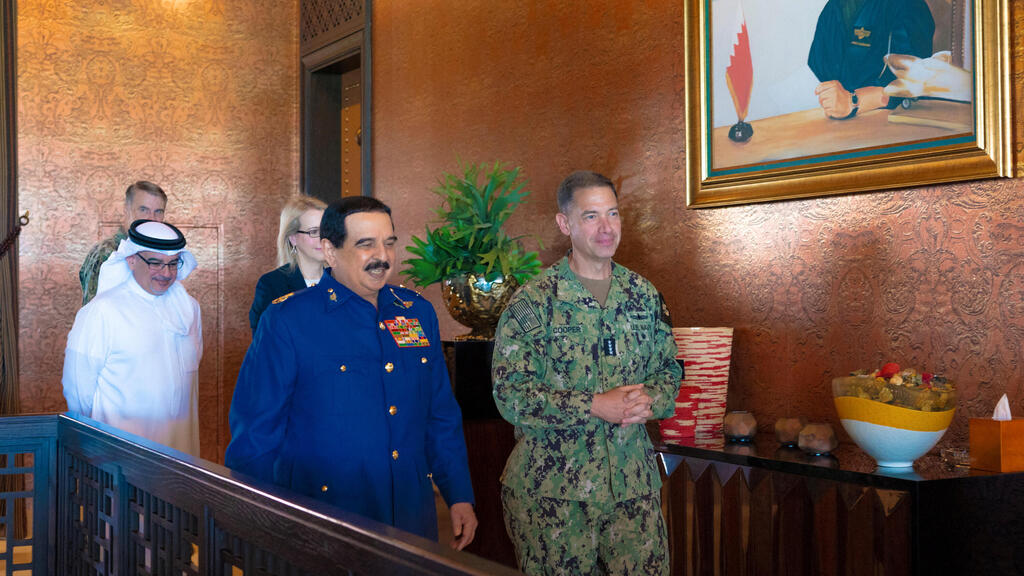
A day later, on March 9, the king — who also serves as the country’s supreme commander — appeared in uniform during a visit to the Royal Bahraini Air Force. He praised its efforts, combat readiness, professionalism and coordination with air defense systems, and said Bahrain was “more united and stronger today.” Arab media echoed the speech, with some outlets highlighting his appearance in uniform against the backdrop of regional tensions.
Gallery
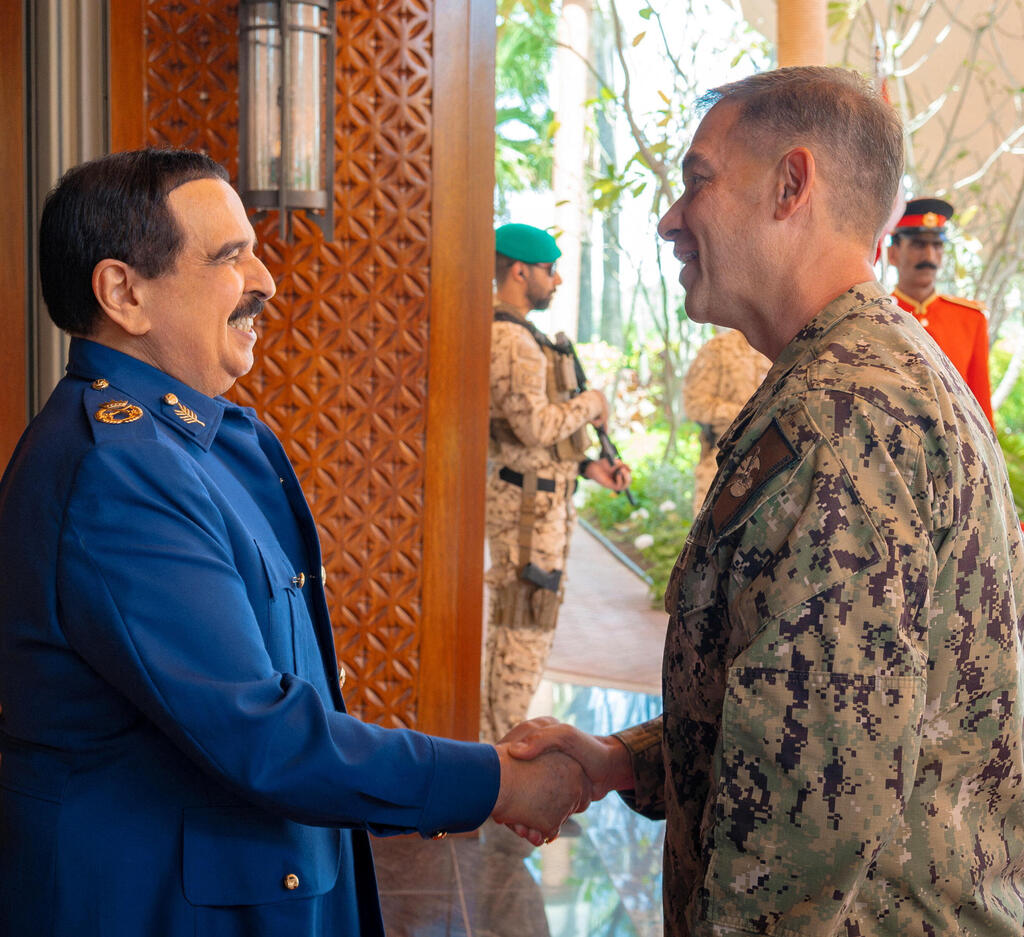
The king of Bahrain with the commander of US Central Command
(Photo: Bahrain News Agency/Handout via REUTERS)
(Photo: Bahrain News Agency/Handout via REUTERS)
On March 25, the king was documented visiting people wounded in the Iranian strikes. The Bahrain News Agency said the visit was part of his effort to assess their condition and the progress of their treatment. He spoke with the wounded and commended medical teams. He said those who sacrifice their lives for Bahrain and its people are role models, reiterating that Bahrain will remain a country of peace.
Throughout the war, the king also held calls and meetings with senior officials in the region and beyond. On the second day of the conflict, the Bahrain News Agency reported that he spoke by phone with U.S. President Donald Trump, who condemned Iran’s aggression and affirmed that the United States was ready to assist in defending Bahrain’s sovereignty, security and stability. The king thanked Trump for his support and praised the partnership between the two countries.
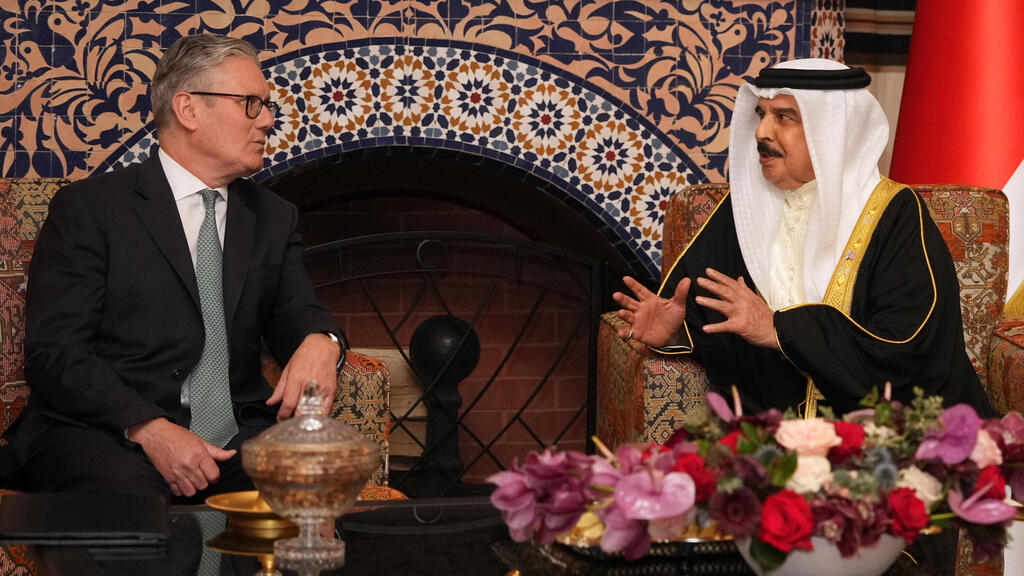
The king with British Prime Minister Keir Starmer
(Photo: Alastair Grant / POOL / AFP)
During March, Al Khalifa hosted Jordan’s King Abdullah II and discussed the Iranian strikes, and later received Egyptian President Abdel Fattah el-Sissi, who said that “the security of the Arab Gulf is an extension of Egypt’s national security.” On April 13, after a ceasefire took effect, Bahrain reported that the king met with the commander of U.S. Central Command, Gen. Brad Cooper.
In recent days, Bahrain reported that the king confirmed the country had begun implementing measures against anyone who dared to “betray the state,” harm its security and stability, or prompt a reassessment of who is entitled to citizenship. According to a Defense Ministry update on April 13, Bahrain intercepted and destroyed a total of 194 missiles and 523 drones. Official statements during the war also said authorities arrested individuals who cooperated with Hezbollah — the Iran-backed Lebanese militant group — and with Iran’s Revolutionary Guard.
Following the king’s announcement, authorities said they revoked the citizenship of 69 people who were not originally from Bahrain “due to their involvement in activities that harm national security, including expressing support for the Iranian attacks and espionage for foreign entities.” Local reports said the move falls within a legal framework adopted by Bahrain to protect its national security.
Iranian Foreign Ministry spokesman Esmail Baghaei criticized the reports, saying: “The Bahraini government’s action to strip citizens of their nationality under the pretext of expressing support for the Islamic Republic is a blatant violation of human rights and evidence of a discriminatory approach by the country’s rulers toward their people.”
'The king projects resolve through visual messaging'
Hamad bin Isa Al Khalifa is the eldest son of Sheikh Isa bin Salman Al Khalifa, who ruled Bahrain from 1961 to 1999. Hamad was born in Bahrain in 1950. He studied at The Leys School in Cambridge, England, and underwent military training in both Britain and the United States, including at the Command and General Staff College in Fort Leavenworth, Kansas. In 1977 he trained as a helicopter pilot and graduated on Jan. 14, 1978.
After his father’s death, and following years in senior roles including in security affairs, Hamad became emir of Bahrain in 1999, serving until 2002. In February 2002, Bahrain was declared a kingdom and the emir became king. During the wave of Arab Spring protests, he faced significant demonstrations and internal tensions.
According to reports, Hamad has four wives and 12 children — seven sons and five daughters. He married his first wife, Sabika bint Ibrahim Al Khalifa, in 1968; they are also cousins. In 2020, he issued a decree appointing his eldest son, Salman bin Hamad — crown prince since 1999 — as prime minister.
At the first meeting of Trump’s Peace Council, held in Washington in February, Trump called out from the stage: “Thank you to the king of Bahrain — where are you? He’s so rich he can sit wherever he wants. He could buy part of the building.” He added, “You’ve been very generous, we appreciate it.” Some outlets viewed the remarks as lighthearted, while others framed them as ridicule.
As for ties with Israel, Bahrain’s king signed a normalization agreement with Israel in September 2020 under Trump’s auspices, part of the U.S.-brokered Abraham Accords (agreements to normalize relations between Israel and several Arab states). In February 2022, then-Prime Minister Naftali Bennett met with Hamad at the palace in the capital, Manama, and in December 2022 President Isaac Herzog visited Bahrain and met the king.
Ahmed Al-Kozaie, a Bahraini geopolitical adviser and commentator based in the United States, told Ynet that “the king uses flexibility in foreign policy as a tool to manage the delicate balance between domestic and international affairs. He understands that Bahrain, by virtue of its geography and size, cannot enter direct confrontations with major powers. Therefore, he relies on calm conduct and a reassuring personal image to reflect internal stability, ease public pressure and give the leadership room to maneuver on sensitive issues such as relations with Israel.
“This flexibility in appearance and behavior is part of a broader strategy to present Bahrain as a country that can adapt to change. For example, when he appears in military attire, he projects resolve by sending a visual message to anyone considering harming Bahrain’s security, specifically referring to sleeper cells backed by Iran.” According to Al-Kozaie, choices related to traditional Gulf dress also reflect states of peace and war.
He added: “In his foreign relations, the king balances international commitments with regional pressures. The Abraham Accords with Israel, for example, were intended to strengthen ties with Washington and bolster regional security, but they faced public rejection due to a lack of understanding of the reasons and context behind the relationship. This is where the king’s role lies — allowing space for parliament and the public to express their views, without formally severing the agreements. It is a policy of two parallel tracks: maintaining international alliances on one hand and absorbing public discontent on the other.
“This ability to manage contradictions gives Bahrain the flexibility to handle complex issues without alienating any side. This approach reflects political wisdom based on managing contradictions rather than confronting them. In this way, the king has managed to keep Bahrain secure amid regional and international turbulence, presenting a model of leadership that, while small in size, is capable of maneuvering with prudence and calm.”