

The High Court of Justice is hearing petitions Thursday seeking to disqualify the Knesset vote that elected attorney Michael Rabello as state comptroller, amid claims that lawmakers were asked to document their ballots in what is supposed to be a secret vote.
The petitioners are also asking the court to block Rabello’s appointment because he served as Prime Minister Benjamin Netanyahu’s lawyer, arguing that his past professional relationship with Netanyahu could make it difficult for him to oversee and criticize the government independently.
The state comptroller is one of the country’s key oversight officials, responsible for auditing government bodies and public institutions. The position is elected by members of the Knesset in a secret ballot.
The petitions were filed by the opposition Yesh Atid party, Fortress of Democracy and the Movement for Quality Government. They argue that Rabello’s appointment should be invalidated on two grounds: first, the claim that Knesset members were required to document their votes despite the legal requirement that the ballot be secret; and second, Rabello’s long-standing role as Netanyahu’s private attorney.
According to the petitions, the election process in which Rabello was chosen “tramples the duty of secrecy set out in the Basic Law: State Comptroller.”
Knesset Legal Adviser Sagit Afik defended the appointment in her response to the High Court, saying the petitions should be rejected and that there was no flaw in the lawmakers’ vote. She said there was no evidence supporting the claim that Knesset members had been instructed to document their votes, and added that there is no explicit legal prohibition on doing so.
Rabello also submitted his position to the court, arguing that the law allows people with previous ties to appointing or audited officials to serve in public roles, provided legal safeguards are in place.
“The law establishes that it is possible to find decent, honest people with integrity and backbone, who will perform their role faithfully and act objectively and professionally, even if they had previous ties with the appointing or audited officials, in light of the guarantees in the Basic Law and the State Comptroller Law, which ensure the independence of the state comptroller,” Rabello said.
The candidate who lost to Rabello, retired Supreme Court justice Yosef Elron, also submitted a brief position to the High Court, asking it to intervene and disqualify the vote that gave Rabello the position.
“Respondent Elron joins the petitioners’ arguments, insofar as they relate to the illegality of the second vote held in the Knesset plenum,” his filing said. “He also joins the request for the remedies detailed in the petitions, including the interim remedy of freezing Rabello’s entry into the position of state comptroller.”
The hearing is expected to be broadcast live. Although there are many petitioners, the court is expected to focus on two main questions. The first is whether there is evidence that Knesset members received an instruction to document their vote. According to the current legal framing, that question may turn largely on a small number of media reports, which are not generally admissible as evidence in court.
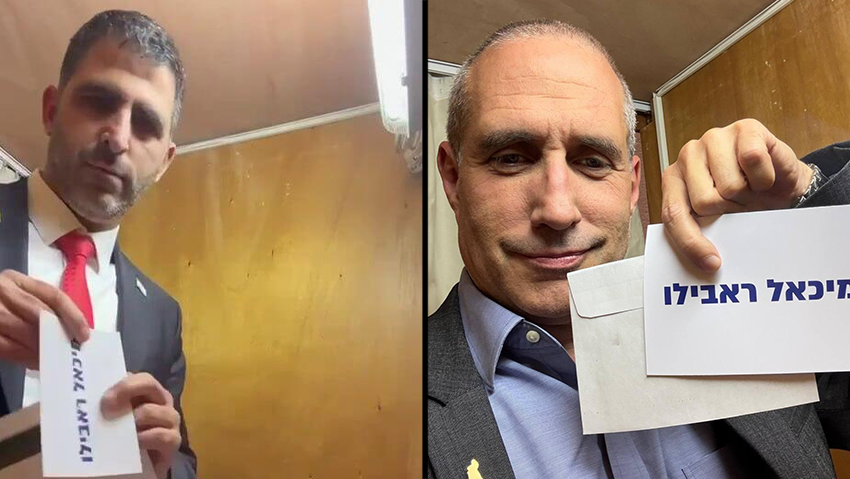
Likud Knesset members photographing their picks
The second question is whether Rabello’s work as Netanyahu’s private lawyer, and the fact that he works at the law firm of Netanyahu’s cousin, attorney David Shimron, prevents him from serving in a role that is supposed to audit someone who was until recently a central and close client.
Under existing case law, court intervention in a Knesset vote is expected only in exceptional circumstances. The justices will need to examine whether Rabello’s appointment as state comptroller suffers from extreme unreasonableness.
Possible intermediate solutions are also expected to come up during the hearing. One option would be for Rabello to sign a conflict-of-interest arrangement drafted by the legal adviser of the State Comptroller’s Office, under which he would be barred from dealing with audits involving the prime minister.
Rabello was elected in a secret vote held in the Knesset plenum about a week and a half ago. In the first round, Elron received the support of 60 Knesset members, compared with 57 for Rabello. But because no candidate received the required majority of 61 votes, a second round was held.
In the second round, the result was reversed: Rabello received 61 votes and was elected to the position, while Elron received 57.
During the second round, opposition lawmakers claimed that Likud Knesset members had been instructed to take a “selfie” with their ballot slip behind the voting screen to prove loyalty, which they said undermined the secrecy of the vote. Some lawmakers, including Shlomo Karhi and Hanoch Milwidsky, published photos of themselves with a ballot bearing Rabello’s name, but said no one had forced them to document their vote and that they had done so on their own initiative.