

The emergency command of Iran’s armed forces, Khatam al-Anbiya, threatened Tuesday evening that if Israel continues to strike in southern Lebanon, “it should expect a harsh response” from Iran’s military forces. The threat came after a series of IDF strikes in southern Lebanon on Tuesday, which reports said killed four people.
“The Israeli army has violated the ceasefire in southern Lebanon 84 times over the past two days, continues to commit crimes and kill the oppressed Lebanese people after the U.S. president declared the end of the war. We warn that if the Israeli army does not stop its evil in southern Lebanon, it should expect a harsh response from our forces,” the Iranian statement said.
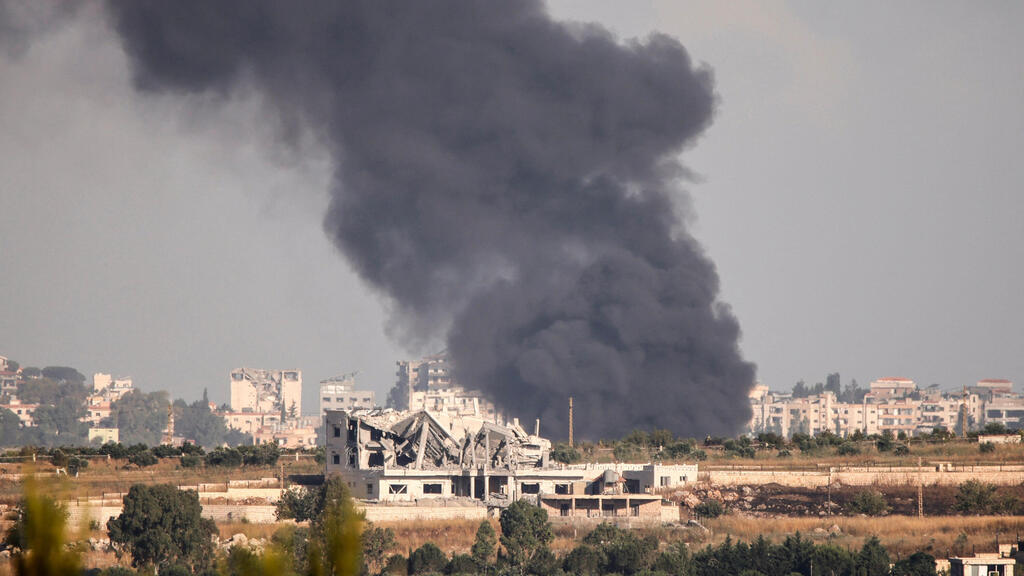
IDF attack in southern Lebanon
(Photo: AFP)
Iran has consistently insisted on linking its own front and its agreement with the United States to the fighting in Lebanon. It directly attacked Israel last week after Israel struck Hezbollah’s stronghold in Dahieh, in an attempt to create a new “equation.” It nearly attacked again after Israel’s strike in Dahieh on Sunday, but refrained after President Donald Trump dramatically accelerated contacts with Tehran and effectively promised it greater benefits, which led Iran to agree to forgo a strike and sign the memorandum of understanding.
Following Iran’s insistence, and with American consent, that memorandum of understanding includes a clause that explicitly refers to ending the war in Lebanon as well. Iran also demanded an Israeli withdrawal from southern Lebanon, but Prime Minister Benjamin Netanyahu pledged that Israel would not withdraw and would continue to defend itself against Hezbollah. It remains unclear, however, to what extent the agreement will constrain Israel, especially when it comes to strikes against future military buildup rather than immediate threats.
The damage after the attack in Mifodon on Tuesday morning


IDF strikes continued Tuesday in several areas of southern Lebanon, and in its official statement, the military stressed that the attacks were intended to remove a threat. “, the Israeli Air Force intercepted several rockets that were launched by the Hezbollah terrorist organization toward the area in which IDF soldiers are operating in southern Lebanon. No sirens were sounded in accordance with protocol,” the IDF Spokesperson’s Unit said earlier in the evening.
“Shortly afterward, the Israeli Air Force struck and dismantled the launcher from which some of the rockets were fired toward IDF soldiers in southern Lebanon," the statement conitnued. "Additionally, earlier today (Tuesday), the IDF identified a suspicious vehicle in the area where IDF soldiers are operating in southern Lebanon and fired a warning shot toward it, and later conducted a strike in the area to remove the threat."
The Hezbollah-affiliated Lebanese channel Al-Manar reported at midday on a drone strike in al-Nabatieh al-Fawqa in southern Lebanon. Shortly afterward, additional Israeli drone strikes were reported in the nearby villages of Mifdoun and Shoukin, also in southern Lebanon. Al-Mayadeen reported that four people were killed and several others wounded in the strikes on those two villages.
Documentation of attack on launcher in southern Lebanon
(Video: IDF spokespersons unit)
Trump himself also addressed the Lebanon issue Tuesday, again criticizing Netanyahu over the strikes in Lebanon while implicitly confirming Iran’s linkage between the arenas. “I am not happy with the way Israel has acted toward Lebanon and toward Hezbollah,” Trump said at the G7 summit in France. “They should have finished that job faster. It just goes on and on and on. And when that happens, it casts a negative shadow over the big deal, and the big deal is the agreement with Iran,” he said, though in the same breath he insisted: “When you ask me about Bibi — we have an exceptional relationship.”
Trump also surprised observers when he said he had suggested that Syria, under Ahmed al-Sharaa, would handle Hezbollah well. “He has done an amazing job unifying the country, and he is very firm against Hezbollah. He does not like them,” he said. “Israel has been fighting Hezbollah for too long, and too many people are being killed. You do not have to bring down a residential building every time you are looking for someone, because there are a lot of people in those buildings and not all of them are Hezbollah, I can tell you that. I suggested to Israel that Syria be allowed to handle Hezbollah, because frankly, I think they would do it better.”
Israeli officials expressed surprise at the remarks. “It is unclear what he meant,” they said. “It sounds like virtual reality. Hezbollah no longer exists in Syria, except for a few individuals who may be hiding. Syria will not act in Lebanon against Hezbollah; it is beyond its capacity. The only thing Syria can contribute is preventing smuggling from Iran through Iraq and Syria into Lebanon.”