

A majority of the world’s Jews will be living in Israel within five years, World Zionist Organization Chairman Yaakov Hagoel predicted during ynet Global’s Aliyah Live Summit, describing what he sees as a profound shift in Jewish identity and attachment to Israel since October 7.
“We are, God willing, within five years of most Jews living here in Israel,” Hagoel said, calling the prospect a historic demographic turning point.
World Zionist Organization Chairman Yaakov Hagoel


He attributed the trend to a combination of aliyah, assimilation abroad and Israel’s comparatively high birth rate, noting that Israel became home to the world’s largest Jewish population roughly two decades ago, surpassing the United States.
“In another five years, most Jews will live here in Israel,” he said. “For 2,000 years, there has been nothing like this.”
But for Hagoel, the significance of the period since October 7 goes beyond immigration numbers. He said the attack and the surge in antisemitism that followed have prompted many Jews, particularly younger ones, to reconsider what Jewish identity and Zionism mean to them.
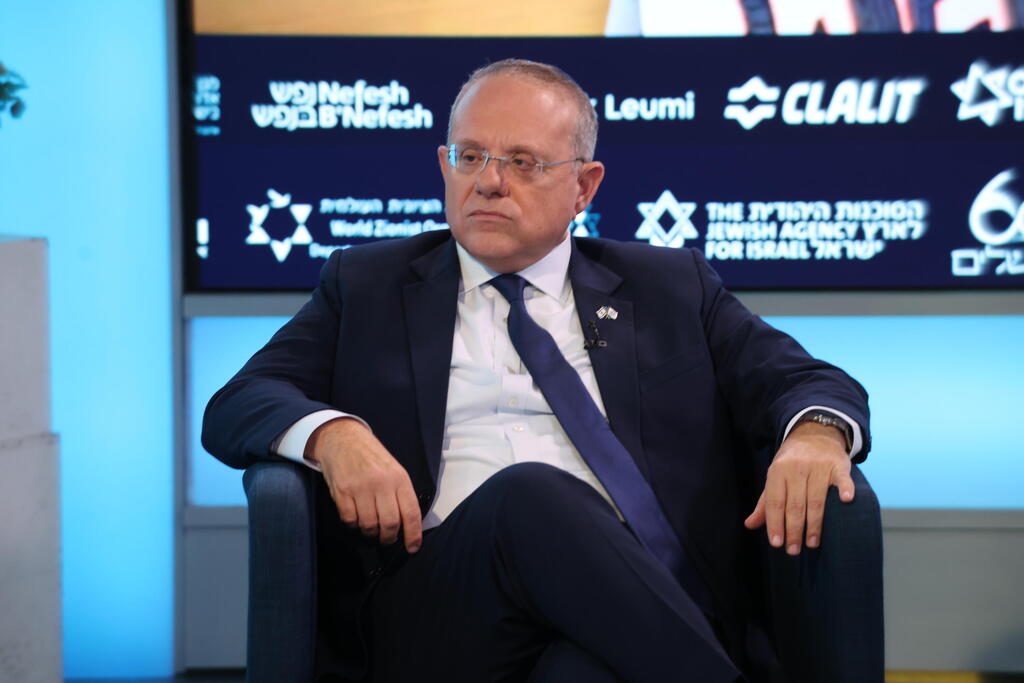
World Zionist Organization Chairman Yaakov Hagoel
(Photo: Yariv Katz)
‘A renaissance’ since October 7
“Since October 7, there has been a renaissance,” Hagoel said. “People want to connect to the Jewish people and to the Zionist movement.”
He pointed to what he described as tens of thousands of American Jews who refer to themselves as “October 8 Jews” — people whose Jewish identity became more central after the Hamas attack and the events that followed.
Some, he said, had previously drifted away from Jewish communal life or no longer strongly identified as Jewish.
“This crisis woke them up,” Hagoel said. “It woke them up to come home and be part of our people.”
That renewed engagement can be seen, he said, in synagogues, Jewish schools, Zionist organizations and growing interest in aliyah.
The process has not been easy for young Jews abroad, Hagoel acknowledged. He described October 7 as the beginning of a conflict that extended beyond Israel and into Jewish communities around the world, pointing to the rise in antisemitism and hostility toward Jews.
He said the World Zionist Organization is trying to turn that crisis into an opportunity to strengthen Jewish identity and connections with Israel.
What draws young Jews to Israel
Asked whether the forces connecting young Jews to Israel have changed, Hagoel said traditional elements remain powerful — family, heritage, religion and the sense of Israel as a Jewish home.
But newer factors also play a role.
Young Jews see Israel as a technologically and economically advanced country, he said, while the war has also strengthened some young people’s identification with the Israeli military.
“We see quite a few young Jews who, even if they don’t make aliyah, come here to serve in the army through various programs,” he said. “It warms the heart.”
At the same time, he said, that connection can carry a psychological cost.
Hagoel described young Jews who serve in Israel, including reservists, and then return to careers in countries such as the United States or Britain, where they may feel unable to speak openly about what they experienced.
“You were here for three months in the reserves, you go back there and you can’t tell people where you were,” he said. “You can’t share it with someone in your law firm, in high-tech or wherever you work.”
The World Zionist Organization, he said, is working with professional partners to provide support to those individuals.
Engagement — and alienation
Hagoel acknowledged that the war and intense international criticism of Israel have not brought all young Jews closer.
“There is both,” he said when asked whether young Jews were becoming more engaged or more distant.
Some have become more connected to Israel and Jewish life, while others have responded in the opposite direction.
Still, Hagoel said he believes the first group is considerably larger.
“Anyone who is afraid to be Jewish — eventually his grandson will not be Jewish,” he said, arguing that the current moment creates an opportunity to strengthen Jewish identity among younger generations.
The WZO, he said, is trying to reach those young Jews through programs both in Israel and abroad.
Aliyah ‘is not hocus-pocus’
Hagoel stressed that stronger Jewish identity does not automatically translate into immigration.
“Aliyah is not hocus-pocus. Aliyah is a process,” he said.
Before someone decides to move to Israel, he argued, they usually need to strengthen their connection to Jewish identity, the Jewish people and Israel itself.
To build that connection, the World Zionist Organization currently sends around 280 Israeli teachers to Jewish communities abroad for periods of two or three years, Hagoel said. It also works with Jewish youth movements and student organizations on university campuses.
The objective is to create a chain of engagement that can begin with education or a campus experience and eventually lead to a much larger decision.
Israelis, he said, sometimes underestimate just how difficult that decision can be.
“We Israelis live in a kind of la-la land and say, ‘How can they not make aliyah? How can they not all be here?’” Hagoel said.
But Jews abroad may have been born in those countries to parents who were also born there. Making aliyah can mean leaving behind a language, family, livelihood and familiar surroundings.
“It’s not simple,” he said. “It is a major challenge.”
‘Aliyah is the project of the Jewish people’
Hagoel said Israel must also do more to ensure that those who do make the move are successfully absorbed.
“The government needs to do much more,” he said, particularly when it comes to immigrant integration.
He pointed to cooperation between national institutions, the government and local authorities, but argued that absorbing olim cannot be left to institutions alone.
“Aliyah is the project of the Jewish people — you and me,” he said.
Israelis, he argued, need to understand the upheaval involved in immigration and make a deliberate effort to welcome newcomers, whether that means helping them navigate everyday life or simply showing patience with their Hebrew.
“We need to embrace the olim,” Hagoel said. “We need to understand that they are going through a difficult upheaval in coming here.”
For him, that approach is not only about making new immigrants feel welcome. It is central to Israel’s long-term strength.
“Aliyah is the growth engine of the State of Israel,” Hagoel said.
First published: 15:44, 09.08.26