

Late Friday night, after eight days of a complete internet shutdown, some users managed to regain limited access using VPNs and began uploading new videos documenting an unprecedented massacre of protesters, one without parallel in Iran’s contemporary history. These images have not only shocked Iranians but have also stunned the international community. Some estimates indicate that the number of people killed over the two days of January 8 and 9, and in the days that followed, has exceeded 16,500.
On Thursday, January 8, Azar, a law student, sent me a video of herself in which she said: “If you don’t see me again, I want this to be the last image you have of me.” In the video, she was chanting: “Death to the dictator.” She later posted additional videos on her Instagram account in the final moments before the internet were cut off, showing herself joining a sea of people chanting slogans against Khamenei. Since then, there has been no news of her. Friends who have contacted me in recent days say there has been no trace of her.
Video of Azar, one of the protesters who took to the streets on Thursday, Jan. 8


Gallery
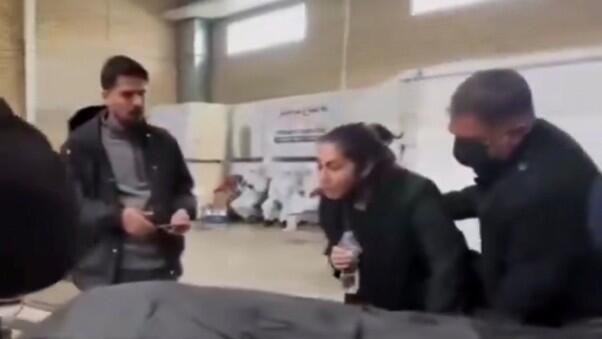
Human rights activists say they fear that thousands of people may have been killed in Iran on January 8 and 9
One eyewitness to the massacre of protesters in Sadeghieh Square on Thursday night wrote to me on Telegram on Saturday, saying that Islamic Revolutionary Guard Corps (IRGC) forces opened fire on protesters without any prior warning. “Before I could save myself,” the witness wrote, “I saw dozens of people fall to the ground, some wounded, some seriously injured.”
But the crimes committed on Thursday and Friday—and in the two days that followed—did not end there. Some hospital medical staff report that IRGC Quds Force and Tharallah units took wounded protesters away, while others say that injured individuals were executed with final shots in the streets.
A young woman in Shahrekord was among those who managed to contact me on Saturday morning. She spoke of large numbers of people killed in this small city and of an undeclared state of martial law that remains in effect.
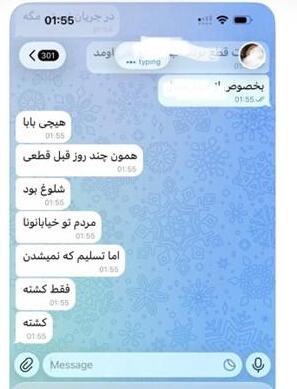
Message from a young woman in Shahrekord: ‘Many have been killed’
Many citizens report that IRGC forces fired machine guns into massive crowds in Tehran’s main streets, particularly in western Tehran. According to witnesses, their aim was not to disperse the protesters but to kill them.
Such mass killings in Tehran are virtually unprecedented in Iran’s contemporary history. Some individuals who managed to establish limited direct phone contact with the outside world in recent days say they saw large numbers of bodies lying in Tehran’s streets on Thursday and Friday, and that the Iranian capital had turned into a battlefield.
Over the past half-century, mass killings of opposition demonstrators in Tehran have occurred only a few times. On September 8, 1978, after the declaration of martial law, dozens of people were gunned down in Jaleh Square in central Tehran, with the total death toll reaching around 100. That day, known as “Black Friday,” marked the beginning of the collapse of the Shah’s rule.
Less than three years later, on June 20, 1981, following the parliamentary impeachment of President Abolhassan Banisadr with the approval of Khomeini, the People’s Mojahedin Organization and Banisadr’s supporters called for demonstrations. Many other opposition groups joined, and more than half a million people marched in Tehran. Revolutionary Guards opened fire, killing and injuring dozens. In the aftermath, many of those arrested including teenagers were executed without identity verification. This day, later known as “Black Saturday,” marked the beginning of a decade-long wave of mass executions of leftist and Mojahedin opposition members and ushered in an era of intensified repression.
On June 20, 2009, during protests against election fraud, protests that many turned into demonstrations against the regime, security forces again opened fire, including the use of snipers, killing numerous young people. One of them was Neda Agha-Soltan, whose final moments were broadcast worldwide and deeply shook global public opinion. Dozens were killed or wounded that day, although the shootings were scattered across central Tehran.
In November 2019, during protests against fuel price hikes, dozens were also killed in Tehran, though the scale of the massacre was even greater in areas surrounding the capital and in smaller cities, with the death toll reaching around 1,500.
During the 2022 protests following the killing of Jina (Mahsa) Amini, widely known as the “Woman, Life, Freedom” revolution, some protesters were also killed in Tehran. However, those shootings were sporadic and occurred over several months across the city.
Therefore, after Black Friday and Black Saturday, the massacre of protesters in Tehran on the recent bloody Thursday and Friday stands as the deadliest and most unprecedented event in terms of scale and brutality carried out by military and security forces in the capital.
Some estimates suggest that more than 1,000 people were killed in Tehran alone over just two days. However, due to the total communications blackout, independent verification is impossible. Thousands more have been arrested, and families remain in the dark—unsure whether their loved ones have been killed, wounded, or detained.
Only since Saturday has limited SMS messaging resumed, and some people have been able to send messages via encrypted apps using VPNs. International calls to Iran remain blocked, while domestic landline services have only recently resumed after limited operation around the clock.
One of the few people who managed to post an Instagram story on Saturday wrote: “Many lost one beloved, but I am still alive.” She was a feminist student and women’s rights activist. After posting the story, she once again went silent.
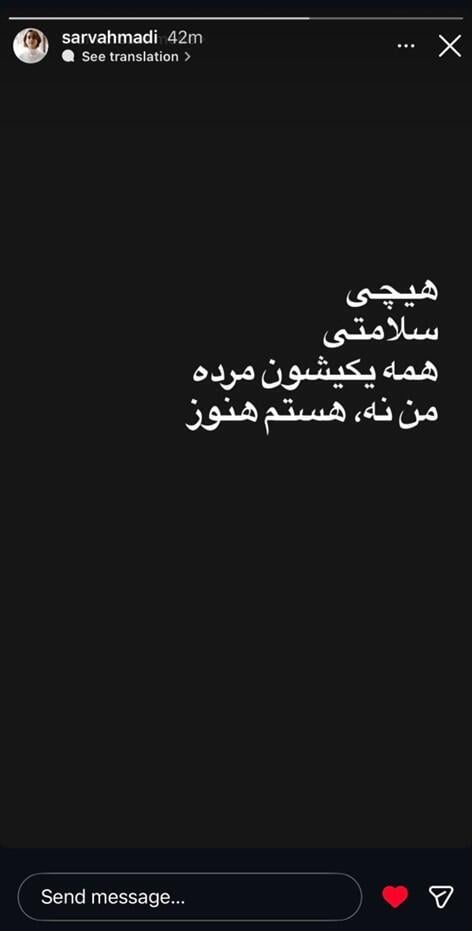
Instagram story from a women’s rights activist in Tehran: ‘I’m still alive’
Many eyewitnesses say that between Thursday and Sunday, January 8–11, some of the forces involved in shooting and pursuing protesters were proxy militias, including Iraq’s Hashd al-Shaabi and Lebanon’s Hezbollah. Media outlets such as CNN and Der Spiegel have also reported, citing various sources, that around 5,000 Shiite proxy fighters were deployed to suppress protests in Iran.
Images and reports arriving hourly from cities such as Karaj, Rasht, and Isfahan are so horrifying that many Iranians abroad have suffered severe psychological shock after seeing them. In an audio message sent to human rights activists and delivered to me from Qom, a woman says the number of dead is higher than current estimates. She reports that many protesters were injured by pellet guns and are too afraid of arrest to seek medical treatment. She also says she personally heard armed suppressive forces speaking Arabic to one another, suggesting they were likely from Iraq or Lebanon.
Woman from Qom says some repressors are not Iranian and speak Arabic
The Islamic Republic has also deployed the Fatemiyoun Brigade, comprised of Afghan Shiite fighters, to suppress protests. On Thursday and Friday, as public anger exploded following the shootings and the regime came close to losing control of the capital, several police stations and security centres were attacked. In clashes with protesters, several regime forces were reportedly killed. The Islamic Republic has not released official casualty figures for its own forces in Tehran, but state-run news agencies—only a few of which have partially resumed operations—reported funerals for 100 security and military personnel in Tehran, underscoring that the capital had turned into a bloody war zone.
Thousands have been arrested in Tehran, and nationwide arrests are estimated at 18,000. It has been reported that prosecutors have sought the death penalty for some detainees after interrogations lasting only a few minutes. In response to comments by Trump claiming he had prevented the execution of 800 people, Tehran’s prosecutor said Trump was “talking nonsense” and that judicial rulings would proceed.
Hours ago, a young man from one of the western Iranian cities that suffered the highest casualties wrote to me: “Many people hope Trump will intervene, or that Israel might strike command centers, so much the better. But the regime should not take comfort in martial law. The fire ignited by killing so many young people will flare up again, and sooner or later, it will be overthrown.”