


Yesh Atid chairman Yair Lapid unveiled his party’s slate for the next Knesset on Saturday night after a wave of departures by veteran lawmakers, as the party prepares to contest the October 27 election as part of former prime minister Naftali Bennett’s Beyachad alliance.
Yesh Atid says the new lineup reflects an effort to renew the party and promote a younger generation of lawmakers who played prominent roles in Knesset committees during the previous term, including the Finance Committee and the Constitution, Law and Justice Committee.
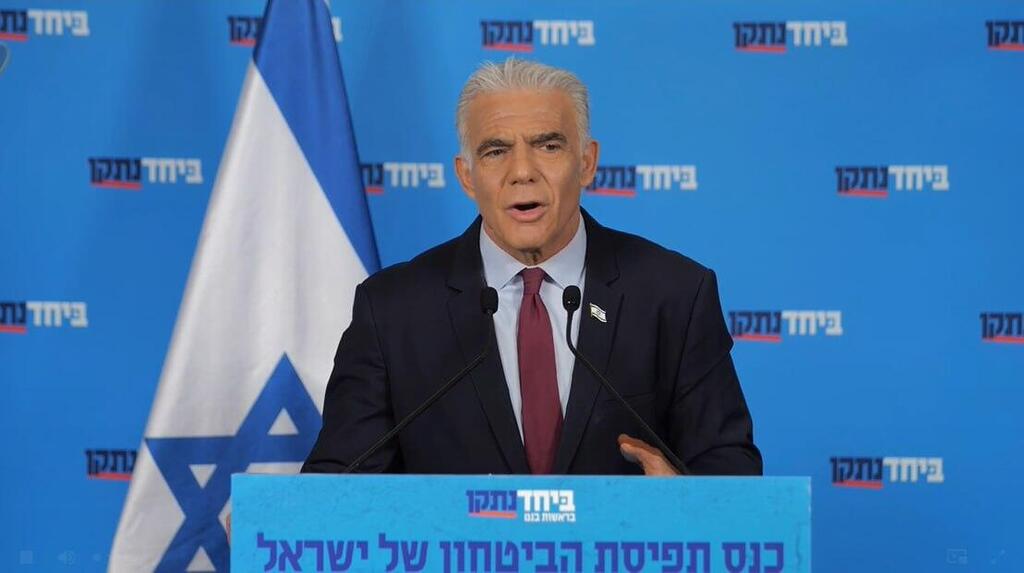
Ynet has learned that after the joint list with Bennett is assembled, Bennett will take the No. 1 spot and Lapid will be second. A Bennett representative will be placed third, followed by Merav Ben Ari in fourth. Another Bennett candidate will take fifth place, with Maj. Gen. (res.) Noam Tibon sixth. Two more Bennett representatives will follow, with Meirav Cohen ninth and two additional Bennett candidates after her.
Lapid is expected to control about 40% of the places on the joint slate, meaning Yesh Atid will likely receive four of the first 10 positions and a similar share of the second 10.
The full Yesh Atid ranking is: Yair Lapid, Merav Ben Ari, Noam Tibon, Meirav Cohen, Ram Ben Barak, Naor Shiri, Vladimir Beliak, Yorai Lahav-Hertzanu, Yasmin Sacks-Friedman, Neta Attias, Moshe “Kinley” Tur-Paz, Simon Davidson, Shelly Tal Meron, Roni Malkai and Mati Harkavi.

Merav Ben Ari
(Photo: Noam Moskowitz / Knesset Spokesperson’s Office)
The party says the ordering reflects a deliberate emphasis on its next generation of leaders. Lawmakers including Beliak and Shiri, who gained prominence through parliamentary battles over coalition funding and other government spending, were rewarded with relatively high positions, while Ben Ari received the strongest placement among Yesh Atid candidates after becoming a prominent figure both online and on the campaign trail.
Aside from Tibon, the only new name on the list is Neta Attias, who has served as Yesh Atid’s faction manager for the past decade and coordinated its coalition and opposition work in recent Knessets. She was placed 10th on Yesh Atid’s internal ranking, a position that is not expected to translate into a realistic slot on the joint Bennett-Lapid slate.
Yesh Atid’s wave of departures
Yesh Atid described the past week as one of the most difficult in its history because of the succession of departures.
In a message to party activists, Lapid said the renewal was necessary if the party wanted to help reshape the country.
“If we want to fix the country, there is no better way than giving power to these people,” he wrote. “They are experienced, they are tough, they know how to work, they get things done and their hearts are in exactly the right place.”
Lapid portrayed the difficult week as a sign of organizational strength rather than collapse.
“The past week was a demonstration of strength,” he wrote. “This is what a tough team looks like, one that knows how to get through difficult weeks together in order to build a better future. Winning teams know how to reinvent themselves.”
“We not only showed the people of Israel that things can be done differently,” he added. “We also ensured this week that we will be part of the country’s leadership for many years.”
Yesh Atid has been one of Israel’s largest and most stable parties over the past decade and has repeatedly competed for national leadership. But ahead of this election, the party has undergone a sharp contraction.
Of the 24 seats it won four years ago, only 12 of its current lawmakers are expected to remain on its list for the October election.

Yoav Segalovich and Mansour Abbas
(Photo: Avihu Shapira)
The merger with Bennett, combined with the approaching candidate-list deadline, prompted more lawmakers who realized they were unlikely to receive realistic positions to announce temporary departures from political life.
The exodus follows a longer period in which several senior figures, including some of the party’s founders, had already left.
Orna Barbivai departed to run for mayor of Tel Aviv, while former minister Yoel Razvozov left politics for the private sector. Boaz Toporovsky, one of Yesh Atid’s founders, announced in June that he was leaving political life. Two other longtime Lapid allies, Meir Cohen and Mickey Levy, announced this week that they were stepping aside to make room for younger lawmakers.
Elazar Stern left for Gadi Eisenkot’s party, while Ron Katz returned to civilian life. Idan Roll quit Yesh Atid in January 2025, established the National Majority faction and later announced that he too would leave the Knesset and political life.
Yoav Segalovich, another figure considered close to Lapid, left to join Mansour Abbas. Lawmakers Tatiana Mazarsky and Debbie Biton announced Tuesday that they would not be on the next slate, although both stressed that they were remaining in the party. Former minister Karine Elharrar joined the list of departures on Thursday.
Bennett’s crowded slate
The pressure on Yesh Atid’s candidates is also a result of Bennett bringing 16 new candidates of his own into the joint slate.
Several of Bennett’s recruits are expected to receive places in the top five, including Keren Turner and Liran Avisar Ben-Horin. With so many candidates competing for a limited number of realistic slots, party officials said some form of selection process was unavoidable.
Some departing Yesh Atid veterans, including Meir Cohen and Mickey Levy, are expected to receive symbolic roles within the party organization, in an effort to emphasize that their exits were coordinated rather than acrimonious.

Naftali Bennett and Lapid
(Photo: Dana Kopel)
Yesh Atid entered the election campaign in one of the deepest political crises since its founding, with polls projecting a single-digit seat total. Lapid and Bennett joined forces in an effort to stop that decline.
But the alliance has also created problems of its own. Since the merger was announced, the two have lost ground in some polls, with party officials acknowledging that parts of Bennett’s potential electorate have struggled to embrace an alliance with Lapid.
The final composition of Beyachad’s joint slate will determine how much of Yesh Atid survives inside the alliance and which of Lapid’s remaining lawmakers secure realistic positions ahead of the October 27 vote.