

Math teacher Zevik Glidai, 78, was sitting in his home office in Kiryat Shmona, tutoring his granddaughter and two of her friends for an exam over Zoom. Fully absorbed in the important lesson, Glidai did not notice the drama unfolding just outside his window until he suddenly heard his neighbor shout: “Zevik, there’s a fire in your yard.”
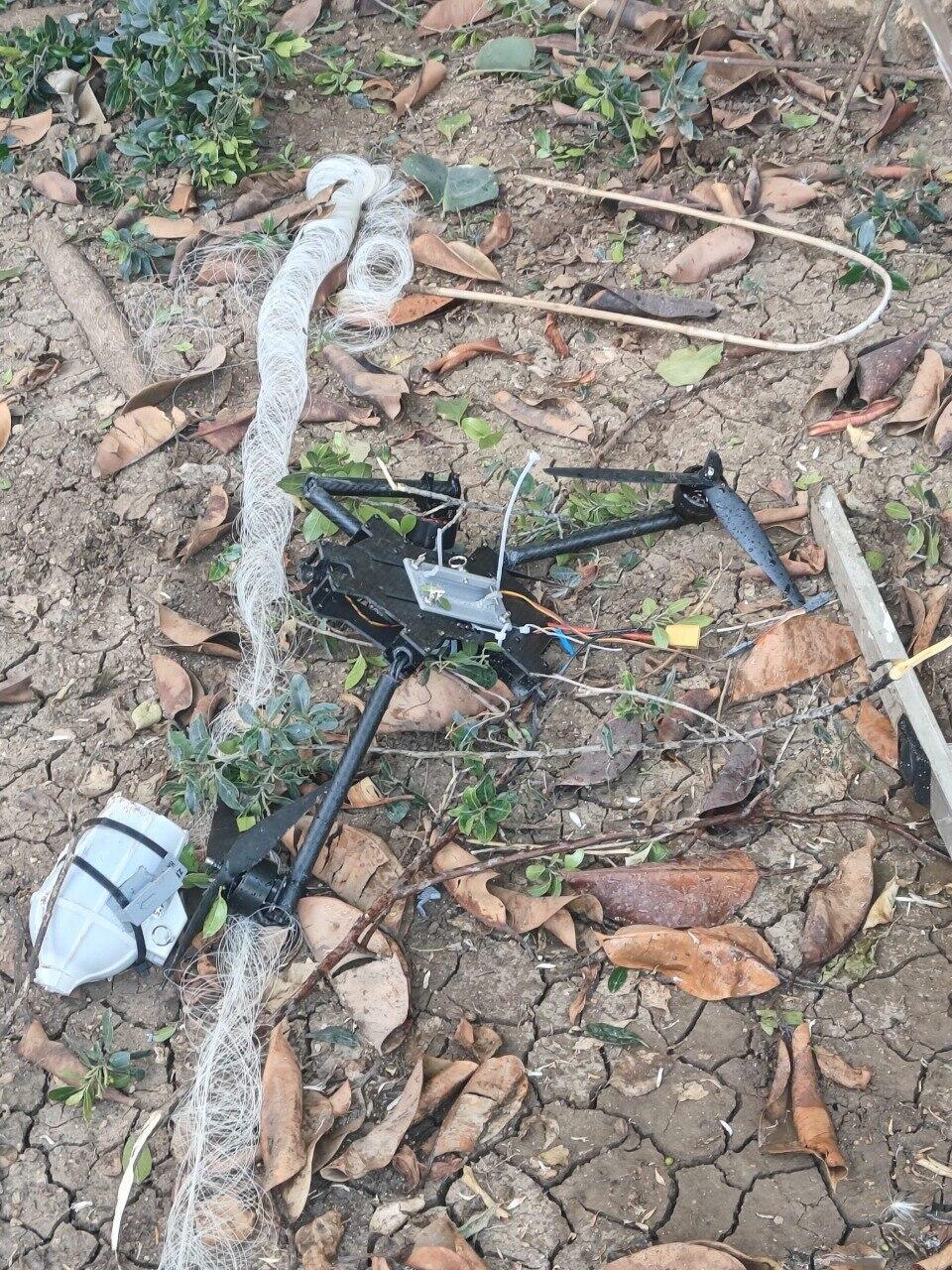
“I went outside and saw really thick smoke,” he recounted. “I got closer and saw that something was burning there. In retrospect, it turned out to be a battery from a drone from Lebanon, which had broken into several parts. Its warhead fell into the trampoline, the drone fell 2 meters away, and about 30 to 40 centimeters from there was the explosive material. The bomb disposal officer told me there were all kinds of metal balls and things like that there that were supposed to cause more damage. He told me, ‘Listen, it was only 1.5 kilograms. These drones can carry several kilograms. You got off lightly.’ Fortunately, nothing happened apart from a hole in the trampoline.”
Hezbollah drone lands in Glidai's backyard


Glidai appeared amused as he put out the burning drone in his yard with a hose, but he knows it could have ended differently. “It’s frightening because I didn’t hear anything,” he added.
As a resident of Kiryat Shmona, Glidai is used to running to the shelter within seconds, but this time there was no siren either. “Even the drone falling didn’t make any explosion or unusual noise. If the neighbor hadn’t shouted to me that there was a fire, then maybe a few minutes later the smoke would already have entered the house.”
A rapid adjustment
This is one of the significant threats Hezbollah has used in the current campaign, and on a fairly wide scale, especially against forces maneuvering in southern Lebanon. These are small fiber-optic-guided explosive drones that quietly slip toward IDF strongholds carrying small charges weighing up to 10 kilograms, then explode.
They are operated by optical fiber from southern Lebanon and can reach distances of several kilometers. That is enough to cover the entire area in which the IDF is operating and also to hit communities near the border. And although a fragile ceasefire was declared Friday, in the next round, if one breaks out, the terror group — which lost far more advanced UAVs in the war — is likely to make even wider use of these cheap tools.
A Hezbollah fiber-optic-guided explosive drone
Tal Inbar, an expert on space and missile programs, said the meaning of the term “fiber drones” is “the ability to bring the drone to levels of accuracy of just a few centimeters, even against moving targets. This threat has been familiar in recent years from the fighting in Ukraine. The fact that the drones are guided by optical fiber means their flight cannot be disrupted by external ‘soft’ measures such as electronic warfare, communications jamming or interference with satellite navigation signals. This issue poses a challenge to the defense establishment, especially in light of the use of long guiding fibers that extend into double-digit kilometers.”
On the same day Glidai’s home was hit, two soldiers were moderately wounded and six others were lightly wounded as a result of such a drone strike in Lebanon. A military source explained that this was a threat that required the forces to adapt quickly, because “inside such a drone they usually place a charge of up to 10 kilograms, but we have also seen cases in which they dismantle an RPG warhead and attach it. It flies fast, and as in Kiryat Shmona it is not always detected. We need to learn how to adjust the way the force operates to it.”
The response: technological methods and also ‘dumb’ ones
That same source explained that despite the challenge, Israeli armored forces are usually able to deal with the threat while maintaining strict operational discipline. Meanwhile, however, the Defense Ministry’s Directorate of Defense Research and Development this week issued a public call for assistance in formulating responses to fiber drones, asking for “technical information regarding the solutions, project-management information regarding work plans and delivery schedules, and cost estimates regarding the development and procurement of systems.”
The Defense Ministry said that “the publication of the call is intended to expand the existing response and enlist innovative solutions from the private market and academia that may complement operational capabilities. The directorate is consistently working to examine every technological lead in favor of technological solutions to changing threats.”
The difficulties are clear: Hezbollah operatives upgraded the explosive drone and attached additional equipment to it, sometimes with very simple connections such as zip ties. They launch it from several kilometers away, and it transmits video feed back while moving relatively quietly. In this way, the drone can reach forces quickly and at times also surprise them and cause deadly results. And as was shown at Glidai’s home — and in at least one other case in Margaliot, where no siren was activated either — drone operators can also send the drone farther south, penetrate Israeli territory and detonate it at one of the homes in northern communities.
According to the military source, “we deal with several of these a day. These are still not large numbers, but it is a threat that exists in the area. It is important to remember that there is an enemy studying us, and although we are ahead of it, it is constantly trying different things. This is another threat we are dealing with, like high-trajectory fire and anti-tank fire, and we have the ability to deal with it using technological methods and ‘dumb’ methods. It does not delay our progress, and in any case it is preferable that these drones be directed at fighters and not at residents.”

Zevik Glidai
(Photo: Gil Nechushtan)
“I took a piece of the drone. It really does not look nice,” Glidai said, describing how he identified “a spool that looked like fishing line” connecting the launcher to the explosive material so it could be guided with surgical precision to the target. “The bomb disposal officer told me the drone has no electronic signature, it cannot be detected, and that is why there was no siren or Red Alert and they did not try to intercept it. So we have a wonderful shelter at home, but we didn’t even hear the buzzing of the drone, so it would not have helped.”
In Northern Command, officials stress that Hezbollah’s future ambition is to launch such drones at homes in frontline communities, but so far most of them — like the anti-tank missiles and indirect fire — have focused on maneuvering forces at the front. “It must be remembered that in every house in the villages of southern Lebanon there is terror infrastructure,” the military source said. “The meaning of terror infrastructure is observation posts, places for launching weapons, command-and-control rooms that manage the fighting remotely, kinetic weapons and more. These are literally military bases through which they try in every way to hamper the forces.”
In the meantime, Glidai can be pleased about one thing: after the drone fell in the yard of his home, “all the top brass and senior commanders” came to him, in his words, and he managed to extract from them a promise — after a prolonged struggle and heavy pressure — that they would bring a reinforced shelter to the Yad Sarah branch that he runs as a volunteer in the city, so that he could open it in accordance with Home Front Command guidelines. “There was madness there with people,” he said, after making sure to approach each and every one of them. The reinforced shelter was indeed placed there on Wednesday, and the branch opened. The day after that, the ceasefire was declared.