

Making aliyah can involve months of planning, but even careful preparation does not eliminate the surprises that come with building an everyday life in Israel.
At ynet Global’s Aliyah Live Summit, three recent immigrants — Danielle Adessky, Arielle Sabol and Daniel Bielak — spoke about the practical and emotional realities behind the move, from finding an apartment and navigating Hebrew to adjusting to Shabbat and discovering just how different familiar routines can feel in a new country.
The panel with Danielle Adessky, Arielle Sabol and Daniel Bielak
(Video: Lior Sharon, Tal Azulay, Tal Saar)


All three made Aliyah with the help of Nefesh B’Nefesh, in partnership with Israel’s Ministry of Aliyah and Integration, The Jewish Agency for Israel, Keren Kayemeth LeIsrael and Jewish National Fund-USA. They have also been documenting their Aliyah journeys on social media, giving prospective immigrants a glimpse of the experiences that do not always appear in official guides.
For Adessky, who moved from Toronto to Tel Aviv, one of the biggest surprises was the cost of living.
“I come from Toronto, which is already a big, expensive city, and I had been told that Tel Aviv was expensive,” she said. “But I didn’t really understand the extent of it.”
Apartment hunting became another crash course in Israeli life. Adessky searched largely through Facebook Marketplace and quickly learned that rental expectations differ from those in North America, including which appliances come with an apartment.
“I really had to learn how to change those expectations and understand what I can get for my budget here versus what I would have expected back home,” she said.
‘You can prepare — but living it is different’
For Arielle Sabol, who made aliyah with her husband and two young daughters, even speaking Hebrew did not eliminate the adjustment.
“You can prepare for making aliyah,” she said, comparing it to becoming a parent. “You can do everything ahead, but when you get here and live it, it’s a totally different experience.”
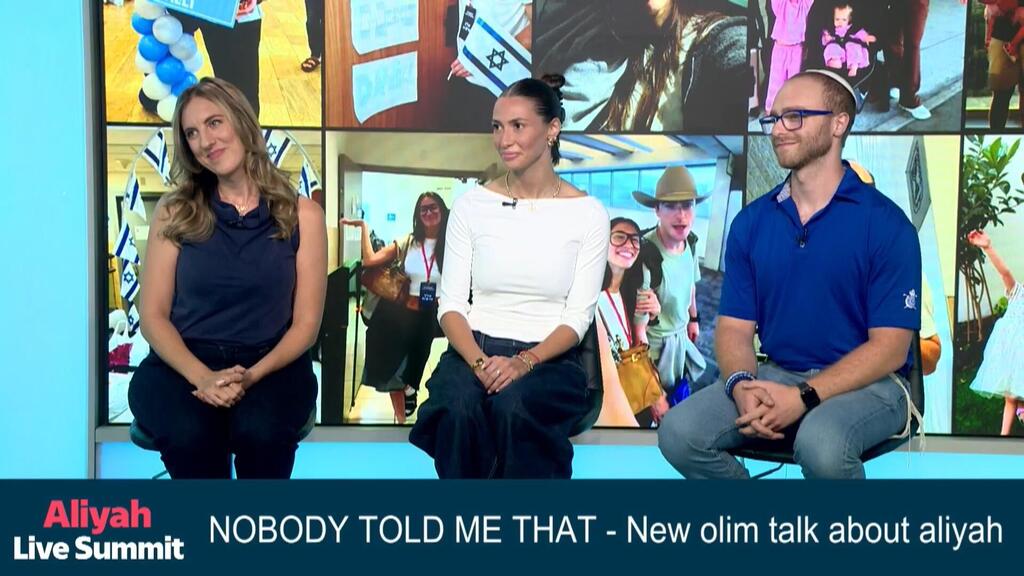
Danielle Adessky, Arielle Sabol and Daniel Bielak during the ynet Global’s Global Aliyah Live Summit
Her latest culture-shock moment came at her daughter’s parent-teacher conference, where she found herself struggling to follow the Hebrew despite already knowing the language.
The small moments, she said, can be the most revealing — filling out a school form, arranging medical appointments or finding the products her children were used to at home.
Sabol did much of her apartment search before arriving and hired someone locally to view properties on her behalf. After weeks of moving with her daughters while their belongings were in transit, she said finding the right home made a major difference.
“We literally live in our dream apartment,” she said.
Her four-year-old daughter, meanwhile, appears to be adjusting even faster.
“She made a best friend already,” Sabol said. “They’re like soul sisters, and she did it in five minutes.”
One week into aliyah
Daniel Bielak was only one week into his own aliyah experience when he joined the panel.
Originally from Canada, he said family in Israel helped provide a “soft landing,” though adjusting to the climate while volunteering on a farm in northern Israel came as a shock.
“As a Canadian that really loves winter, I find it sometimes unbearably hot,” he said.
Other surprises have been more positive. After missing a bus, Bielak said people around him simply told him to put out his hand and find a ride — and someone soon stopped and drove him to Afula.
“People here are really nice,” he said.
Bielak described himself as an “aliyah amateur,” a label he sees as an advantage.
“One of the best things about being an amateur is that you’re always able to learn,” he said. “If you want to make something happen, you can go make it happen.”
He plans to begin an MBA at Tel Aviv University and said the move is also part of a broader spiritual journey.
“This is the best place on earth for you to live out your dreams,” he said.
Sharing the parts nobody tells you about
For all three, social media has become a way to document the details prospective olim may not otherwise hear about.
Adessky said she began leaning more heavily into aliyah-related content after deciding to move because she wanted to share her connection to Israel with an audience interested in following the experience.
Sabol said her posts often generate messages from people experiencing the same frustrations or uncertainties.
After sharing how overwhelmed she felt at her daughter’s parent-teacher conference, she said, she received numerous messages from other immigrants who immediately understood.
“It feels really good to be able to share and be part of this new olim community,” she said.
Their experiences also illustrate how integration is built through small adjustments: learning Hebrew, finding the right apartment, adapting family routines and accepting that even ordinary errands may work differently.
Asked what had surprised him most during his first week, Bielak pointed not to bureaucracy or the weather but to the reception he had received.
“How passionately in love the people are with Israel,” he said, “and with the fact that we’re coming home.”
First published: 17:30, 09.08.26