

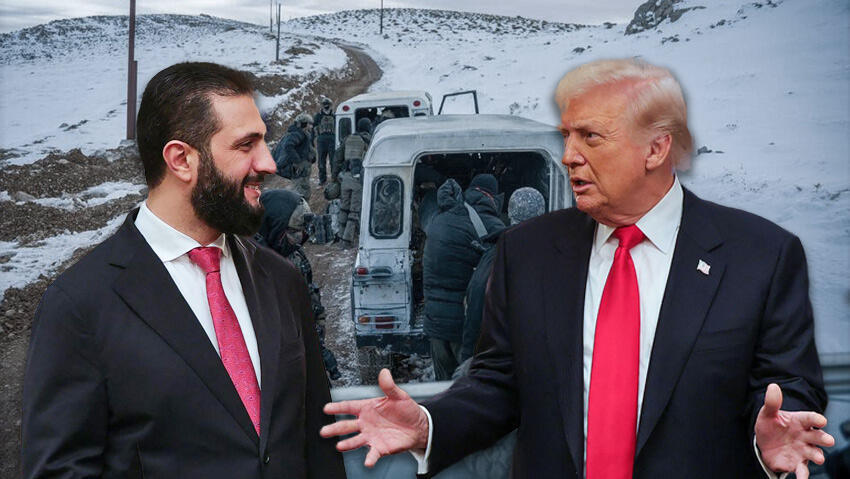
Bulldozers and engineering vehicles are climbing the paved road that rises to 2,800 meters at the summit of Mount Hermon in Syria, a road that until a year ago had been controlled by troops loyal to dictator Bashar Assad. Construction crews are renovating the two Israeli outposts there, Metzuda and Keter Hermon, ahead of the heavy winter approaching. The political echelon does not view this as the last winter the IDF will spend on the mountain. Washington and Damascus may think otherwise after the historic meeting this week between the once jihadist leader Ahmed al-Sharaa and President Donald Trump at the White House.
According to reports, the low-key contacts held in recent months between representatives of Prime Minister Benjamin Netanyahu and envoys of the al-Sharaa administration have not yet produced results. The goal of the talks is to reach a new ceasefire agreement to replace the one that held between the Assad regime over two generations, from 1974 until the fall of the Alawite government in Syria last year. The emerging deal is not a normalization agreement or a peace treaty that would fulfill the Israeli fantasy of eating “hummus in Damascus.” Even so, the new ceasefire could prove problematic for Israel if Trump decides to impose it on Netanyahu, similar to the ceasefire with Hamas that has so far left the group in control of Gaza.
Security officials are urging Netanyahu not to give up the Syrian summit of Mount Hermon, which they view as a strategic anchor for northern security. From that vantage point one can identify every vehicle that enters key positions in the Golan region, including the headquarters of the 210th Division at Camp Nafah. The Syrian side of Hermon also provides effective oversight of the weapons-smuggling routes from Syria to Lebanon, mainly to Hezbollah. Smuggling along these routes has surged in recent months, but IDF Northern Command units stationed at the two Hermon outposts are carrying out operations to disrupt and block some of the movement.
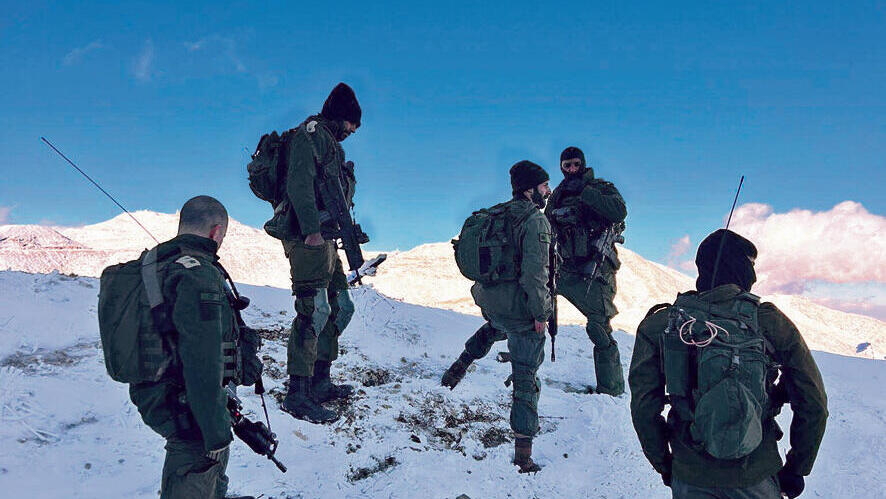
IDF soldiers on Mount Hermon
(Photo: IDF)
Inside the Syrian Golan the IDF currently maintains eight outposts. They are relocatable but include upgraded infrastructure that is continually improved by the Technology and Logistics Directorate to enhance operational capability and living conditions for the soldiers. The outposts are spread a few kilometers inside Syria from the international border, among the Hauran villages in southern Syria that are home to about 70,000 residents. There have been no major clashes between soldiers and locals, aside from isolated incidents in which residents, many of whom previously aligned with ISIS, refused to surrender personal weapons.
Concern over Erdogan’s involvement
Israel is inclined to discuss a withdrawal from these outposts, as demanded by the Syrian president, in exchange for a renewed ceasefire that would ensure Israel’s freedom to strike emerging terror threats in the area. Hezbollah and Iran spent the past decade trying to establish a new front there. Defense Minister Israel Katz has repeatedly said over the past year that Israel will not withdraw from the Syrian summit of Mount Hermon, which it seized without a fight after the Assad regime collapsed. The ultimate decisions regarding the mountain are likely to be made in Washington and Ankara.
Security officials are deeply worried about the warming ties between Trump and Turkish President Recep Tayyip Erdogan. Erdogan has served as the bridge between al-Sharaa and Trump. Over the past year Turkey has been arming Syrian forces, so far with light weapons, but not yet with heavy platforms or air-defense systems that could transform al-Sharaa’s militias into a real army. These include Russian-made S-400 batteries that could severely restrict Israeli Air Force operations in the north. IDF officials were also astonished by the warm hospitality al-Sharaa received at the White House. They noted that no leader of a former terror organization, who was once a senior operative wanted by the West and who has not abandoned his jihadist worldview, has ever been received so openly as legitimate in Washington or played basketball like an old friend with a senior U.S. general.
Al-Sharaa plays basketball in the U.S. with the CENTCOM chief


The militias loyal to al-Sharaa still rely on pickup trucks, machine guns and drones suited for guerrilla warfare. If Erdogan follows through on his plans to arm them further, their capabilities would change significantly. The IDF continues to strike and destroy what remains of the old Soviet tanks and armored vehicles left behind by the Assad army.
Military analysts believe al-Sharaa’s new army will not resemble a classic heavy Arab force. His current troops are deployed north of Damascus as they attempt to reconquer Syria. The south, including the border with Israel, is currently of less interest to the regime. Deadly tensions between Druze and Bedouins in southern Syria, which Israel intervened in on behalf of the Druze, are still simmering. Israel is expected to seek security guarantees to protect local Druze communities or maintain limited permission to act from the air if necessary.
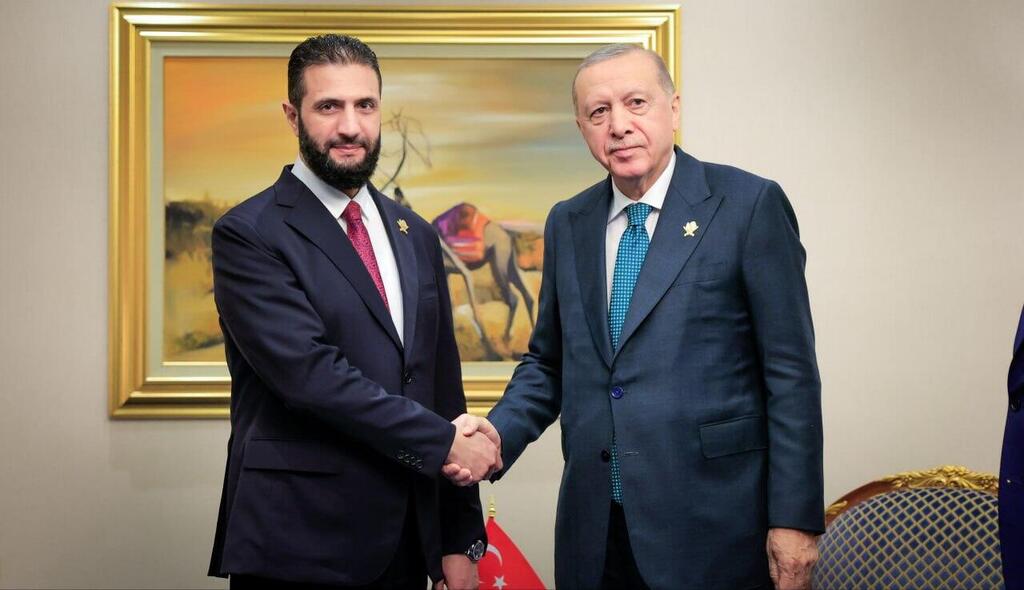
Israel fears Syria may receive advanced weapons from Erdogan
The intelligence community has not yet finalized its position on al-Sharaa. On one hand, he is seen as a charismatic leader who appears to be seeking to unify Syria with consideration for minorities and a willingness to reconcile with the West. On the other hand, he has not abandoned his roots embedded in al-Qaida ideology. None of this prevented the new CENTCOM commander, Gen. Brad Cooper, from meeting him three months ago in Damascus. The meeting drew intense interest in Israel’s defense establishment, where Cooper is well connected from his tenure as deputy commander of U.S. Central Command during the war. Cooper brought his wife to the meeting, signaling a strong desire for rapprochement with Damascus beyond military ties. Washington still aims to withdraw from Iraq and Syria, but the visit also signaled that the U.S. military remains on the ground and expects Damascus not to move too quickly toward Ankara, especially while Russian forces still hold bases along Syria’s coastal northwest, controlled by the Alawite minority from which Assad hails. “He appears pragmatic right now, but he is surrounded by people with a deeply hostile ideology toward Israel,” Israeli officials warned.
Israel edges closer to offensive action against Hezbollah
In Lebanon the IDF is moving closer to a limited offensive against Hezbollah. The plan includes a series of airstrikes on weapons-production facilities across the country, mainly in the Bekaa Valley and Beirut. These sites are built underground or hidden among residential buildings and have basic capabilities to convert heavy unguided rockets into precision missiles by modifying their warheads. Israeli assessments say Hezbollah still holds tens of thousands of such rockets and several thousand missiles. The group has also produced thousands of new UAVs and explosive drones since the end of the war.
The IDF strikes targets in southern Lebanon
Hezbollah’s ability to mount a ground incursion into Israel through its Radwan forces is recovering. Despite the cease-fire, Hezbollah has slowly returned to positions closer to the border. The group has not restored the large staging areas it once maintained along the fence, but Radwan operatives have reestablished themselves in the zone between the Litani River and the border, including in large towns such as Nabatieh.
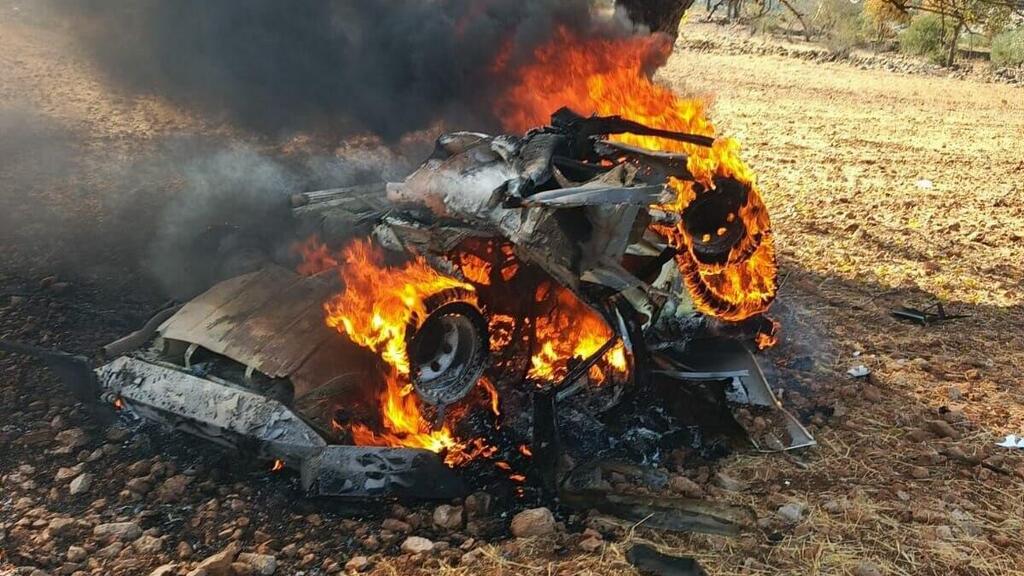
A vehicle burns in Lebanon after being struck by the IDF
The IDF still holds five outposts in southern Lebanon, spread across roughly 135 kilometers of border from Mount Dov to Rosh Hanikra, in commanding positions. These outposts sit along the line of contact, between 500 and 1,000 meters from the border fence. The discussion on an arrangement with the Lebanese government was based on Beirut’s historic decision six months ago to disarm Hezbollah. As time passed, the IDF discovered the mission is far beyond the Lebanese army’s capabilities and is moving slowly. “For every rocket launcher the Lebanese army seizes from Hezbollah, another launcher is converted into a missile system in the Bekaa,” IDF officials say. “There is a great deal of deliberate blindness and cooperation in this long operation the Lebanese call ‘Shield of the South.’ In practice we must continue to strike weapons-production sites again and again, like the strategic weapons plant in the Bekaa we hit this week for the ninth time since the ceasefire began.”
Another example came earlier this week when troops from the 769th Brigade destroyed several buildings in the village of Hula after discovering they were once again being used by Hezbollah. Hula had been captured and cleared by the IDF during the short maneuver phase of Operation Northern Arrows last year. Old explosive devices were found in those buildings last month, but Hezbollah did not hesitate to restore them for future operations. Overall IDF forces, mainly from the air, have killed about 20 Hezbollah operatives since the start of the month in a series of strikes along the front.