


Alon Kaminer — considered among the most severely wounded soldiers since the Swords of Iron War began — sharply criticized the draft‑exemption bill during Sunday's session of the Foreign Affairs and Security Committee. Kaminer, 28, who lost both his hands, a leg and an eye early in the war due to a weapons explosion in Rosh HaNikra, told lawmakers: “I went out to fight to protect Jews and was wounded after a week. My grandmother is a Holocaust survivor, and in my head I said — we will die, but we will not let them win.”
“I will not speak about the clause itself, but about the struggle for the country. Today is the recognition day for Israel’s war casualties, and I want to mention my friends who are wounded in body and soul. I went to the northern arena to defend Nahariya. The only people in the world who can receive citizenship in this country by virtue of their religion are the Jewish people. We are first in rights, and we must be first in duties. Anything else may be relevant — but it is not first.”
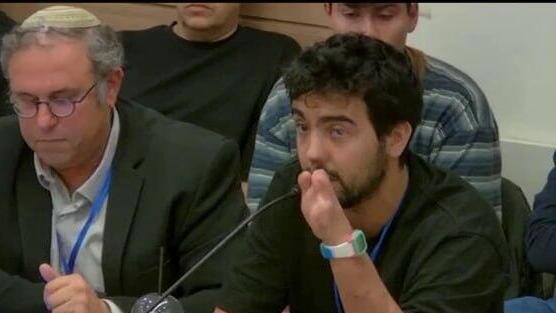
Alon Kaminer speaks to Knesset lawmakers
(Photo: the Knesset channel)
He added: “Seeing the Haredi community as a single block of Torah‑studying students is simply wrong, and we know that. I have enormous respect for yeshiva students, and I ask not to tarnish their name with those who do not study Torah. It makes no sense to allow the system to supervise itself and decide who studies Torah. Whoever does not study Torah, let them go to the army.”
Kaminer criticized the lack of oversight mechanisms under the draft‑exemption proposal by committee chair Boaz Bismuth. “There are no fingerprints and no external supervision of who studies. How can we say who is a yeshiva student and who is not?” he asked. “Whoever doesn’t study in a yeshiva, let them go to the army and contribute to building the country. We are not in ancient times. We need to conscript because the army demands it.”
Also participating in the debate was bereaved father and head of the Lindenbaum yeshiva, Rabbi Ohad Teharlev. He said: “My son, who can no longer speak for himself, studied Torah for two years before his army service, intending to return to the yeshiva afterwards. They tell me ‘we are afraid for how our children will come back', well, my boy did not return.”
They tell me ‘we are afraid for how our children will come back', well, my boy did not return
“One can study Torah and also serve in the army," Teharlev continued. "I cannot understand how these things can be contradictory. Studying and not serving is a mitzvah that comes with a transgression. Your children will return greater, with fear of heaven. As someone involved in creating service tracks for religious women in the army, I can say the experience with the army is excellent. The women remain religious, continue studying Torah and sanctify God’s name there. It cannot be that some are buried on Mount Herzl and some are not.”
“There is a deep moral failure at play,” he said. “I came to cry out for the cry of my son and those buried in cemeteries who cannot voice their pain. History will not forgive us. The days have passed when we could delay further.”
'After the injury I underwent rehabilitation — and returned to reserve duty'
Also during the hearing, exchanges took place between Rabbi Yonatan Reiss and and Yesh Atid party lawmaker Merav Cohen. Reiss argued that different desires for equality exist. “When the Supreme Court ruled on separate buses for men and women, the liberal public rightly yelled that it discriminates against women. That decision causes my daughter to wake up an hour earlier because she cannot sit near men on the bus,” he said.
Cohen, who chairs the Committee for the Advancement of the Status of Women, replied: “But this is the State of Israel — a liberal place, with laws, a place for everyone.”
Hanania Ben‑Shimon, a terror‑attack survivor and member of the reservists’ organization “Shoulder to Shoulder,” recounted: “After my injury I went through rehab and returned to reserve duty. This law doesn’t concern Torah‑studying students of religious Zionism. My brother was almost killed by an anti‑tank missile attack — a month later he returned to the Hesder yeshiva in Ashdod.”
He argued that “this law lowers the Torah of religious Zionism. It discriminates between one Torah study and another. In Shas’ weekly bulletin this week they referred to which Torah students are ‘using Torah’? They spoke about religious women who ‘use’ Torah. Who are you to use Torah as a tool to dig with?”