

U.S. President Donald Trump said Tuesday that no talks are taking place with Iran and none are scheduled, directly contradicting Tehran’s insistence that the Strait of Hormuz will remain closed until Washington meets the terms of an interim agreement reached in June.
“There are no talks or conversations going on, or scheduled, with the Islamic Republic of Iran. The Naval Blockade remains in full force and effect. The Hormuz Strait is open and operating. All water mines have been removed or detonated,” Trump wrote on Truth Social.
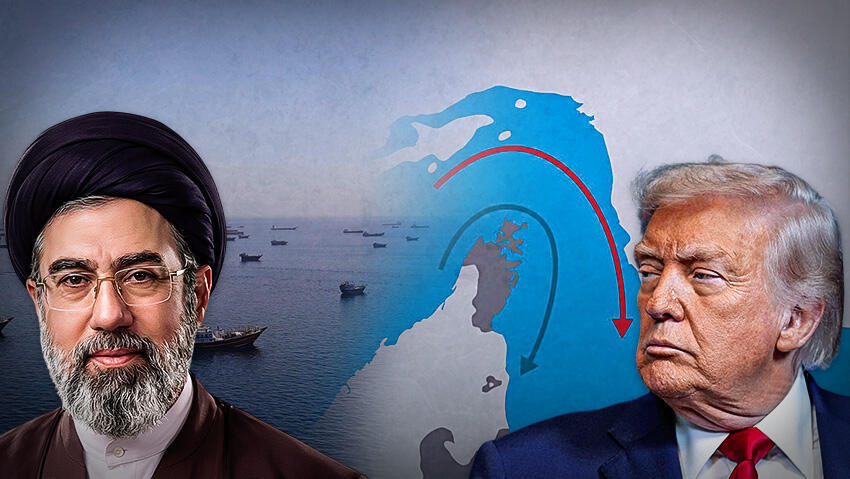
His statement presented a sharply different picture from that offered by senior Iranian officials, who said the strategic waterway would remain shut until the United States complied with conditions Tehran says were included in the June agreement. Iran’s top negotiator, Mohammad Baqer Qalibaf, said Tuesday that those conditions include lifting the U.S. blockade on Iranian ports, removing oil sanctions, releasing Tehran’s frozen assets and ending threats and military operations on all fronts.
The clash over whether Hormuz is open and whether negotiations are even underway comes as tensions remain high across the region and Russia is reportedly expanding a military lifeline to Iran through the Caspian Sea. Russia continues to send Tehran ammunition, explosives including TNT and drone components through a protected and relatively isolated shipping route across the Caspian, NBC News reported overnight Monday into Tuesday.
The report was based on a document from an unidentified European government that NBC said was verified by a Western official who spoke to the network. According to NBC, the continued shipments point to a deepening strategic alliance between Tehran and Moscow as both countries remain embroiled in separate conflicts and face a common adversary in the United States.
Russian shipments to Iran through the Caspian Sea have been reported before. In May, The New York Times revealed that Moscow was using the route to deliver components that could help Tehran rebuild its drone stockpile, about 60% of which U.S. officials said had been destroyed in the most recent war with the United States and Israel. Russia was also reportedly using the route to move other goods that would normally arrive through the Strait of Hormuz but could no longer do so because of the U.S. blockade on Iranian ports.
NBC’s latest report, however, suggests the scope of Russian assistance is broader. In addition to drone parts, Moscow is reportedly supplying ammunition and explosives, including TNT, material that could be particularly important as Iran works to restore military capabilities ahead of another possible confrontation with the United States or Israel.
Trump’s statement also undercut Iranian warnings issued only a day earlier that Washington had “weeks” to accept Tehran’s terms and “renew” the June memorandum of understanding. A senior Iranian official said Iran would not allow the U.S. blockade to continue indefinitely and intended to shift to a “fully offensive” policy if its demands were not met.
Tensions around the Strait of Hormuz remained high Tuesday after another vessel was reportedly attacked while attempting to cross the strategic waterway. The United Kingdom Maritime Trade Operations agency, or UKMTO, said “unidentified ammunition” struck an unnamed vessel as it attempted to leave the Persian Gulf. The ship’s engine room was damaged and at least one person was reported injured. “The rest of the crew is receiving assistance from the Omani Coast Guard,” UKMTO said.
Against the backdrop of the attack, Qalibaf said the Strait of Hormuz would remain closed until Washington fulfilled Tehran’s interpretation of the June agreement. His comments contrasted directly with Trump’s declaration that the waterway was “open and operating” and that all mines had been removed or detonated.
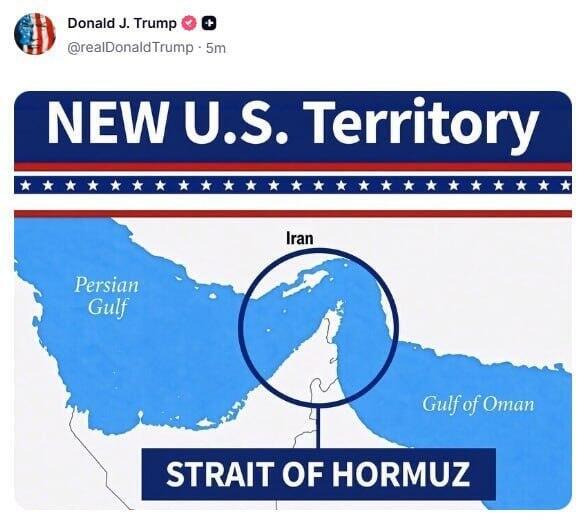
The dispute follows another provocative intervention by Trump over the strait. Hours earlier, he published a map on Truth Social labeling the Strait of Hormuz “new American territory,” after previously threatening to declare it annexed “after we finish defeating Iran.” Iranian officials mocked those claims. Deputy Foreign Minister Kazem Gharibabadi said Trump’s “illusion” over Hormuz would soon be corrected, while senior IRGC official Mostafa Izadi said the strait remained under Iranian control and accused Washington of being “helpless.”
NBC said it remains unclear how far Iran has progressed in rebuilding its weapons arsenal. Tehran, however, has repeatedly said its rearmament efforts are continuing, including what it says is the production of new missiles. Iran’s Defense Ministry said Tuesday: “We will continue on the path laid out by Ali Khamenei to build the country’s defensive power with strength and make it more advanced and powerful in accordance with new needs and threats.”
The Caspian Sea route has for years served as a strategic transportation artery between Russia and Iran. The Caspian, the world’s largest inland body of water, has no U.S. presence, and only the five states bordering it, Russia, Iran, Kazakhstan, Turkmenistan and Azerbaijan, are able to police its waters. Ships traveling between Russia and Iran on the Caspian often switch off their tracking transponders, making them more difficult to monitor.
“If you think about the ideal place to evade sanctions and transport military equipment, it is the Caspian Sea,” Prof. Nicole Grajewski, an expert on Iran and Russia, was quoted as saying by The New York Times in May.
Some experts have dubbed the route the “Caspian Express.” It initially operated largely in the opposite direction, with Iran supplying Russia with drones and other ammunition after Moscow’s full-scale invasion of Ukraine in 2022. Russia, which later began producing Iranian-designed Shahed drones domestically, is now reportedly sending military equipment and weapons back to its embattled ally.
Traffic in the opposite direction also appears to be continuing. Last month, Ukraine attacked vessels in the Caspian Sea, including an Iranian ship where one sailor was killed. The strike triggered serious tensions between Kyiv and Tehran, which threatened retaliation, though diplomatic efforts ultimately prevented an Iranian response.
IDF strike in the Caspian Sea in March
(Video: IDF)


Israel has also attempted to disrupt the route. In March, Israel struck the Iranian Navy headquarters at Bandar Anzali on the Caspian coast, an attack the IDF described at the time as “one of the most significant” of the war. Despite those efforts, traffic along the route continues without interruption, according to the reports, potentially giving Tehran a way to withstand the U.S. blockade and rebuild capabilities depleted during the fighting.
In an opinion column published last week in Britain’s The Telegraph, Glenn Howard, president of the U.S.-based Saratoga Foundation, urged Washington to use its influence over Azerbaijan to try to disrupt the Caspian route. “As the regional dimension of the conflict between Iran and the United States expands, the Trump administration must decide whether to challenge the ‘Caspian Express’ before it becomes entrenched as the permanent logistical backbone of the Russia-Iran alliance,” Howard wrote.
He argued that the U.S.-brokered peace agreement between Armenia and Azerbaijan had created the “diplomatic foundations” for such an effort. “The White House must now build on that success by developing a regional strategy that leverages Azerbaijan’s emergence as a rising regional power in the South Caucasus, while allowing Ukraine to continue applying military pressure on the route without risking direct U.S. involvement,” he wrote.
First published: 15:28, 08.18.26