

Yemen’s Houthi regime is forcing journalists and media workers in areas under its control to attend mandatory training courses that are presented as professional development, but function in practice as ideological re-education.
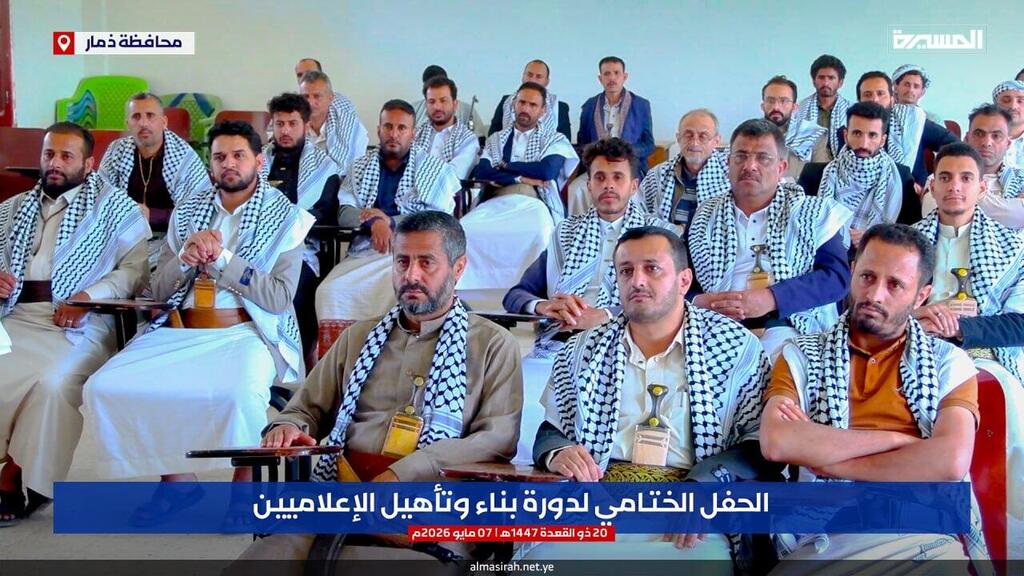
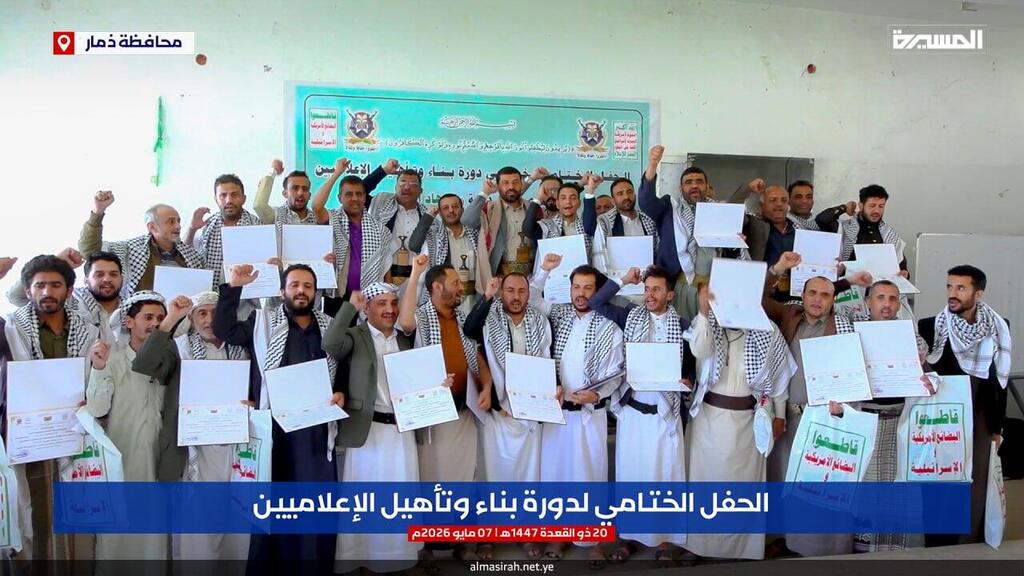
On May 7, the Houthi-affiliated Al-Masirah channel reported the completion of a “training course” for journalists in Dhamar province. The channel published images of media workers who completed the program holding certificates and bags carrying the slogan: “Boycott American and Israeli goods.”
Houthis force Yemeni journalists into ideological training courses against Israel, US
(Video: Lior Sharon)


According to Al-Masirah, the course was organized by the Houthis’ recruitment department in coordination with the local authority. Over 10 days, it was meant to equip 28 media workers and activists with “knowledge and skills regarding the foundations and principles of media work according to the Quran,” according to Houthi propaganda.
In reality, the program appears to be part of the Houthis’ effort to subject journalists in areas they control to ideological indoctrination rooted in the group’s worldview.
Al-Masirah reported that senior Houthi official Mohammed al-Bukhaiti, who frequently gives interviews, speaks out against Israel and the United States and spreads Houthi messaging on social media, also attended the closing ceremony in his role as governor of Dhamar province.
He praised the importance of the course, saying such training programs “improve the performance of media teams and activists” and strengthen their “role in confronting the media campaigns of the enemies of the nation.” At the end of the ceremony, participants received certificates of appreciation and additional gifts.
Yemeni journalists operating from Houthi-controlled areas have little room to resist the group, even if they do not support it. Any journalist who fails to follow the directives of Iran’s proxies in Yemen risks arrest. As a result, journalists are forced to publish only content that does not constitute an “offense” in Houthi eyes, show public support for the speeches of Houthi leader Abdul-Malik Badr al-Din al-Houthi and participate in Houthi-run courses.
A source in Yemen familiar with the training programs told Ynet that the Dhamar course is only part of a series of workshops for media workers being run by the Houthis in several provinces. According to the source, the Houthis aim to equip media professionals with concepts and communication strategies relevant to “the war against Israel and the United States and support for Palestine.”
The source said journalists and media workers in the courses are trained to unify media efforts and coordinate messaging against Israel and the United States, “expose the plans of Israel and its agents in Yemen” and, in some cases, even receive weapons training.
Another Yemeni source, a security official familiar with Houthi recruitment activity in the media field, told Ynet that the Houthis are spending heavily on this system.
According to the official, the Houthis are investing in what he described as “media propaganda aimed at brainwashing the younger generation, the people and society.” He said the goal is also to “spread false rumors and misleading slogans,” while those who oppose the group are immediately arrested.
The source said Mohammed Abdulsalam, the Houthis’ spokesman, plays a major role in organizing the group’s media activity, alongside several other officials. All are coordinated with the media and press department in the Houthis’ security and intelligence apparatus, he said.
The same source added that every military zone, village and neighborhood has a media officer trained and authorized by the Houthis. The group is also deeply invested in media activity outside Yemen, including in Lebanon and Europe.
The emphasis on media is not incidental. On Saturday, Houthi leader Abdul-Malik Badr al-Din al-Houthi addressed the group’s struggle against Israel and the United States in the media sphere.
“The Jews focus greatly on the field of media and have many media outlets,” he said. “There are media outlets in the name of Arab governments or entities, but in reality, they operate as media tools serving the Jews. A large part of the soft war is conducted through the media, to influence ideas, public opinion, loyalties and hostility.”
Alongside the media courses, the Houthis have continued military training and threats against Israel and the United States in recent weeks, even as they were not the main focus of regional attention. From the Houthi perspective, the group is still preparing for the “next round” against Israel, which its leader has repeatedly said will certainly come.
Last week, Abdul-Malik al-Houthi said: “On the military level, we are ready for all developments. We remain firm in our clear and principled positions, which we have affirmed again and again.”
In a series of recent speeches, he also claimed there were “indications of American preparations for escalation, after its failure in the previous round.”
“It is very unfortunate that the American preparations are based on exploiting certain Arab countries in any future escalation,” he said. “Similarly, some regimes and governments have not learned the lessons of the previous round regarding the results and consequences of hosting American bases that attack Iran.”
The Houthis have repeatedly criticized any Arab country they perceive as cooperating with the United States or Israel. At the same time, their growing investment in forced media training shows that the group views journalists not as independent professionals, but as instruments in a broader ideological and military campaign.