


The IDF used more than 1,100 tons of explosives Thursday evening to destroy the tunnels beneath the Ali Taher Ridge in southern Lebanon. The ridge rises to about 600 meters and separates the Litani River to the south and east from the Nabatieh Plateau and the city of Nabatieh to the west. The Hezbollah complex there consisted of eight fortified underground routes built with Iranian assistance and was considered one of the organization’s nerve centers in southern Lebanon.
Because of its depth and fortifications, the complex was extremely difficult to damage through airstrikes alone. A security official said the underground infrastructure stretched for about 5.4 kilometers and was Hezbollah’s deepest and most strategic infrastructure in southern Lebanon.
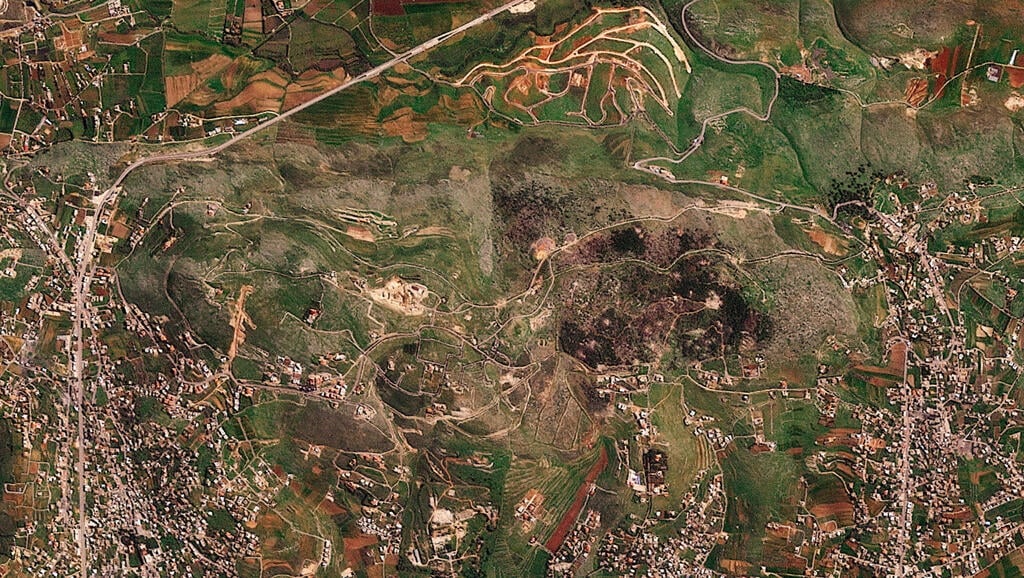
Satellite image of the Ali Taher Ridge in southern Lebanon, March 2026, showing damage from IDF strikes
(Photo: Planet Labs PBC/Handout via REUTERS)
Hezbollah chose to position the headquarters of its Badr regional unit and its heavy firepower on the ridge because it provided observation and fire control over the routes and terrain giving access to the strategic Nabatieh Plateau. It was also close enough to the Israeli border to direct fire attacks against the Galilee home front and conduct a defensive battle against the IDF if Israeli forces advanced north.
According to the IDF, troops found command rooms, weapons storage rooms, generator rooms, living quarters, showers and a kitchen underground, which “allowed the terrorists to manage the fighting and remain there for extended periods. This was strategic infrastructure built over two decades.” The extensive infrastructure was built by Hezbollah’s Badr Unit and was used by its operatives to manage fire systems, fight IDF forces and carry out terrorist attacks against Israeli civilians over recent decades.
Recognizing the ridge’s strategic importance, the IDF sent units from the 36th Division in August to take control of the outskirts of Nabatieh and the Ali Taher Ridge while clearing the Beaufort Ridge to the south. The rapid operation, based on detailed, high-quality intelligence about the underground command complex, caught Hezbollah unprepared. Its operatives were surprised when troops from Egoz and the Yahalom unit appeared at the entrances to several shafts and surrounded them.
Since then, Hezbollah fighters and members of Iran’s Revolutionary Guards made repeated attempts to break out of the complex or, alternatively, move supplies and reinforcements into it from villages on the Nabatieh Plateau. Operational control of the ridge, which made Thursday evening’s tunnel demolition possible, was achieved through operations that included ambushes, firing on tunnel shafts, grenades, drones, fire strikes and other actions.
The exact number of those trapped underground on the Ali Taher Ridge is unknown because some managed to escape before the IDF imposed its encirclement of the area. Media estimates, including from outlets described as close to Hezbollah such as Al Arabiya, put the number at between 20 and 40 Hezbollah operatives.
“All the terrorists who were in the infrastructure were killed or fled,” IDF spokesperson Brig. Gen. Effie Defrin said Thursday evening. “Although Hezbollah declared that it would defend the infrastructure at any cost, it failed and even abandoned its men to die inside.”