

A book officially published by the Turkish presidency presents Israel as committing “genocide” and “war crimes,” portrays Zionism as the root of the Israeli-Palestinian conflict and gives extensive space to Hamas leaders under the heading “The struggle against Israeli oppression.”
A new report by the Jerusalem Center for Applied Policy, or JCAP, warns that the publication is not merely a propaganda document but part of a broader strategy by President Recep Tayyip Erdogan’s government to establish long-term Turkish influence in Gaza, Jerusalem and a future Palestinian security system.
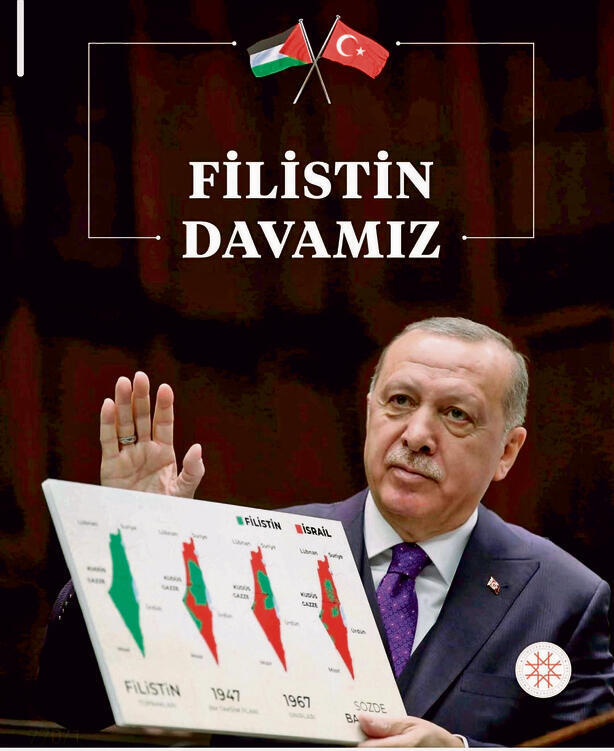
“This book tells the history of the Israeli-Palestinian conflict and explains Turkey’s role in it according to how Turkey sees it,” said Turku Avci, a 27-year-old Turkish student living in Israel who has advocated for Israel since the Oct. 7 massacre.
“The entire book is a lie. If Hamas wrote history, this is what it would look like. They did not mention anything Hamas did on Oct. 7. The only sentence that appears there is: ‘Hamas began resistance, and then Israel attacked Gaza.’”
Avci, who said Turkish authorities have issued an arrest warrant against her because of her pro-Israel activism, cannot return to Turkey to visit her family. She read the hundreds of pages of the Turkish-language book, titled Our Palestinian Issue, which is available on the Turkish presidency’s website.
The 769-page publication was produced by the Turkish presidency’s Directorate of Communications. It reflects the worldview of Erdogan’s government regarding Israel, Gaza and the future of the Palestinian issue. According to JCAP’s report, the document should be viewed as a strategic blueprint through which Ankara seeks to build lasting political and institutional influence.
The book does not outline a military campaign against Israel. Instead, it describes an international strategy based primarily on diplomacy, international law, public opinion and advocacy. The core of Erdogan’s plan appears in the book’s final chapter, which focuses on Turkey’s activities.
It calls for mobilizing world leaders to press for a ceasefire, expanding humanitarian aid to Gaza, promoting legal proceedings against Israel in international courts and continuing a global public diplomacy campaign aimed at persuading additional countries to adopt Turkey’s position.
One of the central findings highlighted in the JCAP report is Erdogan’s proposed “guarantor mechanism.” Under the proposal, several countries, including Turkey, would serve as guarantors of a future agreement between Israel and the Palestinians.
The report’s authors warn that such an arrangement could give Turkey deep involvement in Gaza’s future and potentially serve as the basis for a future Turkish security presence.
A significant portion of the book is dedicated to Erdogan himself, who is portrayed as the world’s leading advocate for the Palestinians through diplomatic initiatives, humanitarian assistance, legal campaigns and international advocacy. According to the report, those efforts serve two connected goals: strengthening Turkey’s regional standing and increasing international pressure on Israel.
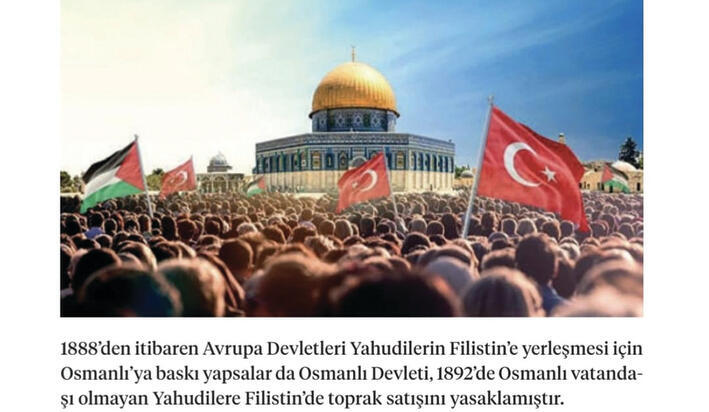
From the book: Temple Mount surrounded by Turkish and Palestinian flags
(Photo: Turkish Presidency website)
JCAP’s authors argue that the difference between Erdogan’s Turkey and Iran lies not in their objective, but primarily in the methods they employ. While Iran supports Hamas through financing, weapons and military guidance, they wrote, Turkey provides the terror group with political, legal and ideological legitimacy. In both cases, according to the report, Hamas is not treated as a terrorist organization that should be dismantled but as a legitimate actor in the future Middle East.
Ran Yishai, a former Israeli ambassador to Kazakhstan and former director general of the Jerusalem and Heritage Ministry who now heads JCAP’s research division, called on Israel to respond by shutting down the Turkish Consulate in Jerusalem. “Israel should respond to Erdogan’s plan by ending the Turkish Consulate’s activities in Jerusalem as a first step,” Yishai said.
“The consulate is the locomotive driving hostile Turkish policy against Israel in the region, while denying Israeli sovereignty and attempting to restore Turkey to a sultan-like status in Jerusalem.”
Until the consulate is closed, Yishai said Israel should immediately revoke benefits granted to diplomats who, in his view, are loyal not to Israel but to the Palestinian Authority. He called for their work visas to be canceled, their freedom of movement within Israel restricted, diplomatic immunity for their vehicles removed, reserved parking spaces revoked and their tax exemptions terminated.
JCAP Chairman Haim Silberstein also warned that Turkey was seeking to strengthen the presence of the Palestinian Authority, and particularly Hamas, in Jerusalem through Islamic organizations and associations operating under the consulate’s protection.
“Turkey is promoting the penetration of the Palestinian Authority, and especially Hamas, into Jerusalem through radical Islamic organizations and associations operating in the city under the auspices of the consulate,” Silberstein said.
“The fact that the consulate presents itself and functions in practice as an embassy to the Palestinian Authority is another reason to end its activities in Jerusalem.”