

U.S. Vice President JD Vance said the United States and Iran agreed to establish a direct security channel between U.S. Central Command and Iran’s Revolutionary Guard Corps, part of an effort to reduce the risk of renewed escalation after the recent war between the two countries.
In an interview with the British website UnHerd following marathon talks with Iranian officials in Switzerland, Vance said one of Washington’s goals was to create a channel on the Iranian side that could help reduce friction and prevent disputes from turning into open conflict.
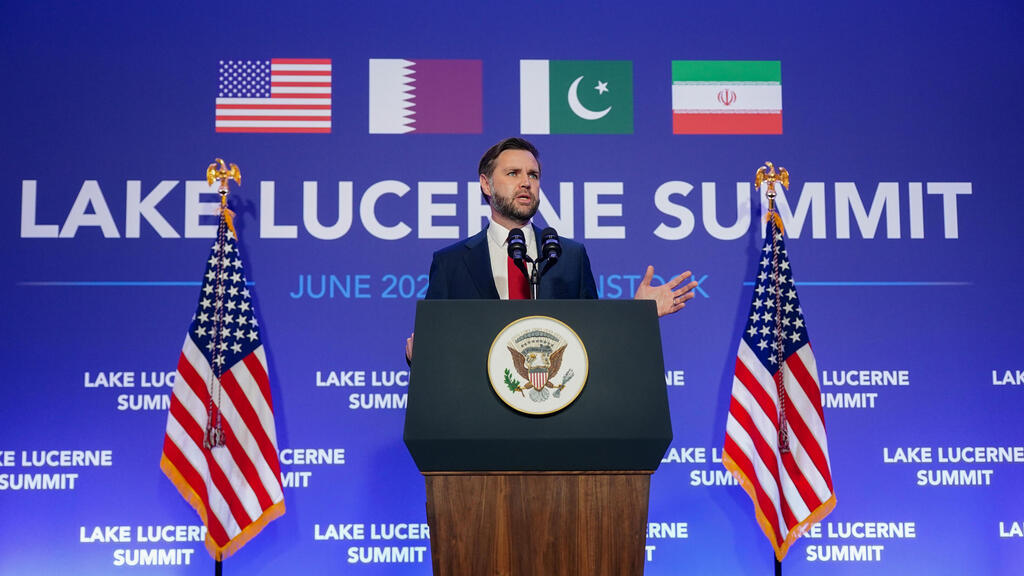
JD Vance at the end of the Switzerland summit


“One of the things we wanted to come out with,” Vance said, was a “channel on the Iranian side” for reducing conflict. “Which we did. They were like, ‘OK, fine, we’ll send somebody from the IRGC to go hang out in Doha with somebody from CENTCOM,’ and that’s how we’re going to settle a lot of these disputes.”
The reported arrangement would bring Iranian military officials and American officers together in Doha, Qatar, in what Vance described as a mechanism to settle disputes and lower tensions.
The vice president, who is seen as a leading voice of the restraint camp inside the Trump administration, has taken a central role in the diplomatic push that followed the opening phase of the war with Iran. The talks in Switzerland were mediated by Pakistan and Qatar and included senior Iranian officials, among them Parliament Speaker Mohammad Bagher Ghalibaf and Foreign Minister Abbas Araghchi.
According to UnHerd, the main breakthrough at the Lake Lucerne summit was an agreement in principle to create a new security channel between the U.S. and Iranian militaries. Vance said the channel could become a foundation for broader de-escalation, though he acknowledged that any progress still depends on whether Tehran’s words are followed by action.
Whether Iran’s “rhetorical flexibility is going to be met with action, that’s the big question hanging over all of this,” he said.
Vance said the current memorandum of understanding being discussed with Iran is not comparable to the Obama-era nuclear agreement, the Joint Comprehensive Plan of Action. He argued that the new document is more limited and preliminary, focused first on stopping the fighting, reopening the Strait of Hormuz and testing whether a broader nuclear and sanctions agreement is possible.
“There are many things I don’t like about the comparison to the JCPOA,” Vance said, “but one of them is that the MOU is a much more generic document than the JCPOA.”
“It really is a foundational document: let’s open the Strait, let’s stop shooting at each other, and let’s see if we can make a nuclear deal. And from their perspective, it’s, ‘Let’s lift the blockade, let’s stop shooting at each other, and let’s see if there’s a sanctions deal.’ That’s fundamentally where it’s coming from.”
Vance said the Iranians were now offering “things radically different from the JCPOA,” including a tougher inspection regime and the “elimination” of Iran’s existing enriched uranium stockpile.
“The flip side,” he said, “is that they really want a fundamentally transformed relationship with the United States and the world — [and] I don’t know where we’re going to be able to land in the middle.”
The vice president also said Gulf states were holding new discussions with Tehran, including with elements of the Revolutionary Guards. He singled out the United Arab Emirates, calling it “by far the most hawkish, by far the most pro-Israel country in the [Gulf Cooperation Council],” and said it had opened conversations with the Iranians that had not taken place before.
“They’re having conversations with the Iranians that have never happened before, including with the IRGC, about various types of economic incentives — ‘Here’s what we’d need to see to make your country investable’ — and the Iranians come back and say, ‘Okay, yeah, we’re willing to do all those things,’” Vance said.
At the same time, Gulf states signaled they oppose Iran’s demand to tie the emerging arrangement to the Lebanese front.
U.S. Secretary of State Marco Rubio, who is visiting Gulf states in a regional diplomatic tour that does not include Israel, met in Bahrain with the foreign ministers of the Gulf Cooperation Council. In a joint statement after the meeting, the U.S. and Gulf states reaffirmed “the strengthening of the strategic partnership and increased coordination on regional and international issues of mutual interest.”
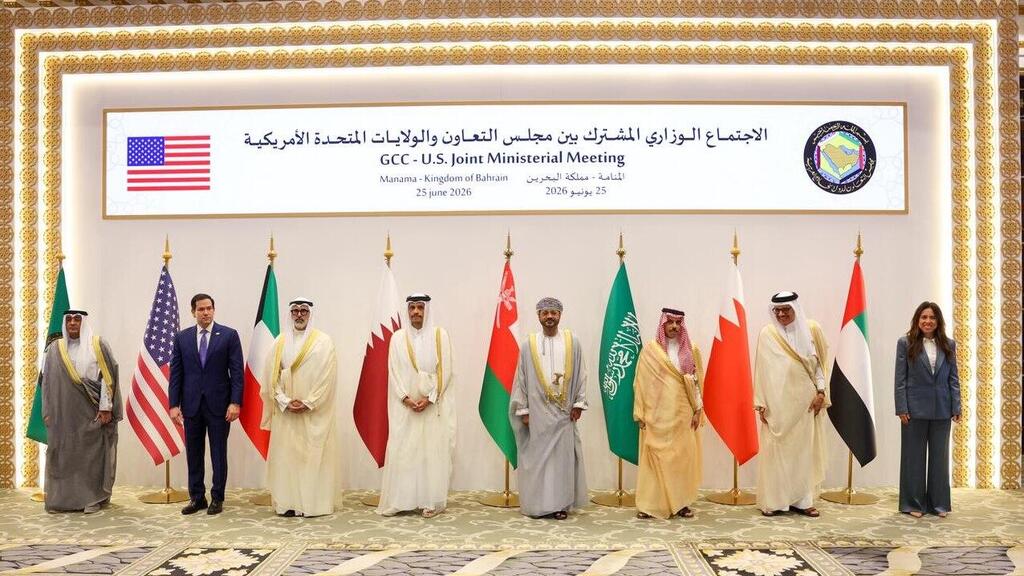
US Secretary of State Marco Rubio and foreign ministers from Gulf states
The statement also addressed Lebanon, where Iran has repeatedly said an Israeli withdrawal is a red line and has warned that continued Israeli action could threaten the agreement. The Gulf states took a different position, calling for the full disarmament of Hezbollah and rejecting any attempt to make negotiations with Iran dependent on other conflicts.
The U.S. and Gulf states said “the negotiations are not conditioned on the outcomes of other conflicts” and called for the “complete disarmament of all non-state groups in Lebanon.”
On Gaza, the joint statement said: “We reaffirm that no one will be forced to leave Gaza and those who wish to leave will be free to return.”
Vance, meanwhile, said the Swiss talks also dealt with Lebanon and regional de-escalation. Asked at a news conference about progress on the Lebanese front, he described it as “very good” and pointed to the deconfliction mechanism discussed at the summit.
“Israel, and every other nation in the region, has the right of self-defense,” he said. “But we want to make sure everyone has that right of self-defense in [a] background where we’re talking about how to de-escalate.”
Speaking later aboard Air Force Two, Vance said the situation had improved compared with several weeks earlier, though he stressed that the process remains fragile.
“I think we’re now [at] 48 hours where the ceasefire in Lebanon has effectively held,” he said. “And even five days ago, the Qataris, the Pakistanis were calling me, like, ‘Here’s this, here’s this, here’s this.’ And I look at the side-by-side of where we were four or five days ago compared to three weeks ago, and it’s like — yeah, it’s annoying, we’re going to keep working on it, but it’s a lot better than it was a few weeks ago. It’s just a continuous process.”
Vance said the Iranians were now speaking in a different tone than in previous encounters, but warned that the test would be whether Tehran follows through.
“They’re certainly talking differently than they have in the past,” he said. “There’s a whole host of reasons why that’s true. But whether the action will follow, whether the final deal actually meets some of what they’re promising in general terms — that’s what we have to figure out.”