

Since the ceasefire in Gaza took effect, the gap between wishful thinking and reality has continued to widen. Many in Israel hoped Hamas was pushed into an agreement from a position of weakness. Instead, the group is once again acting as the dominant power in Gaza, while Israel continues to declare it can return to fighting but faces a firm “no” from President Donald Trump, who has become the final arbiter on Gaza and views the ceasefire as a personal achievement.
Multiple signs point to the U.S. president’s intention to accelerate the process, as usual without fully accounting for the gaps between the sides. Last week, U.S. Central Command convened a conference in Doha on the multinational force intended to deploy in Gaza. Trump envoy Steve Witkoff also held meetings with Qatar, Turkey and Egypt, a sweeping reconstruction plan for Gaza was announced, and a donors conference is being planned.
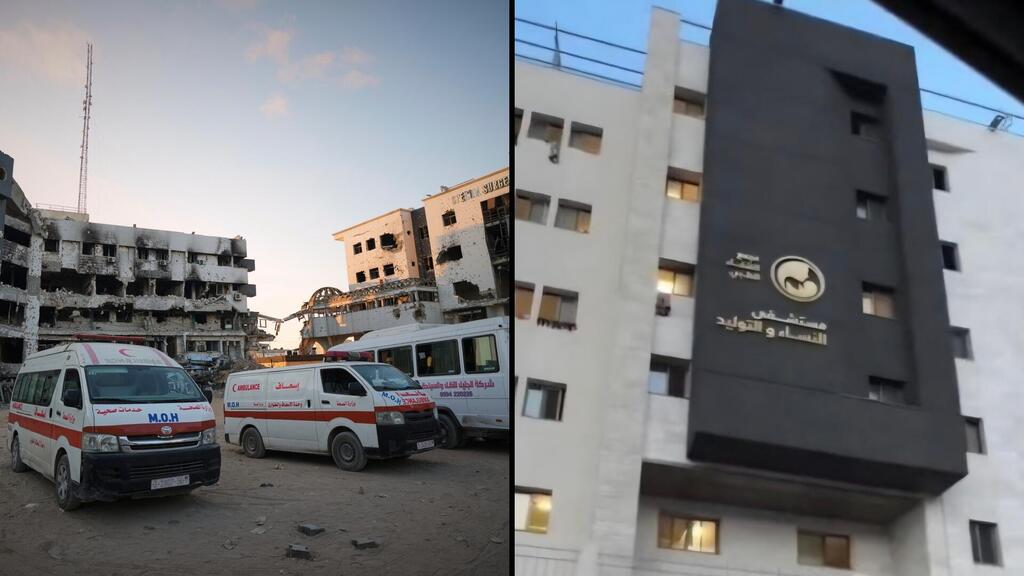
The process appears to be moving forward without waiting for Israel’s position, often described as rigid. While Israel increasingly views Gaza, now split by the so-called Yellow Line, as a new border akin to a “Berlin Wall,” it may soon be asked to deepen its territorial withdrawal.
Three major obstacles stand in the way of the second phase of the agreement, and in all three cases interim solutions are emerging that should deeply concern Israel. The first is the disarmament of Hamas. The organization rejects this outright, and mediators acknowledge there is no chance of full disarmament. Instead, they are trying to market to Trump a compromise involving the surrender of heavy weapons, mainly rockets.
“Disarmament is like stripping the soul,” Khaled Mashaal has said. Islamic Jihad deputy leader Mohammed al-Hindi echoed that stance, saying the group was willing to discuss a weapons freeze but not handing arms over.
The second issue is the deployment of a multinational force, which now appears likely to be far more limited than originally envisioned, amid uncertainty over Turkey’s involvement. Prime Minister Benjamin Netanyahu has defined Turkish participation as a “red line,” a matter expected to be raised in his meeting with Trump next week.
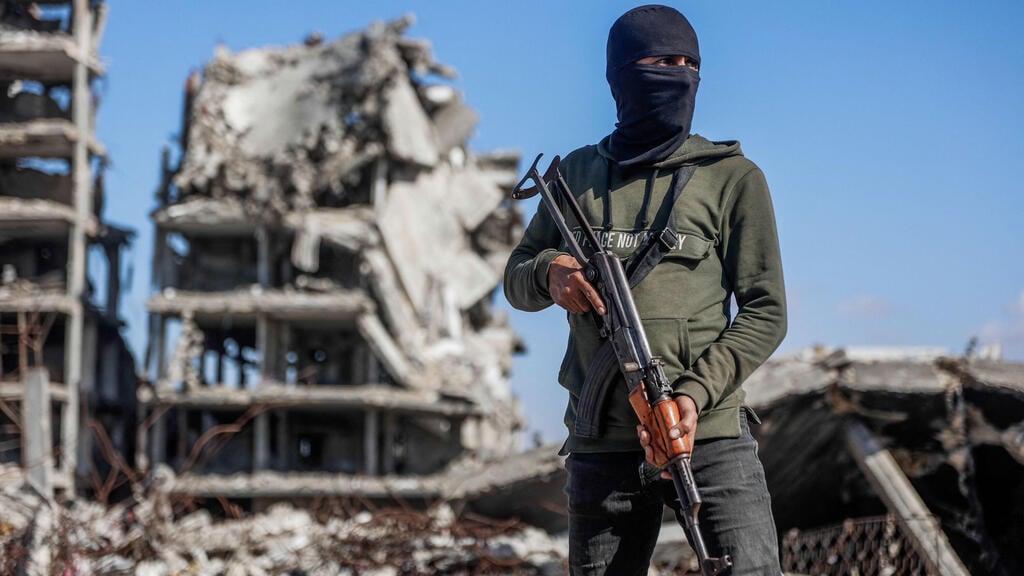
Hamas terrorist
(Photo: Omar aL-Qattaa/ AFP)
“The multinational force is the hardest obstacle to reaching phase two,” said Bashara Bahbah, a Palestinian American businessman involved in contacts with Hamas. “Beyond Israel’s objection to Turkish participation, there is hesitation among other countries that are supposed to take part.”
The third obstacle, comparatively simpler, is the formation of a technocratic government without Hamas involvement. Hamas embraced this idea long ago, assuming it would serve as a cosmetic cover allowing it to operate much as Hezbollah does in Lebanon.
Against this backdrop, Hamas is seeking to score public relations points by portraying itself as flexible and eager to move to phase two, while casting Israel as the spoiler. “Israel understands that in the next phase it will be required to withdraw more broadly, open the crossings and allow Gaza’s reconstruction, and therefore it is dragging its feet,” Hamas political bureau member Bassem Naim said this week. “We are adhering to the agreement, while Israel is violating it.”
Meanwhile, Hamas is demonstrating that it remains firmly in control of Gaza. Roads are reopening, debris removal is advancing rapidly, Hamas police officers are directing traffic in uniform without fear, and courts have resumed operations.
Hamas’ Interior Ministry issues daily updates that underscore the message that it is here to stay: “Police seized 2.5 tons of expired goods in Khan Younis,” “In eastern Gaza City, a police representative resolved a financial dispute between two major vegetable traders,” and “Eight merchants were arrested in Rafah on charges of price gouging.”
“The restoration of Hamas’ governing status is being carried out through local municipalities and cooperation with charitable organizations from Islamic countries that funnel money, humanitarian aid and heavy engineering equipment into Gaza,” said Dr. Ido Zelkowitz, an expert on Palestinian affairs. He cited as a prominent example a mass wedding for 200 couples held last week in cooperation with Turkey’s Ribاط charity, an event that conveyed both care for the population and visible governmental presence backed by major Islamic states.
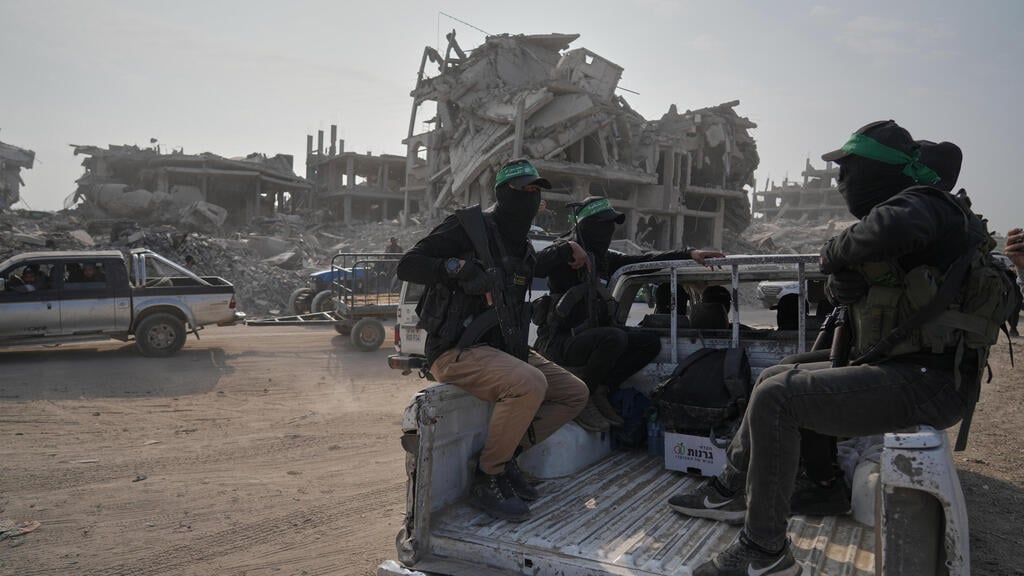
Hamas terrorists in Gaza
(Photo: Jehand Alshrafi/ AP)
Hamas is investing heavily in shaping public consciousness in Gaza, where the overwhelming majority of the population remains inside the territory. Its primary tools are the religious establishment and the education system. Friday sermons are held inside or beside destroyed mosques, large-scale Quran memorization conferences take place under Hamas sponsorship, and schools and academic institutions reopen weekly, even amid ruins, including the Islamic University, a longtime Hamas stronghold.
The rehabilitation effort is also evident within Hamas itself, with the current focus on rebuilding its military wing. That mission had been overseen by Raad Saad, who was killed two weeks ago. Saad worked on reorganizing units, appointing new commanders to replace those killed, restoring infrastructure, particularly tunnels and weapons production facilities, and repairing or locating arms. Operatives are sent to cross the Yellow Line for this purpose, sometimes at the cost of their lives.
Hamas is aware of Trump’s dissatisfaction with Saad’s killing, which he hinted may have violated the ceasefire, and has since tightened security procedures regarding movement and communications.
“Hamas is in the midst of a generational transition,” an Israeli military official said. “After Saad’s elimination, only a handful of senior veteran commanders who planned and carried out the October 7 attack remain. The organization is increasingly relying on younger commanders with limited experience, authority and operational capability.”
As throughout the war, the official added, Hamas continues to recruit new operatives, many of them inexperienced and often minors, typically assigned to relatively simple policing and enforcement roles.
Hamas’ leader in Gaza remains Izz al-Din Haddad, who was far from a natural successor before the war, and he maintains regular contact with the Gaza leadership in Qatar headed by Khalil al-Hayya regarding the group’s strategy. Mohammed Odeh, head of Hamas’ military intelligence, is expected to step into Saad’s role.
“Odeh faces a complex task under difficult circumstances,” Zelkowitz said. “He will have to quickly emerge from the intelligence shadows in which he developed and manage military domains that are less familiar to him, such as force buildup.”
At the end of the war, Israel once again finds itself at the same strategic crossroads it has faced over the past two years, but under worse conditions. Reoccupying the entire Gaza Strip remains an option, but risks a strategic clash with Trump that could prove disastrous. The lesser evil is a weak alternative local administration without Hamas participation.
Under that scenario, Israel would need to set several conditions: the return of fallen hostage Ran Gvili, preservation of operational freedom similar to the situation in Lebanon, strict enforcement along the Philadelphi Corridor and Rafah Crossing, and veto power over the identity of foreign forces entering Gaza and members of the technocratic government.
A calculated approach could allow Israel to focus its efforts and secure critical international legitimacy as it confronts two more dangerous fronts: Lebanon and Iran.
Dr. Michael Milshtein is head of the Palestinian Studies Forum at the Moshe Dayan Center, Tel Aviv University