

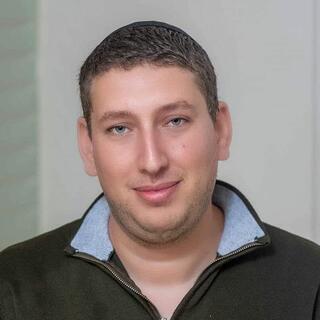
Breslov Hasid Jonathan Karlinsky, a dual Israeli-Ukrainian citizen drafted into the Ukrainian military after traveling to the country for the annual Rosh Hashanah pilgrimage to Uman, received a set of the Four Species on Thursday so he can observe Sukkot while held at a military detention facility in the Odesa region.
Video obtained by ynet showed Karlinsky receiving the ritual items used during the weeklong holiday, which will begin Friday evening. The set included an etrog, or citron, brought from Kfar Chabad in central Israel.
Jonathan Karlinsky receives the Four Species for Sukkot while held at a Ukrainian military detention facility in the Odesa region


Karlinsky, 49, a resident of Beitar Illit, was born in Ukraine and later immigrated to Israel. He was detained by Ukrainian military police during a document check at the Ukraine-Romania border after traveling to Uman for Rosh Hashanah. Authorities determined that he remained subject to Ukraine's wartime military service requirements.
Karlinsky had traveled to Uman as part of the annual pilgrimage by followers of Rabbi Nachman of Breslov, the founder of the Breslov Hasidic movement, who died in 1810 and is buried there. Tens of thousands of mostly Orthodox Jewish pilgrims travel to his grave for Rosh Hashanah each year, a tradition that has continued despite Russia's war against Ukraine and the severe restrictions on commercial air travel to the country.
His detention initially left his family and members of the Breslov community unable to determine where he had been taken. His family appealed to rabbis, community activists and Israeli officials in an effort to secure his release. The Foreign Ministry initially told the family it was working to locate him.
Last week, however, the Ukrainian military informed the Federation of Jewish Communities of Ukraine, or FJCU, that Karlinsky was being held at a detention facility for deserters in the Odesa region. The federation is an umbrella organization representing Jewish communities across Ukraine.
Efforts to obtain an exemption from military service were unsuccessful. An initial claim that Karlinsky qualified for an exemption because he was the father of six children was found to be incorrect; he has one daughter. According to the FJCU, Karlinsky had also previously served in the Ukrainian military before becoming religious and immigrating to Israel.
Because of his medical background, however, Ukrainian authorities decided not to send Karlinsky to a frontline combat position. He is expected instead to serve as a military doctor at a rear-area base near Kharkiv, several dozen miles from the combat zone. Karlinsky also asked not to carry a weapon for religious reasons, a request Ukrainian authorities agreed to accommodate, according to the FJCU.
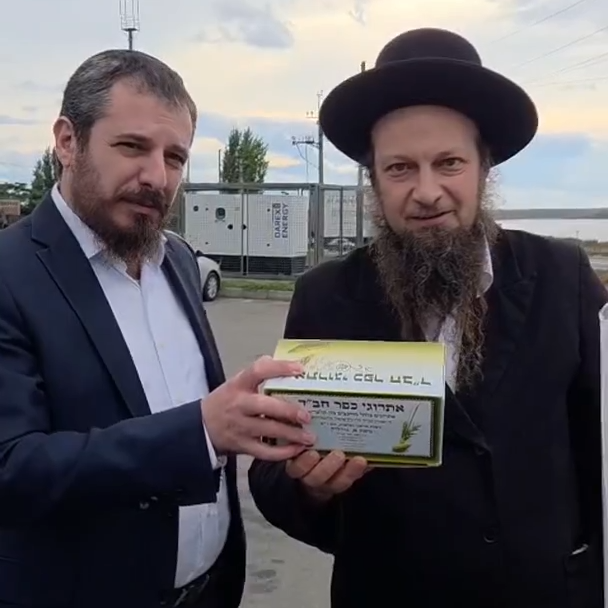
Jonathan Karlinsky receives the Four Species for Sukkot while held at a Ukrainian military detention facility in the Odesa region
The organization said a video provided by the military showed Karlinsky saying he was in good condition and being treated fairly. The FJCU said Ukraine's shortage of medical personnel was one reason authorities were unwilling to release him.
Since Karlinsky was located, Rabbi Avraham Wolff, the chief rabbi of Odesa and southern Ukraine and a Chabad emissary, has been working to provide for his religious needs. Wolff arranged for fellow Chabad emissary Rabbi Shneur Vigler to visit Karlinsky and provide religious and emotional support.
Wolff has also arranged for kosher food to be delivered to Karlinsky each day. The Jewish community provided him with food for Shabbat, the meal before the Yom Kippur fast and the meal breaking the fast, as well as a prayer book. Ahead of Sukkot, Wolff arranged for Karlinsky to receive a set of the Four Species so he could perform one of the holiday's central religious commandments while remaining at the military facility.
The Four Species — an etrog, a palm branch, myrtle branches and willow branches — are traditionally held together and waved during prayers on Sukkot, the Jewish harvest festival that follows Yom Kippur.
Rabbi Meir Stambler, chairman of the Federation of Jewish Communities of Ukraine, said Ukraine's continuing war with Russia had left the country with a severe shortage of personnel and made exemptions from military service increasingly difficult to obtain.
"This is truly a war of survival," Stambler said, noting that people are being killed daily and that Ukraine faces a severe manpower shortage. "Every Ukrainian citizen is needed here."
Meanwhile, Stambler praised Ukrainian authorities for accommodating Karlinsky's religious requirements, including his request not to carry a weapon. He said it might eventually be possible for Karlinsky to serve within the Ukrainian military rabbinate.
Local Jewish community officials said Karlinsky was the only ultra-Orthodox Jew detained in the current wave of stepped-up mobilization enforcement. They said Ukrainian authorities had significantly intensified checks on men of military age, with eligible Ukrainian citizens encountered inside the country increasingly being stopped and directed toward military service.
Karlinsky's case drew particular attention in Israel because he has lived in the country for years, is married, studies at a yeshiva and is part of the Breslov Hasidic community. But his Ukrainian citizenship left him subject to the country's wartime mobilization rules when he entered Ukraine.
His detention was one of several involving Breslov pilgrims traveling to or from Uman around Rosh Hashanah this year, though the other cases were unrelated to Ukrainian military service. Three other pilgrims were detained in separate incidents in Cyprus and Moldova, a major transit route for Israelis traveling to Ukraine while its airspace remains largely closed to commercial flights because of the war.