


Turkish President Recep Tayyip Erdogan arrived in Egypt on Wednesday for an official visit, a day after a warm visit to Saudi Arabia. Erdogan and the leaders of Egypt and Saudi Arabia formally announced understandings and agreements on cooperation between the countries, against the backdrop of the Israel's fading prospect of normalization with Riyadh and strained relations with Cairo.
Earlier in the day, Egypt’s presidency announced that President Abdel Fattah el-Sissi would receive the Turkish president. The statement said the two leaders were expected to hold an official meeting and then convene “the second session of the High-Level Strategic Cooperation Council between Egypt and Turkey.” It added that both leaders would also take part in the closing session of the Egyptian-Turkish Business Forum, with broad participation from the business community.
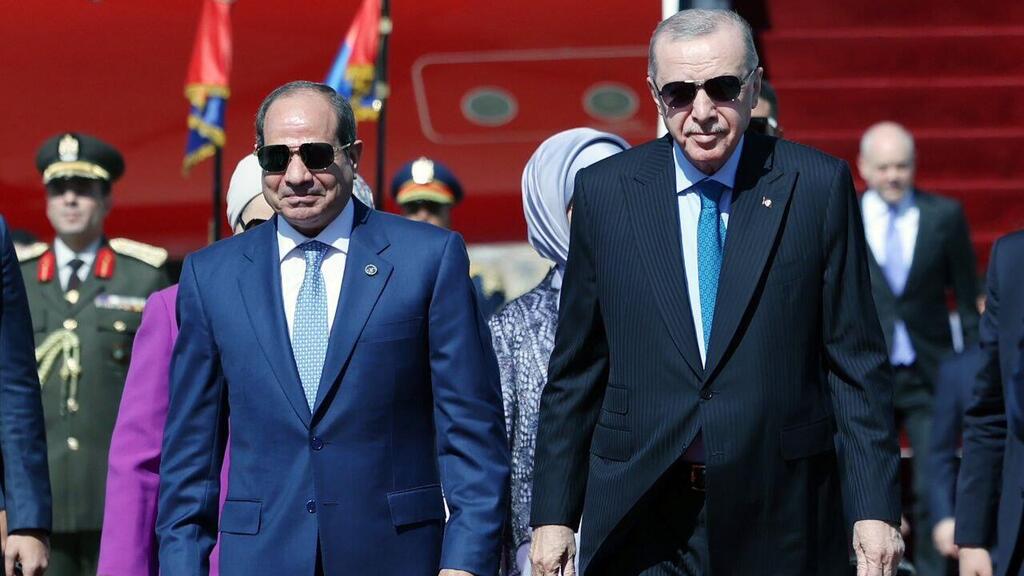
Upon Erdogan’s arrival in Egypt, images of the reception were published on Arab social media, including a photograph of the presidents’ wives, Emine Erdogan and Entissar Amer, shaking hands. Later, Turkey’s state-run Anadolu Agency reported that the presidents of Turkey and Egypt signed agreements and memorandums of understanding.
Erdogan and Sissi appeared at a joint news conference in which they spoke, among other issues, about the importance of implementing the ceasefire agreement in the Gaza Strip. Egypt’s presidency also released an official statement containing no fewer than 40 clauses addressed by the presidents during the meeting of the Strategic Cooperation Council between the two countries. The clauses included condemnations of Israeli activity in Syria and Lebanon.
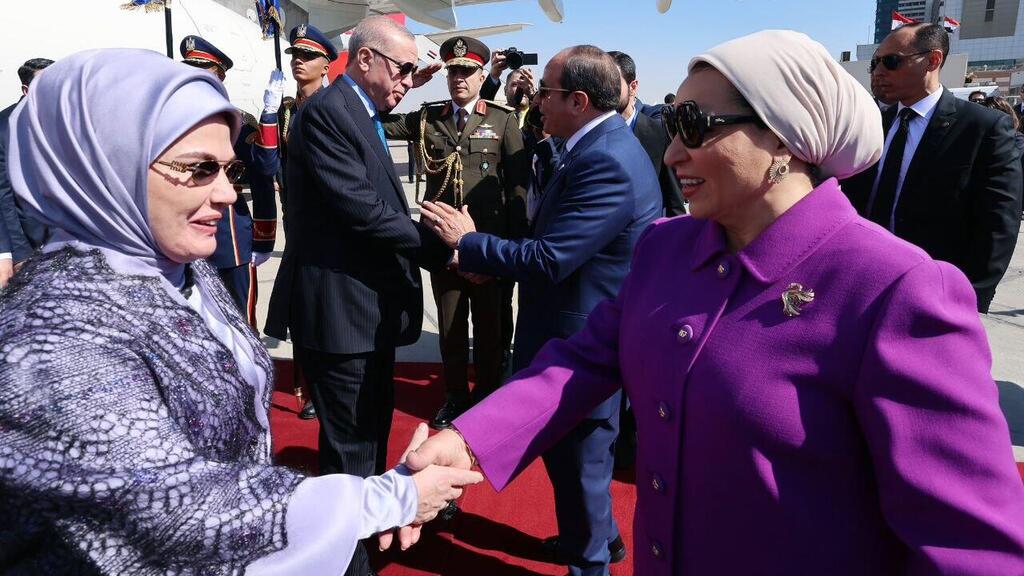
The presidents’ wives, Emine Erdogan and Entissar Amer, shake hands
Erdogan’s visit to Egypt came immediately after a visit he held Tuesday in Saudi Arabia, at the conclusion of which a lengthy and detailed Saudi-Turkish statement was issued. The statement outlined the full scope of economic cooperation agreed upon by the two countries and addressed nearly all of the major challenges of the moment, in the region and beyond.
Regarding Gaza, Saudi Arabia and Turkey said they “expressed deep concern over the deteriorating humanitarian situation in the Strip, the ongoing Israeli aggression and the blocking of the entry of humanitarian aid and the crossings.” The two countries welcomed the establishment of U.S. President Donald Trump’s Board of Peace, the launch of the second phase of the Gaza peace plan and the start of work by the technocratic committee tasked with administering the Strip.
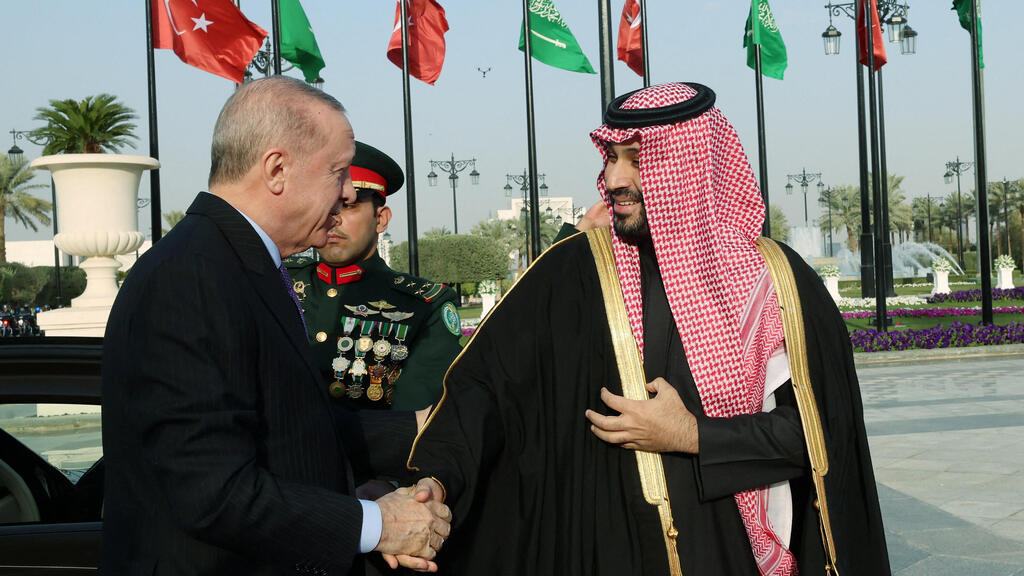
Turkey's Erdogan and Saudi Arabia's Bin Salman
(Photo: Murat Cetinmuhurdar/Turkish Presidential Press Office/Handout via Reuters)
At the same time, the Saudi-Turkish statement also addressed the latest round of escalation in southeastern Yemen. The two countries expressed support for Yemen’s legitimate government in the face of the Southern Transitional Council, which is backed by the United Arab Emirates. In addition, Saudi Arabia and Turkey once again condemned Israel’s recognition of Somaliland and addressed developments in Sudan and Syria, as well as the Russia-Ukraine war. In the defense and security sphere, the two countries agreed on the need to activate the agreements signed between them on security cooperation.
'Perception that Israeli power is dangerous'
According to Dr. Gallia Lindenstrauss, a senior researcher at the Institute for National Security Studies, Turkey has worked in recent years to improve relations with various countries in the region, a process that began around 2021, but “with Egypt it was the hardest.” She explained that “Erdogan was angered by what he saw as Western hypocrisy in failing to acknowledge that there was a military coup in Egypt. There was also an element of personal identification on his part, because of the attempted coup against him in 2016, so these relationships were tense. They still come from a place of suspicion and tension, but I would say that several things have changed that make this more stable today.
“One aspect is that Turkey has become a significant arms exporter, especially of drones. Saudi Arabia is not only buying drones from Turkey, but they are also cooperating on defense production of drones. This fits into the agenda of regional countries that do not want to be dependent on the United States and are wary of moving toward China and Russia because of a possible American backlash. Relying on regional capabilities is, therefore, a good response to growing needs and challenges in the international arena. In addition, there is concern that the United States is not fully reliable, so there is an advantage to relying on regional countries.”
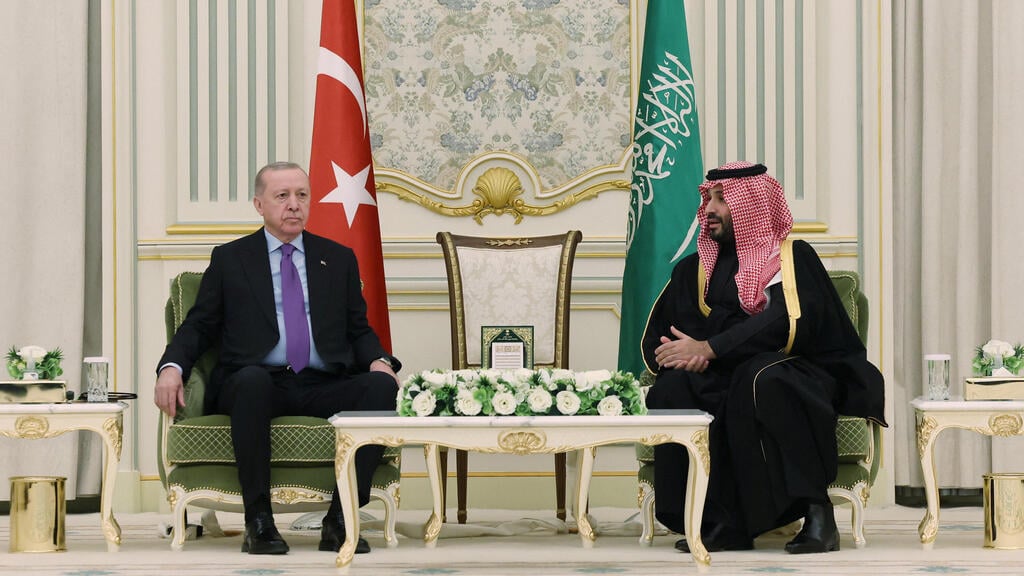
'Without normalization, Saudi Arabia will look for another partner'
(Photo: Murat Cetinmuhurdar/Turkish Presidential Press Office/Handout via Reuters)
Lindenstrauss added: “There is also the Gaza story. From Egypt’s perspective, Gaza is a threat to its national security. There was fear in Egypt that thousands of Palestinians would arrive from the Strip, and therefore, on the Gaza issue as well, there is a greater Egyptian desire than in the past to reach some kind of stable solution. The fact that a joint military exercise between Egypt and Turkey took place last September for the first time in 13 years points to something new, and it cannot be understood without Gaza. This is a significant element.”
Lindenstrauss also addressed additional factors behind Erdogan’s current visits to Saudi Arabia and Egypt: “The war against Iran was perceived by all of these countries as dangerous Israeli power, and therefore there is a desire here to restrain Israel. There is also the issue of Israel’s recognition of Somaliland, which both Saudi Arabia and Egypt are unhappy with, each in its own way. The most dissatisfied is Turkey, but Saudi Arabia and Egypt as well.
“There is a convergence of interests among Saudi Arabia, Turkey and Egypt that has not existed for a long time. It is a convergence against the policies of the United Arab Emirates and Israel in the region, and also related to Turkey’s defense industry as one that offers a potential response to the challenges facing these countries.” Lindenstrauss stressed that these are closer relationships than in the past, but still with limits — Turkey has not reached the point of a military alliance with Saudi Arabia.
Should Israel be concerned about the strengthening of Turkey’s regional ties?
“Israel should be concerned if we see that the rapprochement between these countries deepens our diplomatic isolation. We see Saudi Arabia moving away from normalization with Israel," she said. "Beyond that, if Israel does not deliver what Saudi Arabia needs in terms of improving its security situation, because normalization is not achievable, Riyadh is looking for it elsewhere. This also contributes to the weakening of Israel’s ties with traditional peace partners such as Egypt. Developments in Gaza are perceived as a threat to Egypt’s national security, and therefore Cairo is willing to go far in cooperation with Turkey to ensure that the situation in Gaza stabilizes and does not spill over into Egypt.”