

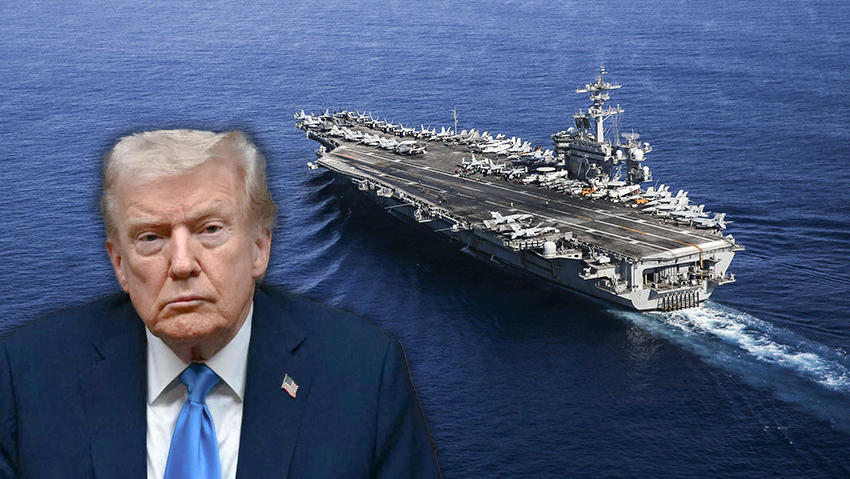
President Donald Trump issued another warning to Tehran on Friday, saying “Iran should make a deal.” At a news conference, he described the situation as very sad and said the Iranian people are better than their leaders, adding that 32,000 protesters were killed in a short period of time.
Amid the threats, The New York Times reported that Washington is preparing for a range of scenarios, including a broader confrontation than last year’s. Pentagon officials said hundreds of troops have been evacuated from Al Udeid Air Base in Qatar, and personnel have also been moved from a cluster of US bases in Bahrain, home to the US Navy’s Fifth Fleet.
Days after last year’s US strike on Iran’s nuclear facilities, all sides agreed to a ceasefire. But this time could be different, experts told The Times. In June, the United States joined a campaign launched by Israel, with Trump giving the military a defined objective: bomb nuclear facilities and delay Iran’s ability to produce a nuclear weapon.
Twelve days after Operation Rising Lion began, Trump announced a ceasefire in the middle of the night after joining the campaign, without any American casualties. Now, however, the Pentagon is in the midst of its largest military buildup in the Middle East in two decades, and Trump is considering a much broader operation — this time led by US forces — without publicly declaring his objectives.
US officials and Middle East experts told The New York Times that ambiguity about Trump’s goals could be particularly dangerous, as it may lead Iran’s leadership to view an attack as an existential threat. As a result, Iran could escalate in ways different from last June or from its response after the killing of Qassem Soleimani in 2020.
Vali Nasr, an Iran expert at Johns Hopkins University, told the newspaper that Tehran may conclude its restrained responses to previous US military actions only led to further threats and that it must raise the cost of war for Washington.
In a letter sent Thursday to UN Secretary-General Antonio Guterres, Iran’s ambassador to the United Nations warned that if Iran is attacked, “all bases, facilities and assets of the hostile force in the region will be legitimate targets,” and that the United States would bear full and direct responsibility for any unforeseen and uncontrollable consequences.
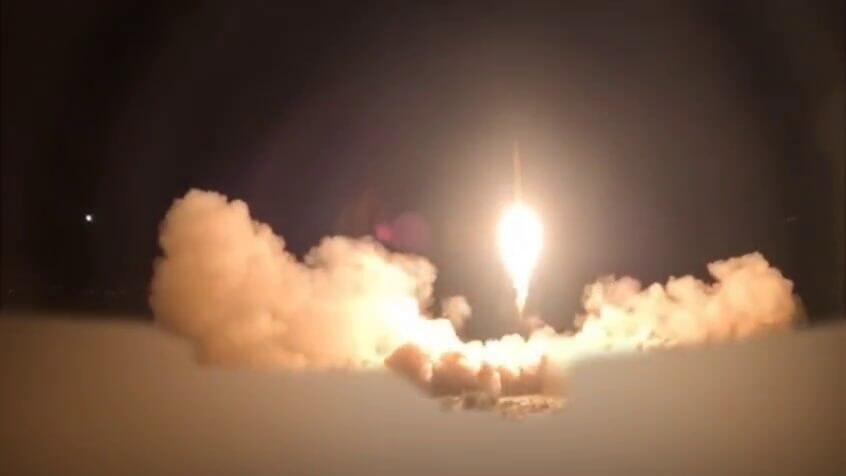
Iranians gave advance warning before launching missiles at Qatar
The New York Times noted that the threat endangers the 30,000 to 40,000 US troops stationed at 13 military bases across the Middle East. The Pentagon has deployed additional air defense systems to protect the bases.
Last June, Iran launched missiles at the US base in Qatar only after warning Washington and Doha in advance. But a senior Pentagon official acknowledged this week that it could be different this time, saying US forces may face greater risk if the United States — rather than Israel — initiates the strikes.
Iran’s leadership also faces a dilemma. Karim Sadjadpour of the Carnegie Endowment for International Peace told The Times that retaliation would be a “huge gamble for a regime whose overriding objective is survival,” potentially prompting Trump and Israeli Prime Minister Benjamin Netanyahu to escalate beyond their original plans, even toward regime change.
Katherine Thompson of the Cato Institute, a former senior US Defense Department official, said the American “armada” sent to the Middle East is the clearest indication that the Pentagon believes the war could last longer than 12 days. “It looks like preparation for a much longer conflict,” she said, adding that the Pentagon expects an Iranian response that could pose significant risks to US bases in the region.
At the same time, Thompson noted that interceptor stockpiles for defending US bases and Israel are limited, and a prolonged conflict could force difficult decisions. The ability of the United States to protect its forces and bases over time while also supporting Israel’s defense is a major concern, she said.
Another US military official told The Times that US Central Command is keeping two aircraft carriers in the region at a considerable distance from Iran to avoid making them targets. Other officials noted that it is difficult to strike a fast-moving aircraft carrier with a ballistic missile, and that the carriers are escorted by destroyers capable of intercepting such threats.
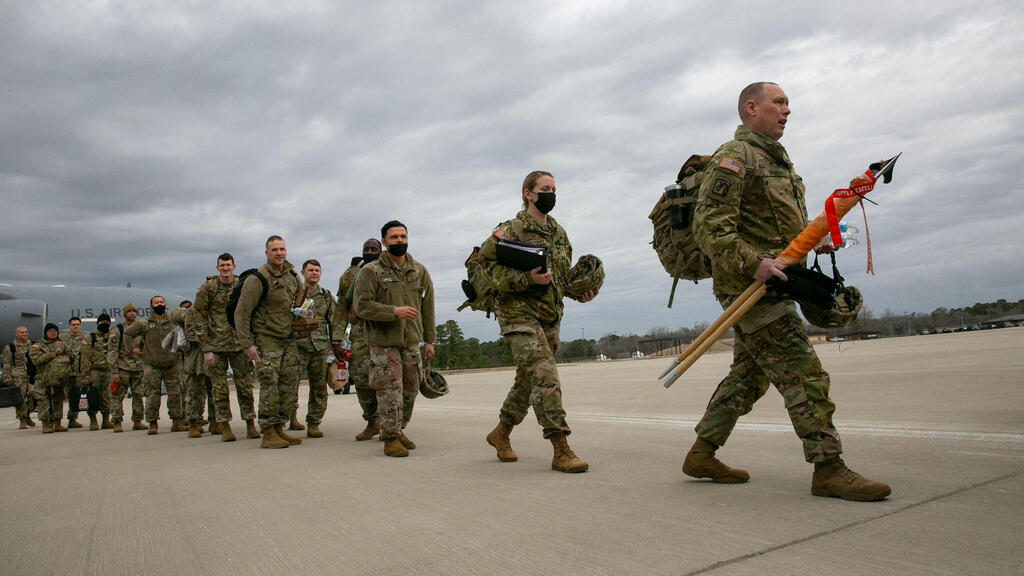
Unprecedented preparations for conflict; US soldiers
(Photo: AFP)
Publicly, Trump administration officials insist they remain committed to exploring a diplomatic solution that would lead Iran to accept new restrictions on its nuclear program. In private, however, they say it is hard to see what Iran could offer in the near term that would deter Trump from another military campaign.
Iran International, a Persian-language channel based in London and associated with opponents of Iran’s leadership, reported that Tehran’s proposal in Geneva includes halting uranium enrichment for three years; limiting enrichment to 3.67% afterward; diluting enriched uranium under US supervision or transferring it to a third country, preferably Russia; retaining missiles for defensive purposes only; refraining from questioning Israel’s right to exist; avoiding aggressive military promotion of a Palestinian state; and selling oil under an agreed quota through Swiss mediation, including a roughly 5% marketing commission for Americans.
Meanwhile, Reuters reported Friday, citing US officials, that US military plans against Iran are at a very advanced stage and include a range of options, from targeted strikes on specific individuals to efforts aimed at regime change.
Reuters reported last week that the US military was preparing for a multi-week operation. The latest reports indicate detailed and ambitious planning. The officials, who spoke on condition of anonymity, did not provide details about potential targets or how the US military might seek to topple the regime without ground forces.
One official cited by Reuters pointed to Israel’s success in targeted killings during the 12-day war, saying the Israeli strikes on individuals demonstrated the effectiveness of that approach.