

The prevailing view in Israel tends to treat the Iranian-led Shiite axis as a single bloc: Tehran as the leader and financier, with its regional proxies — Hezbollah in Lebanon, the Houthis in Yemen and militias in Iraq — acting under its command. But despite Iran’s clear status within this structure, the interests of its various branches do not always fully align.
The past several days appear to demonstrate this. Despite the war being waged by Israel and the United States against Iran, the Houthis in Yemen have limited themselves to muted statements of support for their partners. For 13 days, they have chosen not to join the fighting by firing on Israel or the Sunni Gulf states, nor by attacking ships.
Training by the Houthis last month ahead of a war with Israel


It is impossible to know whether this situation will continue. In any case, their decision for now to watch from the sidelines is not the result of a directive from Tehran. In recent years the group has developed a degree of independence and makes many of its decisions on its own.
A source in Sanaa who spoke with ynet said the Houthis are waiting to see how the war develops — both the conflict itself and the broader reshaping of the region — and will intervene, if at all, according to their own needs.
“They are not taking risks that could lead to their collapse or weaken their influence, as happened to Hezbollah,” the source said. “They are trying to learn lessons from the war so as not to repeat the mistakes of others.”
According to the source, the Houthis have refrained from intervening despite preparing intensively for war.
“They trained a lot recently, including in villages, for face-to-face confrontations with Israel,” he said. “They reorganized their ranks and appointed more than one level of leadership in case of assassinations.”
How do they coordinate with Iran?
“It is well known they are linked to Tehran through the axis’ joint operations room,” the source said. “Their participation there continues. The war in Iran may reach a point where they will have to enter the conflict. But they are trying to assess where a future confrontation with Israel could lead. It could be decisive and lead to their destruction and expulsion from Sanaa. War with Israel is their project, but they are also trying to preserve their position in Yemen.”
Do they see the war differently from Iran and Hezbollah?
“There are points where they differ from Hezbollah, and certainly from Iran. The Houthis follow Iran in many areas, but they also make many decisions independently, which angers the leadership in Tehran. At one point it reached the stage where Hezbollah even wanted to mediate between the Houthis and Iran.”
“The Houthis are trying to prove they are Yemeni, not Iranian. And if Iran collapses, it will collapse alone. If the regime in Tehran falls, they will carry the Shiite banner.”
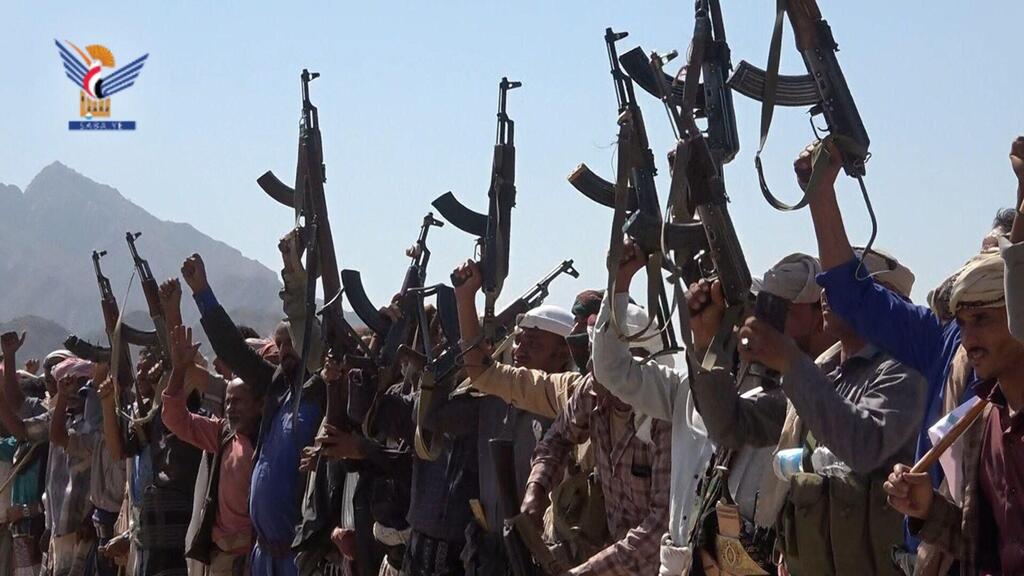
A Houthi military exercise in Ibb province last December
How would you describe the past few days in Sanaa?
“Like the calm before a storm. The pictures of Khamenei that were hung after his assassination have already been replaced with images of Abdul-Malik Badr al-Din al-Houthi,” the source said, referring to the group’s leader.
“Houthi fighters are moving around without uniforms, in civilian cars, blending into the population. You can’t know where they are. It seems they are preparing for any trouble — an external strike or an internal uprising. The leadership cannot be seen at all.”
Concern about Israel in Somaliland
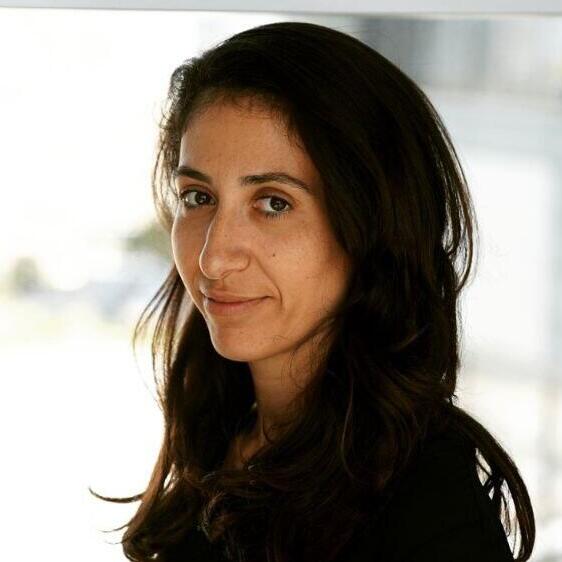
Sima Shine, a former senior Mossad official and now a researcher at the Institute for National Security Studies (INSS), agrees that despite their ties to Tehran, the Houthis ultimately act according to their own calculations.
“Israel is currently also present in Somaliland, in the Horn of Africa opposite Yemen, and the United States is in the Middle East with forces that have never been here in such numbers,” she said. “From the Houthis’ perspective, entering the war could carry a heavy price, and they need to ask what they would gain from it.”
“That does not mean they will not intervene at some point. I think that from the Iranian perspective, the Houthis are a pressure card meant to prevent Saudi Arabia from intervening.”
How independent are they?
“They have proven in the past that they are relatively independent,” Shine said. “I also think they understand that Iran after the war will not be the same Iran in terms of capabilities.”
 Sima Shine
“Their ultimate goal is to control Yemen, or at least to be a central part of its leadership. In addition, they have already been hit by the Israeli military during the ‘Swords of Iron’ war, and they understand Israel has improved its capabilities since then. Together with the United States there is significant military power in the region that could seriously harm them. In my view, that is a central consideration.”
Danny Citrinowicz, a former head of the Iran branch in the IDF Military Intelligence Directorate’s research division and now a research fellow in the Iran program at INSS, stressed that “Iran and its proxies do not operate in a classic patron-client relationship.”
“We don’t know what Iran currently wants from the Houthis,” he said. “But there are two possibilities: either it wants them to enter now, or it prefers to keep them for later, in case the campaign becomes prolonged.”
According to Citrinowicz, developments in the civil war in southern Yemen mean the Houthis currently face no significant internal threat, making it likely they will eventually join the conflict.
“I find it hard to see this campaign continuing without them entering it at some point,” he said. “Yes, they think about their own interests, but there is also their basic commitment to the axis.”
“In general, the Houthis’ relationship with Hezbollah has been deeper and more strategic than with Iran. They are closer to them in language and culture, and militarily, Hezbollah helped upgrade their capabilities. Its representative even took part in the decision-making process in Yemen.”
“You could say that even if Iran were in trouble, if Hezbollah is in trouble, then the Houthis would certainly step in. But they have not.”
Could there be tensions between the Houthis and Hezbollah?
“If there are, it would be along the lines of ‘we don’t dance to Hezbollah’s tune,’” Citrinowicz said.
“In other words, the Houthis see themselves as leading the axis and do not automatically respond when called. They will decide according to their own interests. In a sense, it is a golem that has turned on its creator.”
“In the past, they were heavily influenced by Hassan Nasrallah personally. His assassination, combined with the fact that over the past year they see themselves as having become such a significant force within the axis, has led them to feel they can decide when it suits them to enter the conflict.”