

Air raid sirens sounded repeatedly across central and southern Israel early Saturday as Iran launched what Israeli officials described as roughly an hour of continuous fire following Tehran’s confirmation that Supreme Leader Ayatollah Ali Khamenei had been killed.
The Israeli military said the barrage, which began around 6:15 a.m., consisted mostly of single missile launches every few minutes, many of which were intercepted by air defenses. Millions of residents were sent into protected spaces as alerts sounded across the Tel Aviv metropolitan area, Jerusalem, the Shfela, the Sharon region and parts of the Negev.
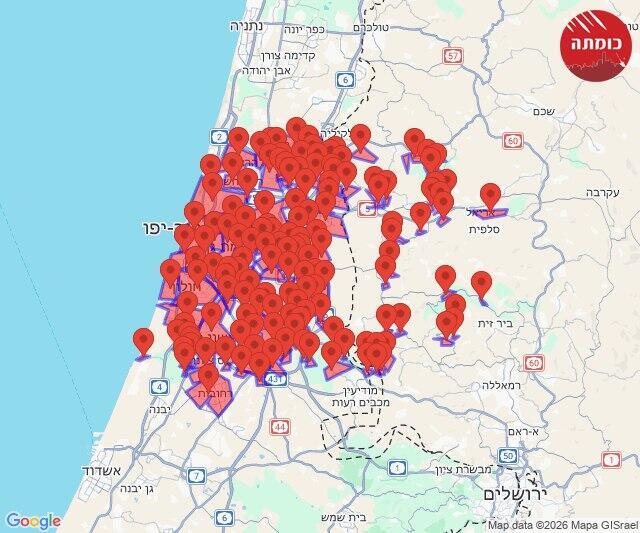
Alarm map
(Photo: Cumta)
Israel’s Home Front Command later said residents in several areas, including the south and parts of central Israel, could leave protected spaces but should remain nearby.
Magen David Adom, Israel’s emergency service, said it had not received reports of direct hits or casualties from the latest salvos. Fourteen people were treated after being injured while running to shelters, and five others were hurt in similar incidents earlier in the morning.
Before midnight, a woman in her 50s was killed in a direct missile strike in Tel Aviv. One person was seriously wounded and at least 25 others were injured, most of them lightly.
Iranian President Masoud Pezeshkian said the killing of Khamenei “will not go unanswered” and that Iran would overcome the crisis. The Islamic Revolutionary Guard Corps announced what it called a “sixth wave” of attacks, claiming it had launched missiles toward 27 U.S. bases as well as Israeli targets. Those claims could not be independently verified.
Iranian Parliament Speaker Mohammad Bagher Ghalibaf said authorities had prepared plans for all scenarios following Khamenei’s death and warned the United States and Israel that they had crossed a red line.
Explosions were also reported in Doha, Dubai and Kuwait City, with Al Jazeera reporting interception blasts over Qatar’s capital. Pro-Iranian media outlets said launches had also targeted Jordan.
The Israeli military urged the public not to share footage or locations of impacts, saying air defense systems were continuing to identify and intercept threats.
Intercepts in the skies over Doha


Overnight news summary
It is now official: Iran’s Supreme Leader Ayatollah Ali Khamenei has been killed. Iranian state media anchors announced his death in tears, while tens of thousands of mourners were seen in Tehran. Earlier, regime opponents across Iran took to the streets to celebrate U.S. President Donald Trump’s announcement of Khamenei’s killing, and were reportedly dispersed by security forces.
According to U.S. reports, Khamenei was killed after moving up a meeting he had planned with two senior advisers, Ali Shamkhani and Ali Larijani. Iranian officials confirmed that Shamkhani was killed, along with Islamic Revolutionary Guard Corps commander Mohammad Pakpour. U.S. media reported that the United States and Israel identified three simultaneous meetings of senior Iranian political and military officials earlier in the day and decided to strike in daylight. Thirty bombs were dropped on Khamenei’s residence, and about 40 senior Iranian officials have been killed so far. The Revolutionary Guards have threatened to retaliate “soon” with an unprecedented and “historic” operation against Israel and U.S. bases in the Middle East.
A temporary leadership council composed of Iranian President Masoud Pezeshkian, Judiciary Chief Gholam-Hossein Mohseni-Ejei and a representative of the Guardian Council will assume the leadership’s duties in the Islamic Republic.
The Washington Post reported overnight that Saudi Crown Prince Mohammed bin Salman, who had publicly supported a diplomatic solution, pressured Trump to strike Iran and warned of dangerous consequences if he did not. According to the report, bin Salman’s efforts, along with those of Israeli Prime Minister Benjamin Netanyahu, played a central role in Trump’s decision to launch the attack.
There were no casualties in drone and missile launches toward Israel after midnight. Before midnight, a woman in her 50s was killed in a direct missile strike in Tel Aviv. One person was seriously wounded and at least 25 others were injured, most of them lightly and some moderately. At the same time, Iran continued heavy launches toward Muslim countries in the Middle East.
Throughout the night, the Israeli military and the United States carried out waves of strikes across Iran, targeting air defense systems, missile launchers, regime-linked sites and military headquarters.
First published: 07:45, 03.01.26