


Former IDF chief of staff and Yashar! party leader Gadi Eisenkot pledged Thursday to end Hamas rule in the Gaza Strip within 18 months of becoming prime minister, reviving a promise made by Benjamin Netanyahu in 2009, when he was opposition leader.
Speaking near the Gaza border less than two weeks before Israel's October 27 election, Eisenkot presented his plan to remove Hamas from power and sharply criticized Netanyahu's handling of the war, accusing the prime minister of allowing the terrorist organization to remain in control despite three years of fighting. "I pledge that within 18 months of entering the Prime Minister's Office, Hamas will no longer rule the Gaza Strip," Eisenkot declared.
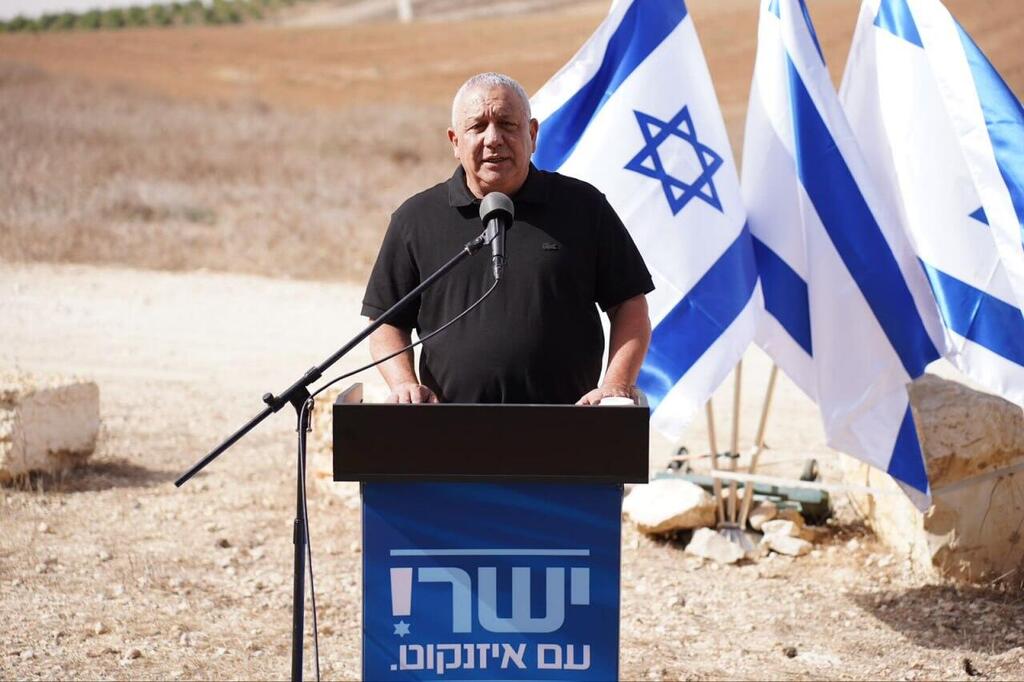
Gadi Eisenkot
"We will bring about the destruction of Hamas' military wing. This will happen either through action based on President Trump's framework, which was accepted by Netanyahu's government, or through the use of military and operational capabilities."
Eisenkot's declaration echoed Netanyahu's February 2009 election campaign, when the Likud leader, then in opposition, visited Ashkelon following rocket attacks from Gaza and promised to topple Hamas rule if elected.
Seventeen years later, Eisenkot argued that Netanyahu had failed to deliver on that promise. "As long as he remains in power, Hamas will remain in power," Eisenkot said. "The man who puts up signs saying 'We will not surrender' is the first to surrender: to draft dodgers, to his coalition partners and to Hamas."
He accused the government of squandering the extensive domestic support and international legitimacy Israel received after the October 7 massacre.
"Never has an Israeli government been given so much room to maneuver and so much legitimacy from the public and the world, only to suffer such a resounding strategic failure," Eisenkot said. "Three years after the October 7 massacre, Hamas remains the sovereign authority in the Gaza Strip, armed, rearming and rebuilding its military capabilities."
Likud responded by questioning Eisenkot's ability to carry out his pledge with the support of Arab political parties. "How will you topple Hamas without getting permission from your partners Mansour and Tibi?" the party said, referring to politicians Mansour Abbas and Ahmad Tibi.
‘Three years of war, and the objectives have not been achieved’
At the beginning of his speech, Eisenkot reflected on the human and military costs of the war. "The State of Israel has been fighting for three years. This war, which began with a terrible failure and an unimaginable massacre, has continued for three years at a heavy cost and with enormous sacrifice," he said.
"The bravery of our soldiers, their courage and determination have brought extraordinary military achievements. Yet even after three years, the objectives of the war have not been achieved. Across all the battlefronts, the threats persist."
Eisenkot also spoke about the personal losses his family suffered during the fighting, recalling his son Gal and two nephews, Yogev and Maor, who were killed in the war. "I stand here today, a short distance from the communities surrounding Gaza, from Sderot and Ofakim, where civilians fought with their bare hands and soldiers ran toward the flames," he said.
"From here, 251 civilians and soldiers were abducted. Not far from here, in Jabaliya, where my son Gal fell in December 2023, the mission to bring home the fallen hostages was completed. Not far from here, my two nephews, Yogev and Maor, also fell, may their memories be a blessing, alongside nearly a thousand IDF soldiers killed in Gaza and Lebanon."
Eisenkot described the war against Hamas and Palestinian Islamic Jihad as justified, but argued that the government had failed to translate military achievements into its declared strategic objectives. He also claimed that returning the hostages had not initially been included among the war's formal objectives and was added nine days later at his insistence. "This week marked the anniversary of the return of the last living hostage to Israel," he said.
Eisenkot urged Israelis to confront what he described as the continuing failure to dismantle Hamas' governing and military capabilities. "Three years after the October 7 massacre, Hamas remains the sovereign authority in the Gaza Strip. Hamas is armed, rearming and militarily active," he said.
He cited intelligence assessments and the experience of senior security officials indicating that Hamas was rebuilding its military capabilities, reestablishing itself in Gaza and seeking opportunities to carry out attacks against Israel. "Returning to the policy of preferring Hamas to remain in power in the Gaza Strip is a resounding failure of the Israeli government," Eisenkot concluded.