


Education Minister Yoav Kisch adopted the recommendation of professional staff and decided that middle schools, in addition to elementary schools, will also be included in the ban on cellphone use. According to a statement released Sunday, the measure will take effect at the start of the next school year and is part of a broader policy aimed at strengthening social connections, attention spans and the overall school climate.
According to the Education Ministry, devices will remain turned off in students’ bags or in storage facilities designated by schools. Use will be permitted only during designated lessons and for educational purposes.
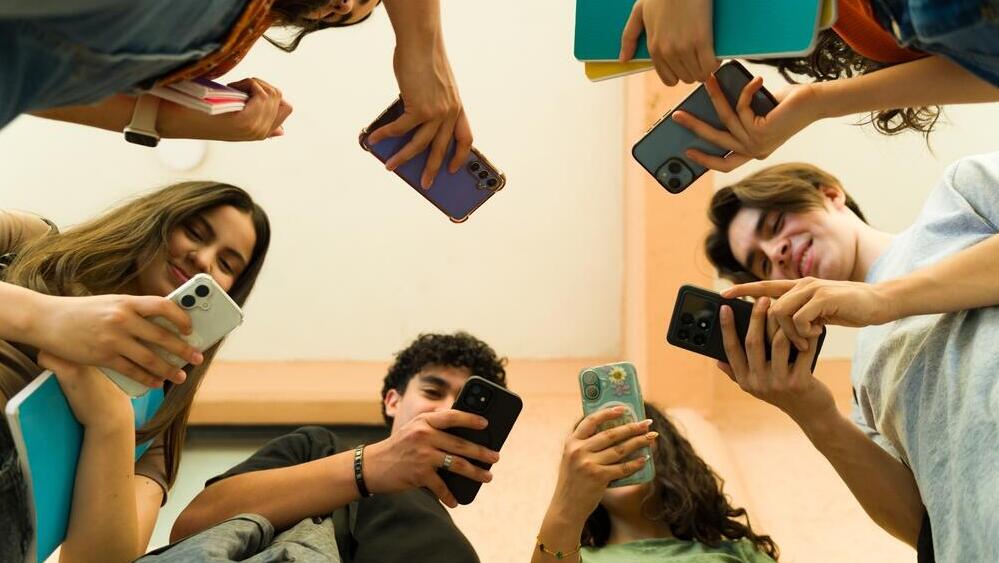
The move will be accompanied by educational programs focused on digital literacy, balanced technology use and strengthening social and emotional skills.
Professional staff reviewed studies and trends in Israel and abroad regarding the impact of smartphone use on attention and concentration, sleep quality, emotional well-being and the ability to maintain direct social relationships during adolescence. Among the findings presented were data pointing to increased use associated with addictive social media behavior, damage to sleep habits, fewer face-to-face social interactions and the effects of prolonged attention fragmentation on learning and development during adolescence.
Studies from around the world were also presented showing improvements in school climate, academic achievement and student engagement following restrictions on cellphone use in schools.
The policy will be implemented gradually and accompanied by detailed guidelines for schools, educators and parents, alongside adjustments to activity spaces and social alternatives during recess. The goal, the ministry said, is to strengthen interpersonal interaction, social activity and a continuous, focused learning environment.
Efrat Bida, the mother of Libby, 14, who attends a middle school in Ness Ziona, said she partially supports the decision but believes there should be a clear distinction between classroom time and breaks.
“Every classroom should have a storage unit for phones where students place them at the start of each lesson, but phone use should still be allowed during breaks,” she said. “I think banning phones for children this age during free time is pointless.”
“The children won’t really follow such a directive, and it will create a situation where teachers become police officers for this too, as if they don’t already have enough to supervise,” she added. “Elementary school ages are definitely suited to this restriction, but in middle school they’re already older, and in my opinion this decision is detached from reality. There are many other things worth fighting for, not phones.”
The Education Ministry stressed that the policy was formulated through extensive professional discussions conducted within the ministry in cooperation with the Office of the Chief Scientist, professional staff, school principals, local authorities, parent leadership groups and the National Student and Youth Council.

(Photo: shutterstock)
Implementation of the cellphone ban in elementary schools began in February. According to a circular issued by Education Ministry Director General Meir Shimoni, the ban in elementary schools applies throughout the school day, including during breaks and in public spaces, except during designated lessons in which educational staff permit supervised use of cellphones or other digital devices for learning purposes.
Kisch said the goal is eventually to expand the ban to high schools as well.
“We are seeing too many cases of children sitting together in the classroom, but each one alone on front of their own screen,” he said. “In recent months, extensive work has been carried out on this issue. This is not only a technological issue, but also an educational and values-based question. We examined studies from Israel and around the world and held discussions with educators, principals, parents and students, with genuine attention to what is happening on the ground and the needs arising from it.
“Our responsibility is not only to understand reality, but also to act in time. Schools must be a place that restores human interaction and the ability for children to truly be with one another, reduce distractions and increase attention to learning.”