


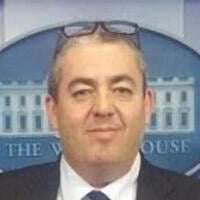
Prime Minister Benjamin Netanyahu met on Sunday with U.S. Special Envoy for Syria and Lebanon Thomas Barrack in Jerusalem, as part of Washington’s efforts to broker a security arrangement involving Israel, Syria and Lebanon. The meeting included former U.S. envoy to the region Morgan Ortagus, National Security Advisor Tzachi Hanegbi and U.S. Ambassador to Israel Mike Huckabee.
Barrack, who has been mediating between Jerusalem and Damascus while pressuring Lebanon’s government to disarm Hezbollah and other armed terror groups, discussed U.S. requests for Israel to curb strikes on Hezbollah infrastructure and address Israel’s withdrawal from five points where IDF forces are present in Lebanese territory.
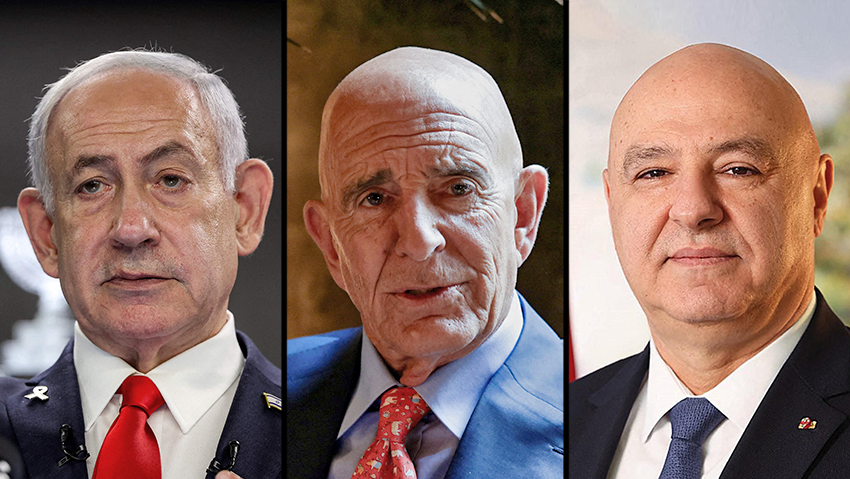
Prime Minister Benjamin Netanyahu, Thomas Barrack, Lebanese President Joseph Aoun
(Photo: ABIR SULTAN / POOL / AFP, AFP PHOTO / HO / LEBANESE PRESIDENCY, REUTERS/Emilie Madi )
Barrack, who recently told the Associated Press that Israel prefers to see a “fragmented and divided” Syria over a strong centralized state, added, “All the minority communities are smart enough to say, ‘We’re better off together, centralized.’”
The talks come amid reports of progress and tensions in negotiations with Israel, with Lebanon’s Al-Jadid channel noting that during a Paris meeting between Strategic Affairs Minister Ron Dermer and Barrack, Israel responded to a U.S.-drafted document aimed at resolving internal Lebanese issues and establishing security understandings between Jerusalem and Beirut.
Arab media described Israel’s response as a “rejection of the Barrack proposal,” agreeing only to some clauses. Israel tentatively approved a gradual halt to strikes and targeted eliminations, a withdrawal from certain areas and resolution of Lebanese prisoner issues, but insisted destroyed border villages remain uninhabited, repurposed as an industrial buffer zone.
Beirut now grapples with critical choices: extending UNIFIL’s mandate, due to expire by month’s end, its stance on disarming Hezbollah and endorsing the U.S. document. Hezbollah rejects the proposals, demanding Israel first honor existing agreements, cease attacks, withdraw from all Lebanese territory and release prisoners.
IDF strike against Hezbollah forces in Lebanon
(Video: IDF Spokesperson's Unit)


Reports suggest Barrack will soon return to Beirut with Ortagus and a delegation led by Senator Lindsey Graham, though the Hezbollah-aligned Al-Akhbar outlet labeled Graham a “radical Zionist” and warned of the mission’s intent.
Efforts to ease internal Lebanese friction persist, particularly between President Joseph Aoun and Hezbollah, with a meeting between Hezbollah parliamentary leader Mohammed Raad and a presidential envoy addressing the rift over government decisions on disarmament.
Raad “explained Hezbollah’s stance, emphasizing the group’s commitment and demand that the government reverse its decision,” according to reports.
Meanwhile, Lebanon’s Nidaa Al Watan, critical of Hezbollah, published an article titled “Iran Guides, Hezbollah Executes. Lebanon is a Hostage to Regional Influence,” citing sources claiming criticism of Prime Minister Najib Mikati and escalated rhetoric against Saudi Arabia reflect an Iranian strategy to reshape Lebanon’s dynamics.
A U.S. diplomatic source warned of a severe crisis if disarmament fails, not ruling out a new military clash with Israel.