


Russian Ambassador to Israel Anatoly Viktorov confirmed on Saturday that Moscow held secret diplomatic contacts last month with Israel and Iran, at the request of both countries, in order to prevent a military confrontation.
Russia is prepared to offer its "good services, without imposing them," Viktorov said, adding that "when the United States and Iran reach an understanding, Moscow will be ready to assist in implementing it." The ambassador clarified that these are classic diplomatic channels that are not made public prematurely.
Gallery
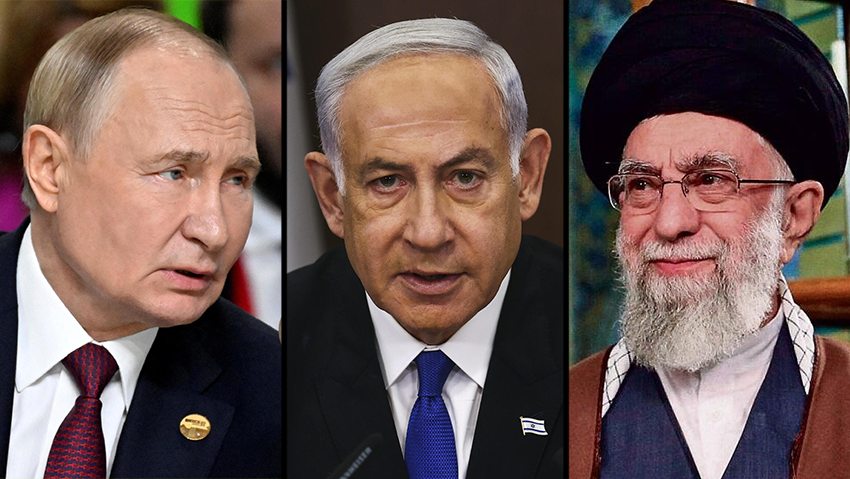
Vladimir Putin, Benjamin Netanyahu, Ali Khamenei
(Photo: AFP , ALEXANDER NEMENOV/Pool via REUTERS, AP)
Against the backdrop of rising tensions and preparations for a possible U.S. military action against Iran, Viktorov stressed in an interview with the news website RIA Novosti that Russia "has an orderly course of action that proved its effectiveness during the confrontation in the summer of 2025."
According to him, "we are prepared for any change in the security situation, but prefer not to have to activate the plan. Russia continues to adhere to a political and diplomatic solution to conflicts in the region and is ready to coordinate positions with international and regional partners in order to prevent further escalation."
In the interview, the Russian ambassador added that relations between Moscow and Jerusalem, renewed in 1991, "have stood the test of time and continue to be based on intensive political dialogue, deep cultural ties, and impressive trade volume - even amid international turbulence and regional conflicts."
In October, the two countries will mark 35 years since the renewal of diplomatic relations. According to Viktorov, from the late 1980s and early 1990s, an extensive legal framework for cooperation was built, laying the foundations for expanding ties in almost every field. However, he acknowledged that "in recent years, events have occurred that did not contribute to the development of relations, including the political crisis in Israel in 2019–2021, the COVID-19 pandemic, international polarization surrounding the crisis in Ukraine, and the escalation in the Middle East after October 7, 2023.
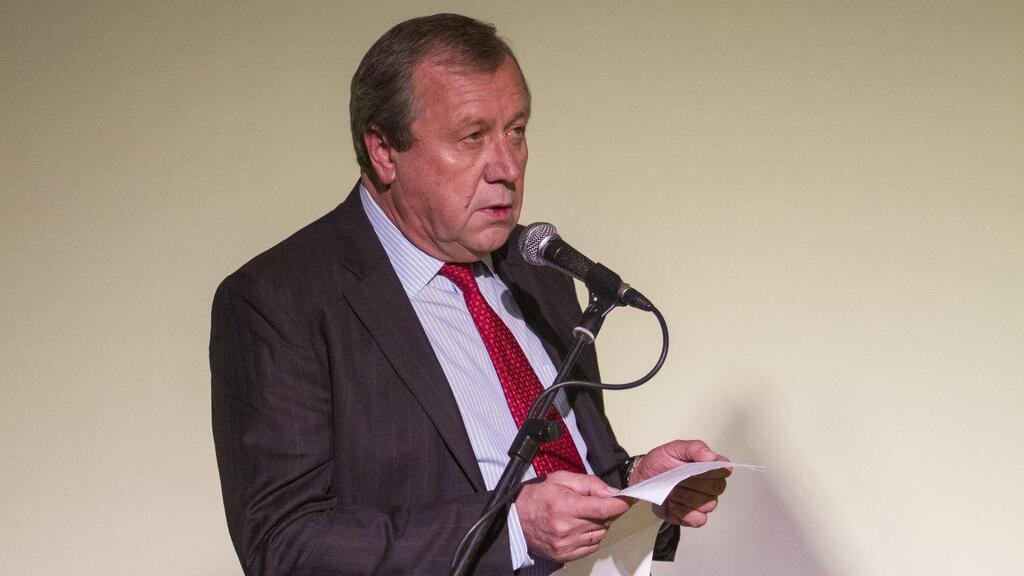
Anatoly Viktorov
(Photo: Ido Erez)
Nevertheless, Viktorov noted that a tradition of open dialogue and trust between the countries’ leaderships had taken shape already in the 2000s. "Even today, the solid foundation of cooperation is intensive political dialogue, first and foremost at the highest level", he said.
According to him, Russian President Vladimir Putin and Prime Minister Benjamin Netanyahu held six phone conversations in 2025, with an additional call already taking place in January of this year. Viktorov noted that ongoing contacts are maintained between the Security Councils, the foreign and defense ministries and other government bodies. He emphasized that cultural ties play a central role, particularly thanks to the large community of immigrants from the former Soviet Union and Russia living in Israel.
He also stressed the importance of preserving the memory of World War II and the Great Patriotic War, and the struggle against Nazism and the extermination of the Jewish people and the Soviet people. According to Viktorov, despite Western pressure and sanctions, mutual trade has never ceased. He emphasized that Israel has not imposed any restrictions on Russia, although measures taken by Western countries complicate full economic activity, mainly due to challenges in carrying out international bank transfers. Despite this, bilateral trade in 2025 amounted to more than $2 billion. The main areas of trade include agriculture, food products and metals, with Israel continuing to purchase Russian wheat on a large scale.
'About two million Israelis speak Russian'
Viktorov noted that a legal process to restore Russian ownership of the Alexander Courtyard in Jerusalem has been underway since late 2019. According to him, a special Israeli interministerial committee is discussing the matter and held professional hearings in November 2025 with the participation of Russian representatives, including officials from the Prosecutor General’s Office of the Russian Federation. "We expect that this holy and important site will be returned to its lawful owners, the Russian Federation, and that historical justice will be restored in the foreseeable future," he said.
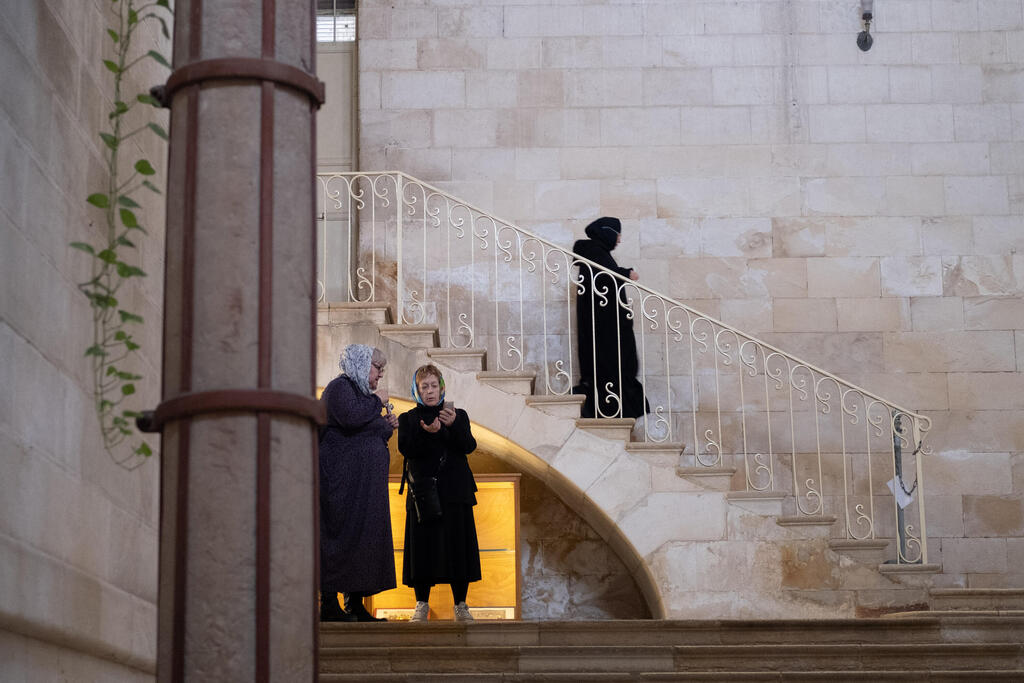
Alexander Courtyard
(Photo: Yoav Dudkevitch)
The ambassador described a particularly tense atmosphere during the 12-day war between Israel and Iran last June, which saw Israel targeted with daily missile fire. According to him, windows were shattered in several apartments rented by the embassy during one of the attacks, and the family of one employee - with three children - was saved by a miracle after entering a protected space in time. The embassy in Tel Aviv and the Consulate General in Haifa switched to round-the-clock emergency operations.
"We activated a round-the-clock hotline that received thousands of inquiries", he said. Consular teams provided expedited services to citizens seeking to return to Russia, and alternative exit routes were explained due to the closure of Israeli airspace. According to him, families of embassy staff were temporarily evacuated via Egypt, and families of Russian citizens receiving medical treatment in Israel - including three children suffering from serious illnesses - were evacuated to Jordan with medical accompaniment.
Viktorov noted that the level of development of trade and logistics systems in Israel is high, and there is no shortage of products. According to him, products familiar to immigrants from the former Soviet Union are widely available, and "Russian" stores and products from Eastern Europe are an integral part of the Israeli landscape. According to the embassy’s estimates, about two million Israelis speak Russian to some degree. "We speak the same language, celebrate similar holidays and preserve shared traditions. This connection is not subject to political conjuncture", he said.
The ambassador concluded that despite disagreements and challenges, there is a mutual desire to maintain an open, respectful and constructive dialogue. "The work continues, sometimes quietly, away from the spotlight, but aimed at results and at strengthening the ties between Russia and Israel," he said.