

U.S. President Donald Trump said Sunday that the United States would not launch an attack on Iran that day, even as tensions between Washington and Tehran continued to simmer, American military forces maintained a heightened presence in the Strait of Hormuz and the State Department ordered some embassy personnel to leave Saudi Arabia.
"There will be no attack on Iran today," Trump told reporters, offering a temporary assurance amid mounting concerns about another round of fighting.
Trump rules out Iran strike Sunday as tensions mount across Middle East
(Video: FoxNews)


Trump rules out Iran strike Sunday as tensions mount across Middle East
His comments came a day after Prime Minister Benjamin Netanyahu repeated his claim that Iran had resumed its nuclear program. Netanyahu also released a simulation Sunday depicting a nuclear bomb striking Tel Aviv.
Trump, however, disputed the suggestion that Iran was rebuilding its nuclear facilities, saying American intelligence indicated little activity at sites previously bombed by U.S. forces.
Asked in an interview with Fox News whether Iran was attempting to restore damaged nuclear installations and what satellite imagery showed, Trump said Washington had extensive surveillance capabilities.

"We can read the badge on somebody's shirt from space," Trump said. "We know exactly what's going on at Pickaxe Mountain. We know the other three [facilities] are obliterated. They're not moving around there very much."
"We're watching them. We have access to every one of the facilities we bombed. They're covered by thousands of tons of rock," he added.
US commander visits Strait of Hormuz
Meanwhile, Adm. Brad Cooper, commander of U.S. Central Command, visited the Strait of Hormuz on Sunday as American forces continued operations aimed at securing the strategically important waterway.
CENTCOM said Cooper toured the area as U.S. military forces marked what it described as a milestone in helping Gulf partners export more than 1.5 billion barrels of crude oil since the summer.
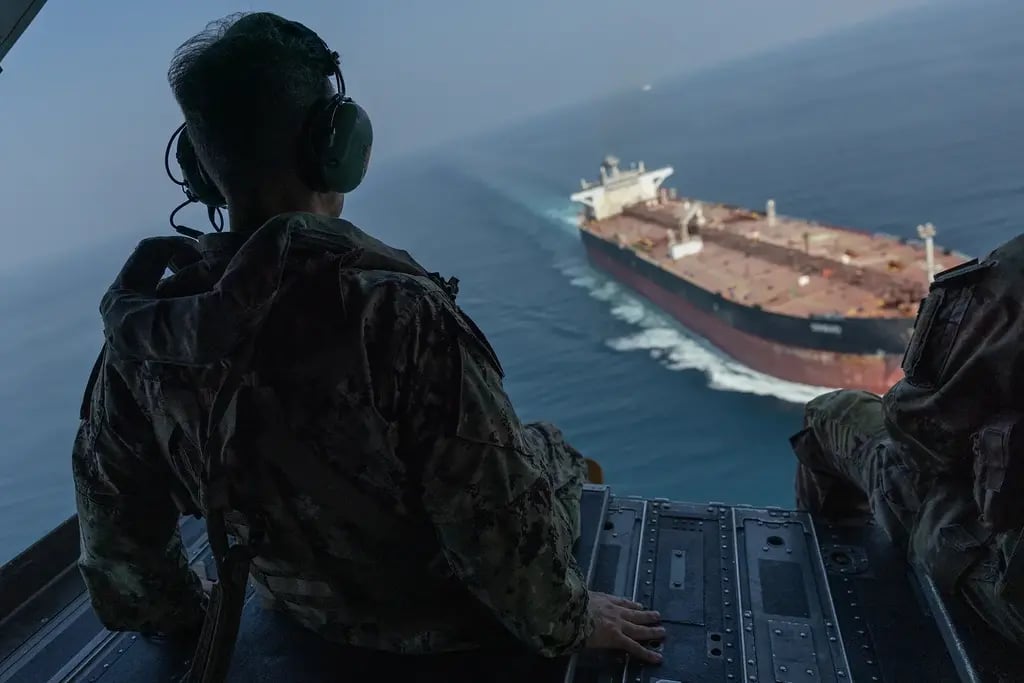
US CENTCOM Commander Adm. Brad Cooper visits Strait of Hormuz
(Photo: CENTCOM)
During the visit, Cooper flew aboard a CH-47 Chinook helicopter over the international shipping route to assess the operational environment.
According to CENTCOM, more than 3,000 commercial vessels have successfully passed through the strait with American military support over the past six months.
"We continue to stand shoulder to shoulder with our Gulf partners and the shipping industry," Cooper said. "This visit underscores our strong commitment to continued freedom of navigation through the Strait of Hormuz."
The narrow waterway between Iran and Oman connects the Persian Gulf with the Gulf of Oman and the Arabian Sea and is one of the world's most important maritime routes for oil exports.
CENTCOM said commercial shipping through the strait had gained momentum in recent months after U.S. forces cleared naval mines that it said had been deployed by Iran's Islamic Revolutionary Guard Corps.
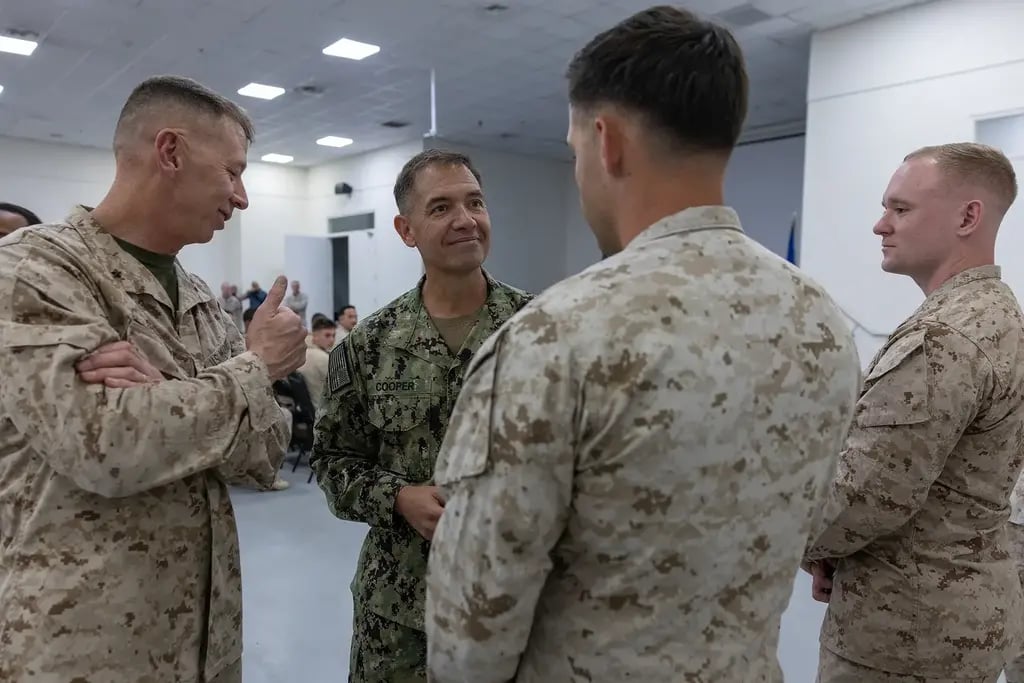
US CENTCOM Commander Adm. Brad Cooper visits Strait of Hormuz
(Photo: CENTCOM)
The American military said the mine-clearing operations had allowed vessels to resume using the strait's international shipping lanes.
"Today, primary transit routes in the Strait of Hormuz remain free and clear of Iranian sea mines thanks to incredible efforts by our people," Cooper said.
CENTCOM also claimed that more than 95% of vessels traveling through the strait in recent months had sailed safely despite what it described as unprovoked aggression by the Revolutionary Guard.
The figures, according to the command, demonstrated that the United States and its regional partners maintained control of the international waterway.
US orders embassy staff to leave Saudi Arabia
The State Department confirmed Sunday that it had ordered the departure of nonemergency U.S. government personnel and their family members from the American Embassy in Riyadh amid fighting between Saudi Arabia and Yemen's Iran-backed Houthi rebels.
The confirmation followed reports of diplomatic evacuations from several locations across the Middle East.
"Effective Friday, the Department of State ordered employees to depart Saudi Arabia due to security risks," the department said in a statement.
It cited recent Houthi attacks on Saudi territory, including strikes against civilian airports and other critical infrastructure that had caused civilian casualties and significant travel disruptions.
"The Iran-backed Houthis have carried out acts of aggression against Saudi Arabia, including attacks on civilian airports and other critical infrastructure," the statement said.
The department warned that the violence could escalate rapidly and spread beyond the areas immediately affected by the fighting.
The evacuation order underscored growing American concerns about the security of diplomatic personnel as hostilities involving Iran and its regional allies threatened to expand.
Sri Lanka evacuates 40 Iranian sailors
In a separate development, Sri Lanka's Foreign Ministry said Sunday that the island nation had coordinated the evacuation of 40 Iranian sailors from 19 commercial vessels operating in international waters near the country.
The operation was conducted at Tehran's request after the sailors experienced unspecified medical problems.
Iranian vessel struck off Sri Lanka
(Video: US Department of War)
Sri Lankan authorities said Iran had submitted its request through established diplomatic channels and that the sailors had since been returned to the Islamic Republic.
The ministry did not explain why the sailors needed to be evacuated or provide further details about their medical conditions.
Local media outlets, along with India's The Hindu newspaper, reported that the sailors had been aboard oil tankers subject to U.S. sanctions imposed as part of Washington's confrontation with Tehran.
A Sri Lankan government source with direct knowledge of the operation told Reuters that the country's navy and coast guard routinely assist with humanitarian missions.
The latest operation followed Sri Lanka's involvement in rescue and repatriation efforts after a U.S. submarine sank the Iranian warship IRIS Dena with a torpedo off the island's coast on March 4, during the first week of the war involving Israel, the United States and Iran.
Dozens of Iranian sailors were killed in that attack, while Sri Lankan authorities helped rescue survivors.
Sri Lanka subsequently assisted in repatriating the bodies of 87 Iranian sailors, as well as 32 survivors from the Dena and 208 crew members from another Iranian vessel.
Iranians stockpile food and medicine amid fears of renewed war
With Israel's elections two days away and the U.S. midterm elections about a week and a half away, fears of renewed fighting are also growing among ordinary Iranians.
As leaders in Washington, Jerusalem and Tehran exchange warnings and threats, residents of the Iranian capital are preparing for the possibility of another military escalation and further economic disruption.
In interviews with The Associated Press, Tehran residents described stockpiling food, medicine and emergency supplies, while some said they were preparing to leave the city if hostilities resumed.
Fereshteh Hajipour, a 35-year-old mother of a toddler, said she had begun accumulating over-the-counter medications and food in anticipation of a possible war involving more powerful bombs.
The U.S. blockade of Iranian ports has contributed to medicine shortages, according to AP, although there have been no indications of widespread shortages of food or other essential goods.
Iran's economic difficulties have intensified as the rial has fallen to record lows and inflation has surged, severely eroding household purchasing power.
A typical monthly salary in Iran is about 400 million rials, equivalent to roughly $150, leaving many families struggling to afford basic necessities.
"Grocery shopping can cost half a month's salary," said Mohammad Mohammadi, 36.
Despite soaring prices, some residents said they felt compelled to purchase additional supplies because of the confrontation in the Strait of Hormuz and the possibility that trade disruptions could worsen.
Mohammad Abdi, 39, said he had stocked up on dried dates, cooking oil and rice for his family.
"I'm worried the situation could get worse," he said.
Others are preparing to leave Tehran altogether.
Hashem Vajdani, a 45-year-old fitness trainer, said he had already packed his belongings and planned to seek refuge in a smaller town in northern Iran if fighting resumed.
"I've already packed my things to go to a safer town in the north of the country," he said. "Today I bought more canned food, crackers and extra blankets."