


When the state-funded girls-only Inbar School opened in Jerusalem seven years ago, it faced criticism and skepticism over the creation of a single-sex school within Israel's secular public education system, which defines itself as egalitarian and coeducational.
Critics argued that establishing a school exclusively for girls contradicted liberal values, while others predicted that enrollment would be low. Seven years later, the school attracts hundreds of applicants each year.
Gallery
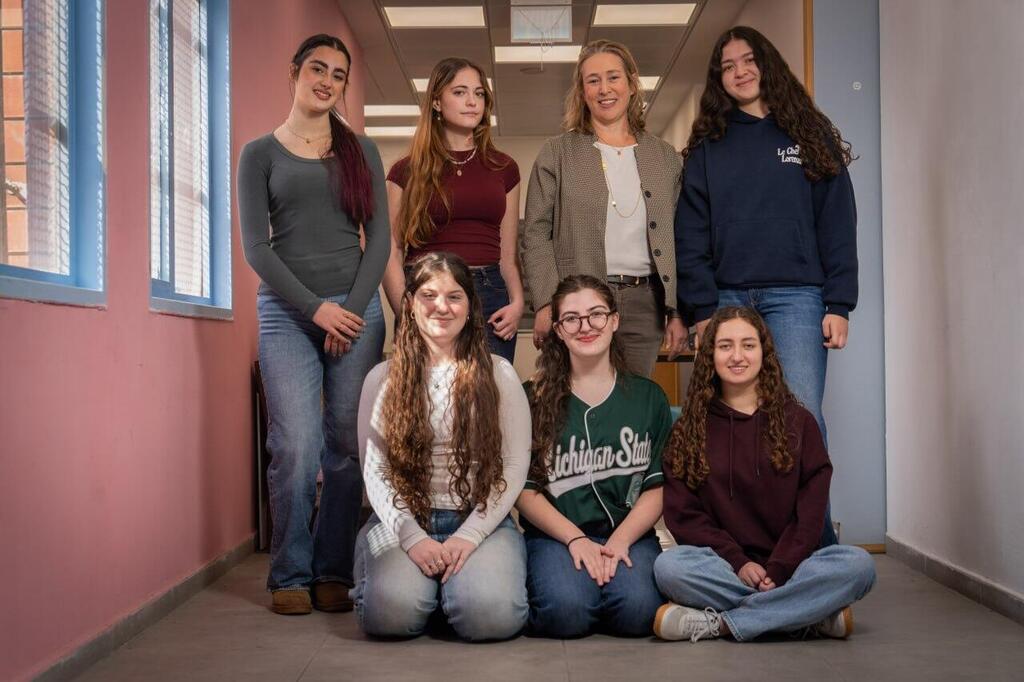
Girls-only Inbar School principal Miriam Leibowitz-Ashraf (center) students
(Photo: Shalev Shalom)
Inbar, operated by the Jerusalem Association for the Advancement of Education, opened with just 17 students. Today, it has about 300 students and a waiting list of secular families seeking to enroll their daughters, which is roughly twice the school's capacity.
The school's first graduating class, whose students enrolled in seventh grade when the school opened, achieved a 100% matriculation rate on the nationwide high school graduation exams, with half graduating with honors. The second class also graduated this year.
"Creating a separate learning environment provides fertile ground for advancing gender equality," principal Miriam Leibowitz-Ashraf said.
"A girls-only environment creates a space that gives students an equal opportunity to develop and grow," she said. "Our goal is to help secular girls realize their full potential and excel academically, socially and ethically."
Leibowitz-Ashraf said the suspicion that surrounded the school's opening has faded over time. Families that were initially hesitant enrolled their daughters, and younger sisters have followed older siblings into the school.
"To break glass ceilings, it isn't enough simply to encourage girls," she said. "Gender gaps don't stem from a lack of talent, but from a sense of self-confidence that this environment enables them to develop."
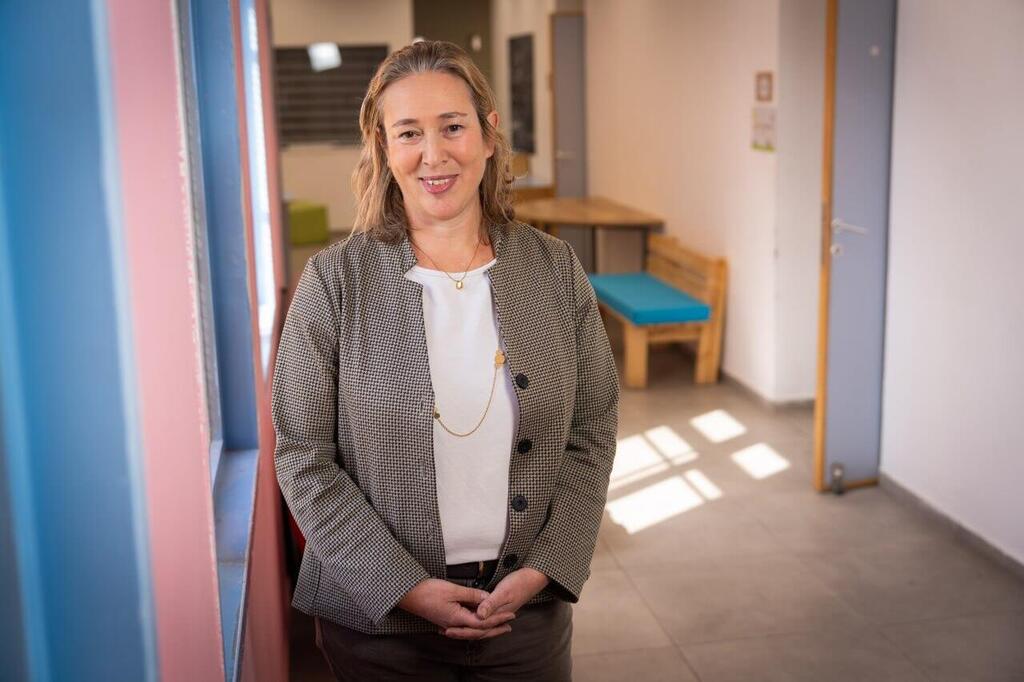
Leibowitz-Ashraf
(Photo: Shalev Shalom)
She argued that girls receive more restrained social messages than boys from an early age.
"In a safe, protected girls' environment, we can quiet the background noise, allowing students to focus on being themselves," she said.
Leibowitz-Ashraf described the school's approach as an innovative educational model with a gender perspective supported by international research. Responding to criticism of gender separation, she emphasized that students are not isolated from boys.
"This isn't about living separate lives," she said. "It's about creating a space that allows girls to grow. They have boys in their lives. School is girls-only, but they interact with boys outside school hours."
Each school day begins with physical exercise, reflecting neuroscience research suggesting that academic achievement benefits from combining cognitive learning with physical activity.
To address the roots of gender inequality, the school also emphasizes public speaking, self-expression and leadership, while encouraging students to believe they "can become whoever they want to be."
One day each week is devoted to learning outside the classroom. Students participate in leadership and democracy programs, visit the Knesset and the Supreme Court, and meet women working in business, law, medicine, the arts and other fields as role models.
"We don't talk about feminism," Leibowitz-Ashraf said. "We teach skills. We focus on doing rather than talking."
Students also take an advanced course in gender studies and conduct independent research projects on related topics.

Shiri Zelcbuch
(Photo: Shalev Shalom)
Shiri Zelcbuch, who graduated this year, said her mother encouraged her to attend, although some relatives worried she would later struggle to communicate with boys.
"What makes a girls' school special is the atmosphere," she said. "Everyone can be whoever they want to be, express what they think without feeling judged. We all studied the same material and everyone had their own place."
"The school shaped me," she said. "I would absolutely make the same choice again and recommend it to other girls. It gave me a huge boost in self-confidence. We never felt boys were missing. It was simply a fact that only girls studied there."
Her mother, Dana Zelcbuch, said she initially hesitated but was ultimately won over by what she described as the school's focus on empowering girls.
"Inbar allows every student to learn in her own way, adapting education to the girls' abilities, personalities and strengths," she said.
"It may not be politically correct to say, but there is no background noise," she added. "The girls don't come to impress anyone or compete socially. They develop as individuals, build their identities and gain tools that will stay with them throughout their lives. This model allows girls to reach their full potential without unnecessary distractions."
She argued that separating boys and girls during school years actually removes gender barriers.
"They have more room to express themselves," she said. "Without competition in the early stages of life, girls build confidence and strengthen their identities without feeling diminished."
Addressing criticism that single-sex education could make future interactions with men more difficult, Dana Zelcbuch rejected the argument.
"The girls at Inbar gained confidence and skills they wouldn't receive elsewhere," she said. "They'll communicate with men just fine."
She noted that her daughter did not miss a single day of school during her six years at Inbar.
"People compare the school to the ultra-Orthodox world, as though that makes it inferior, but that's simply not true," she said. "The girls flourish here. I don't know another school where the principal and teachers see educating students as their life's mission."

Shayah Offaim
(Photo: Shalev Shalom)
Shayah Offaim, a member of Inbar's first graduating class, recently completed a year of national volunteer service in the community of Tzafririm.
"I grew up in a feminist family, so they were very supportive," she said. "People always asked whether I missed having boys around, and the answer is no. The school isn't against meeting boys. It simply believes it's better to learn separately. I was in youth movements and stayed friends with boys outside school."
She said the school's academic results demonstrate the benefits of the model.
"At Inbar, girls can ask questions, explore subjects and focus on learning," she said.