


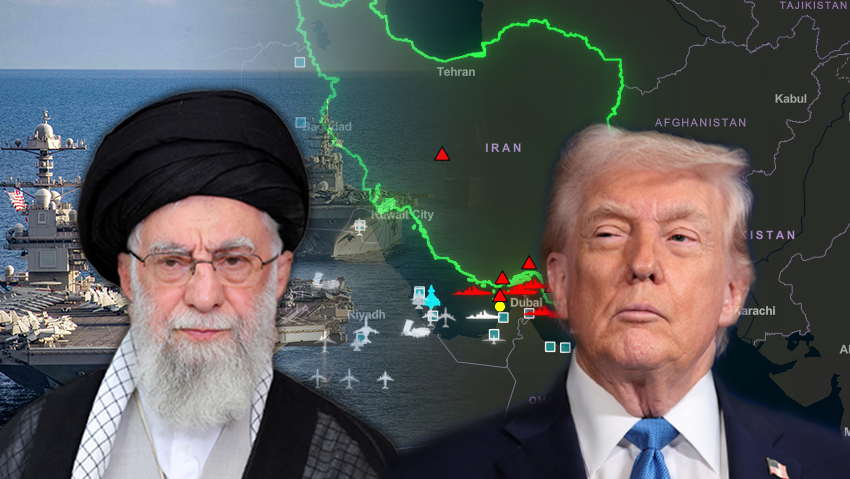
Alongside dozens of fighter jets of various models and air defense batteries positioned to intercept missiles and drones, the United States has in recent weeks deployed at least 10 warships to the Middle East. They are to be joined by the aircraft carrier USS Gerald R. Ford and six additional destroyers.
The U.S. is effectively preparing for the possibility that negotiations with Iran could collapse and a military confrontation between the countries could erupt. If that happens, the offensive could be a joint American-Israeli operation.
The Iranian threat against the aircraft carrier USS Abraham Lincoln, last month


Gallery
(Photo: REUTERS/Jonathan Ernst, Office of the Iranian Supreme Leader/WANA (West Asia News Agency)/Handout via REUTERS)
Brig. Gen. (res.) Yuval Eylon, a senior researcher at the Institute for National Security Studies and former head of the Israeli Navy’s Planning Directorate, said in an interview with Ynet that “the Americans have decided to lay all the cards on the table so they can act as they see fit. But in the end, it’s not about how many assets are in the region, but about the objectives and capabilities of the task force.”
He noted that during the war with Iraq, the United States deployed six aircraft carriers with their strike groups, generating 18,000 sorties over five weeks. “Back then, they said ‘all in’ — we’re going all the way,” he said. “If the Americans are required to act now, the campaign won’t last a day or two.”
“The question now is what the Americans want,” Eylon added. “Time is on their side. If they are coming only to carry out a signaling strike or hit a few key targets in a limited way, that’s one type of event. But if they want a more complex campaign, that’s something else. You need to build a target bank and bring significant force.”
He emphasized that U.S. Central Command is deployed across the region. “There are many more capabilities here beyond the ships,” he said. “They are building a framework that gives them all the tools to make decisions and are bringing substantial task forces. That provides staying power and diverse capabilities. The issue is not the number of ships, but what they can do and what their mission is.”
The strike groups and submarines in the field
Among U.S. naval forces in the region is the aircraft carrier USS Abraham Lincoln and its strike group, which includes the destroyers USS Michael Murphy, USS Frank E. Petersen Jr. and USS Spruance, positioned in the northern Arabian Sea. The aircraft carrier USS Gerald R. Ford, described by the New York Post as the world’s largest warship, and its strike group have begun heading toward the Atlantic Ocean. According to the report, the carrier is accompanied by “a vast fleet of aerial refueling tankers and F-22 and F-35 fighter jets.”
Eylon said each aircraft carrier carries dozens of aircraft for various missions, including strike operations, intelligence gathering, air-to-air combat and maritime warfare. The USS Gerald R. Ford can carry about 75 aircraft and helicopters, including F-35C stealth fighters, F/A-18E Super Hornets for multirole strike missions and EA-18G Growlers for electronic warfare and jamming.
The air wing aboard the USS Abraham Lincoln includes nine squadrons with about 90 aircraft and helicopters, including stealth jets, Super Hornets, Growlers, Seahawk helicopters for search and rescue and Osprey aircraft for logistical support. Despite the carrier’s size — longer than three football fields — it generally has limited self-defense capabilities, Eylon said.
“There are thousands of crew members, a flight deck, communications systems, extensive munitions for aircraft and many other capabilities and assets,” he said. “Therefore, among other reasons, the carrier’s self-defense is relatively limited and mainly for short-range protection.” He added that the task force commander typically operates from the aircraft carrier, directing the battle group from there.
“The task force is built to defend itself against various types of attacks, whether missiles or other means,” he said. “It develops a threat picture and has both electronic warfare and kinetic capabilities, meaning interception using missiles. Another capability is deep-strike capacity, for example with Tomahawk missiles that can be launched from surface ships and submarines over hundreds of kilometers.”
The framework combines defense and offense, including maritime strike capabilities “if attacked by suicide vessels or enemy ships,” he said. “They have surface-to-surface missiles, anti-aircraft guns and systems to intercept underwater threats such as submarines or unmanned vessels.” Such a task force typically also includes submarines responsible for three missions: covert intelligence collection, undersea warfare and strike operations. “Submarines can launch Tomahawk missiles from a location you didn’t even know had forces present,” Eylon said. “An aircraft carrier arrives with such a strike group.”
Interceptor destroyers with offensive capabilities
In addition to the aircraft carriers and their strike groups, additional destroyers have been deployed to the region, some primarily tasked with intercepting threats.
The U.S. Navy destroyers transferred to the region carry guided missiles capable of neutralizing aerial threats and striking targets deep inside enemy territory. They have been deployed near the Strait of Hormuz, in the northern Arabian Sea, the Red Sea and the eastern Mediterranean.
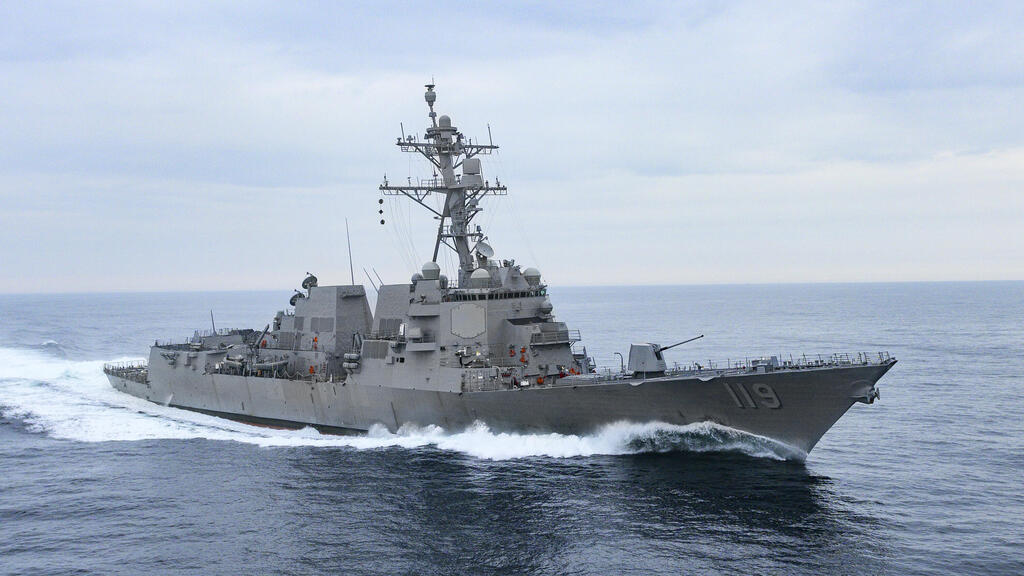
The US destroyer USS Delbert D. Black
(Photo: Lance Davis/United States Navy/Huntington Ingalls Industries)
For example, the guided missile destroyer USS Delbert D. Black is operating in the Red Sea with hundreds of crew members. It is equipped with guns, machine guns, Tomahawk cruise missiles, anti-submarine weapons, surface-to-air missiles and ballistic missile defense systems. It also has electronic warfare systems and decoys against torpedoes and anti-ship missiles.
“The USS Delbert D. Black is an Arleigh Burke-class destroyer designed around the Aegis combat system, so its primary purpose is ballistic defense,” Eylon said. “It can intercept threats and is tasked with defending a specific area. It can conduct strikes, but its main mission is to intercept threats in its assigned sector. It provides area defense.”
The destroyers USS Roosevelt and USS Bulkeley, operating in the eastern Mediterranean, are also Arleigh Burke-class vessels equipped with similar weapons and systems, as are the USS McFaul and USS Mitscher near the Strait of Hormuz.
All are equipped with the Aegis combat system and provide air and missile defense against aerial threats, ballistic missiles and cruise missiles. They also carry Tomahawk cruise missiles with a range of 1,500 to 2,500 kilometers, enabling strikes on strategic targets deep inside Iran from distant maritime positions.
Supply and refueling ships USNS Carl Brashear and USNS Henry J. Kaiser are also in the region, providing logistical support and replenishment. This ensures that surface and air forces can maintain a forward presence and remain on station for extended periods without returning to port.
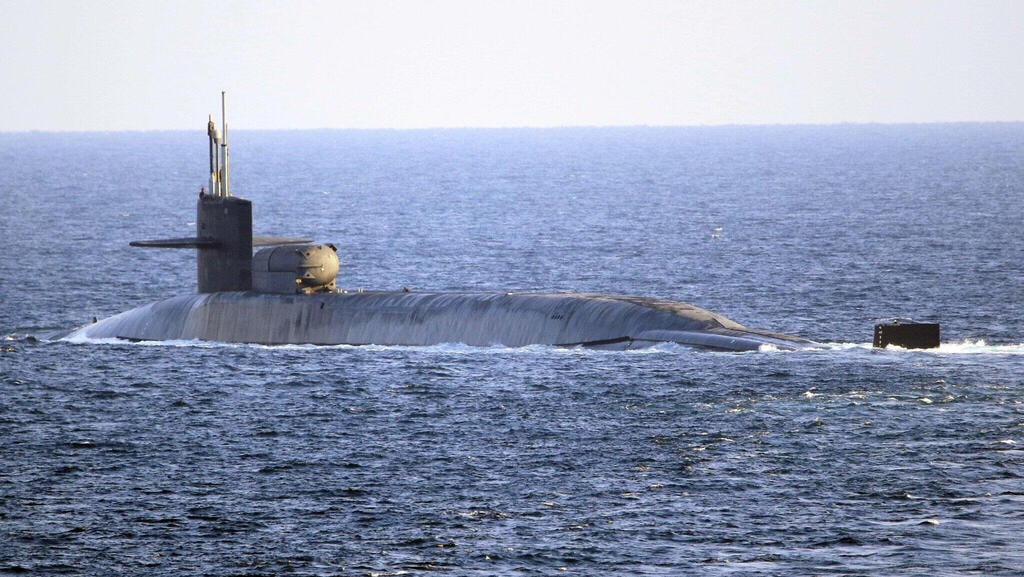
Submarines are also part of the strike groups, including the USS Georgia
(Photo: AP / US NAVY)
The command ship USS Mount Whitney is also deployed, providing integrated command and control capabilities and coordination among naval, air and ground forces. The USS Lewis B. Puller, which serves as a floating sea base, is in the area as well, along with Coast Guard vessels such as the USCGC Canberra, USCGC Tulsa and USCGC Santa Barbara, supporting ongoing operations and the protection of shipping lanes.
The reinforcement package also includes the nuclear-powered submarine USS South Dakota, which provides intelligence, surveillance, reconnaissance and conventional strike capabilities beneath the surface, and the submarine USS Georgia, which also carries Tomahawk missiles.
Dozens of fighter jets and air defense batteries
The United States is not relying solely on naval forces. Air defense batteries have been deployed in several countries in the region, along with fighter jets.
In recent days alone, the U.S. has sent about 50 fighter jets of various models to the Middle East, joining those already deployed. According to reports, the U.S. Air Force has stationed about a dozen F-15E aircraft at regional bases.
In addition, six F-35 jets from the Vermont Air National Guard were seen in recent weeks landing in the Azores, a Portuguese archipelago in the Atlantic Ocean, after being moved from the Caribbean to a position closer to the Middle East. The New York Post reported that the dozens of aircraft recently sent to the region also include F-16 Fighting Falcons, F-22 Raptors and F-35s.
Several U.S. Navy EA-18G Growler electronic warfare aircraft also left Puerto Rico in recent weeks and landed in Spain. Even before that, squadrons of F-35A, F-15E, F-16 and A-10 aircraft were deployed in the region under Central Command, alongside P-8A Poseidon maritime patrol aircraft and MQ-9 Reaper drones. KC-135 and KC-46A refueling aircraft that have also landed in the region enable extended range and longer-duration operations.
As for air defense batteries, reports said the United States has deployed an additional THAAD battery as well as Patriot batteries at bases hosting its forces across the Middle East, including in Jordan, Kuwait, Bahrain, Saudi Arabia and Qatar.
Satellite imagery has indicated that the U.S. positioned another Patriot battery at Al Udeid Air Base in Qatar, its main base in the Middle East, which was also targeted by Iran in response to strikes on its nuclear facilities in June last year.
THAAD systems are capable of intercepting ballistic missiles outside the atmosphere, while Patriot systems defend against lower-altitude and shorter-range threats.