


Lithium batteries have become an inseparable part of daily life in recent years. They are found in electric and hybrid vehicles, scooters and bicycles, as well as in smaller devices such as laptops, phones and tablets. But even something as routine as going to sleep next to a charging phone can turn into a fire trap in an instant.
"If people understood that there is something like a small gasoline tank on the back of their phone, they would be more careful," said Roy Zuckerman, head of the Hazardous Materials Division at the national Fire and Rescue Authority. "These are materials that have to be treated cautiously. Don't charge them at night and certainly not next to the bed."

Over the past 20 years, the technology has brought about a major revolution, allowing people to work and travel without being tethered to an electrical outlet. But even a minor internal battery failure can lead to an immediate fire.
According to Zuckerman, there are three main types of failures that can trigger such a blaze. The first is mechanical failure caused by an impact. The second is a thermal failure in which the device heats up for an external or internal reason and reaches a point of no return. The third is an electrical short caused by the use of a nonstandard charger or a defective battery.
"When the battery goes beyond 100% charge, a short circuit is created," Zuckerman explained. "At that point, an uncontrollable process begins in which it heats up. The heat is released, the flammable gases inside ignite immediately and it becomes an extremely dangerous event."
Contrary to what some might assume, he said, the greatest danger is not necessarily on Israel's roads. Although hundreds of thousands of electric and hybrid vehicles are now in use, the number of fires in which the battery was the initial trigger is very low, thanks to sophisticated cooling systems that protect them.
Electric bicycles and scooters, however, do not have such cooling systems, and fires involving them are occurring with alarming frequency.
Ignition within seconds
Data from Israel Fire and Rescue Services show that a fire caused by an overheating lithium battery occurs nearly every day and a half. In 2025 alone, about 256 fires linked to such batteries were reported, killing four people and injuring dozens with varying degrees of severity. Most of the injured were children ages 10 to 13.
Among the victims was an 11-year-old boy from Ashdod who was killed the previous year after charging his scooter in his bedroom.
The figures reflect a continuing and troubling trend. From 2022 through 2024, about 700 such fires were reported in Israel, causing an average of about five deaths a year and injuring dozens.

11-year-old Li-Yam, who was killed in the Ashdod fire
(Photo: Courtesy of the family)
Fire and Rescue officials stress that makeshift modifications to batteries or increases to the speed of electric vehicles are strictly prohibited because they push batteries to extreme operating conditions and can cause failures. Charging such vehicles inside the home is also prohibited.
In the past, an apartment fire would often begin with smoke and then develop intense heat, leaving residents time to escape. Today, officials say ignition can occur in just 15 seconds, leaving people virtually no time to get out. Their unequivocal recommendation is to install smoke detectors in every room, particularly bedrooms and living rooms.
Against that backdrop, the Fire and Rescue Authority has begun working with Israel Railways on warning announcements at stations, targeted safety information aboard trains and training for inspectors. The next stage calls for designating train cars specifically for electric bicycles, alongside expanded educational programs in schools.
At the same time, scientists in Israel and around the world are investing heavily in research into safer alternatives, including sodium-ion batteries, solid-state batteries that do not contain flammable materials and green hydrogen technology being tested in a limited Transportation Ministry pilot.
Fire officials estimate that the results of some of this research could begin to be seen in practical use within about three years. Until then, the danger remains an everyday one.
'There is zero awareness'
Few have paid a heavier price than Shiron Alter.
Her disaster occurred two years ago during what had been a routine ride on a mobility scooter with her son Yotam, who was 10 1/2 at the time. The scooter suddenly caught fire and exploded in central Tel Aviv because of a lithium battery that had been improperly handled at an unauthorized repair shop.
Shiron was critically injured, suffering burns over 80% of her body. Yotam died of his injuries a week later.
Recently, after a long journey that included a year of hospitalization and grueling rehabilitation at Sheba Medical Center, she returned home. Now, out of her personal devastation, she speaks about what has become the new mission of her life.

Shiron and her late son Yotam
(Photo: Courtesy of the family)
"What happened to us was not an ordinary case," Shiron said. "When you see the video of the scooter fire and watch us get ourselves out within six seconds, you understand that it's a miracle I survived. I wasn't supposed to make it out.
"I heard that while I was lying in the hospital, four more children burned to death because of lithium batteries, and it drove me crazy that it was still happening. There is zero awareness. Everyone is walking around without realizing they have ticking time bombs in their homes and everywhere around them."
Shiron approached the authorities and explained what urgent changes she believes are needed to prevent future disasters, from introducing fire safety regulations for workplaces and private homes to enacting comprehensive legislation, which she says does not currently exist in Israel.
The main problem, she said, is teenagers ordering spare parts from abroad and modifying vehicles themselves using tutorials on social media, along with unauthorized repair shops offering cheap and dangerous solutions.
"My battery was worked on at one of those unauthorized shops, and that's why this disaster happened to us," she recalled. "The person who installed it lives with the agony of that. He's my cousin. He would never have wanted anything like this to happen to me or my son, but he had no idea.
"There are extremely toxic substances inside these batteries. It was like entering a chamber filled with poisonous gases. That's what happened to me. I was immersed in gas and burning fire."
Shiron stressed that the public does not understand the force of a lithium battery explosion and its blast wave, which she said can break walls and blow door frames from their fittings. She also said such a fire cannot be extinguished with a standard fire extinguisher.
The solution, she argues, must include a legal ban on the sale of discounted, refurbished or secondhand batteries, along with mandatory annual inspections to identify defective batteries.
Her public campaign is unfolding alongside a grueling daily struggle with the consequences of her injuries and her loss. After a year in the hospital, including two months under sedation and seven months of orthopedic rehabilitation, she is now trying to rebuild her life.
She has enrolled in studies to become a Tao Therapy facilitator and hopes to establish a nonprofit organization that will work with government ministries to regulate oversight of the field. At the same time, she gives lectures in cooperation with the national Fire and Rescue Authority.
"I am in physical and emotional agony. I am in pain all the time," Shiron said. "Losing my only child hurts, and I don't want other people to hurt like this.
"When I ask myself how you live in a body like this, I understand that I can't go back to the job I had, the home I had and I can't be the mother to the child I had.
"My motto right now is to do what remains with whoever remains. We have to focus on what we still have and be careful with lithium batteries. I wouldn't have wanted to be doing this. I just want to do what needs to be done to keep people safe because I care."
The goal: An alternative to lithium
While public awareness has focused mainly on fires involving the smaller batteries used in bicycles, scooters and smartphones, a danger on a very different scale is developing largely under the radar.
As Israel becomes increasingly reliant on renewable energy sources such as solar and wind power, it needs massive storage facilities with capacities of hundreds of megawatt-hours to support the electricity grid.
A scenario in which a lithium-based storage facility of that size catches fire would present an unprecedented environmental and safety threat. That reality is accelerating the global race for safer alternatives and raising the question of whether the next solution could emerge from Israeli research and startups.
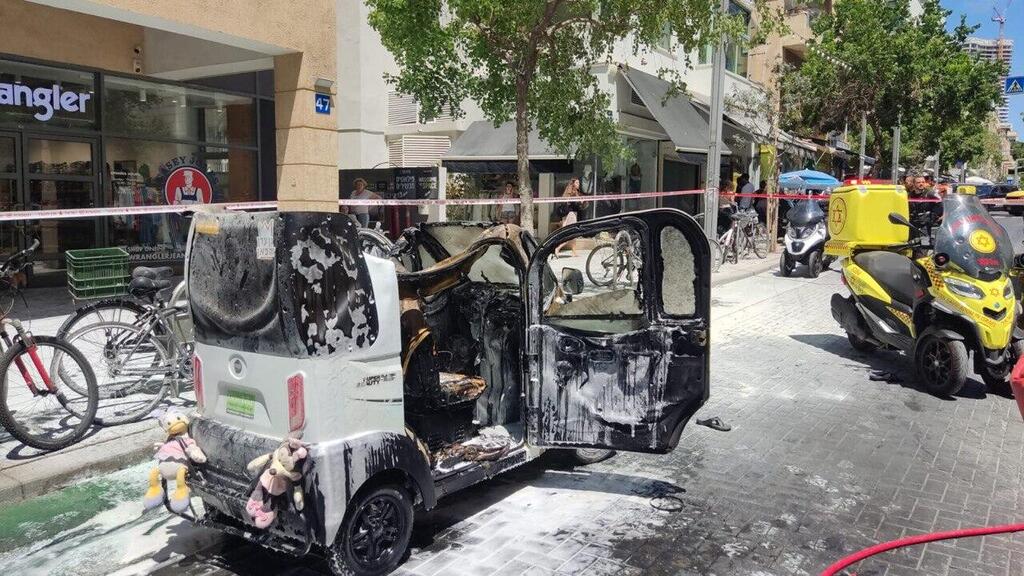
The mobility scooter in which Yotam was killed
Prof. Brian Rosen, chief scientist at the Energy and Infrastructure Ministry, draws a clear distinction between household and personal batteries and the large-scale storage systems used for the electricity grid.
"For the public, the more urgent issue is the smaller batteries — scooters, bicycles and laptops — because that's where you see all the incidents on planes or in homes," he said. "The most suitable solution for smaller batteries is solid-state batteries."
In that technology, the flammable organic liquid between the battery's electrodes is replaced with a solid material, reducing the risk of a spreading fire.
But when it comes to large-scale storage facilities for the power grid, solid-state batteries become too expensive to be economically viable.
"Imagine a battery fire at a major electricity storage facility. It could be a catastrophe," Rosen said. "There is an inherent danger if we want to use the existing technology. That's where we see aqueous batteries as the solution. Water-based batteries address the safety concern and can also be economically viable."
In those batteries, the flammable organic solution is replaced with an aqueous one using widely available materials such as sodium, iron, zinc and bromide, eliminating the risk of ignition.
Israel has identified aqueous batteries as part of its national strategy for integrating safe energy storage into the power grid.
The Energy Ministry's chief scientist's unit supports the technology from the basic research stage at universities through the establishment of startups and field pilots. Four active studies on aqueous batteries are currently receiving funding at Bar-Ilan University, the Hebrew University of Jerusalem and Ariel University.
At the same time, since 2023, the ministry has invested about 54 million shekels in the National Institute for Electrochemical Energy Storage, which operates at the Technion and Bar-Ilan University and brings together academic research and industry.
The expectation is that in the coming years, the first Israeli startups in the field will emerge from laboratories and begin launching pilot projects.
If those breakthroughs mature into commercial products, Israeli research could not only help secure the country's power grid but also provide the global energy industry with the long-awaited breakthrough in battery safety.