

The president of the United States is again threatening Iran’s leaders as the Pentagon continues building up forces in the Middle East and preparing for possible war if no agreement is reached. On Friday, when asked about regime change, President Donald Trump said it “would be the best thing that could happen”, arguing that Iran’s leaders have spent 47 years “talking and talking and talking. In the meantime, we’ve lost a lot of lives while they talk.”
At the same time, two senior U.S. officials told Reuters that the U.S. military is preparing for a prolonged operation in Iran that could last weeks if Trump orders a strike. They said that unlike Operation Midnight Hammer, which targeted only Iran’s nuclear facilities, current planning is more complex. One official said an extended campaign could include strikes on Iranian government facilities in addition to security targets and nuclear sites, and noted that Washington expects Tehran to respond, potentially triggering a period of reciprocal retaliation.
Trump says regime change may be the best option
(Video: FOX NEWS)


Asked at the end of a visit to Fort Bragg in North Carolina what could prevent a strike, Trump said it would require Iran to agree to the deal he believes it should have accepted from the outset. If such an agreement is reached, he said, there would be no attack, but he added that historically Iran has not followed through. He expressed hope that Tehran would engage seriously, arguing that so far it has talked extensively without taking meaningful action.
Earlier, Trump discussed his decision to deploy a second aircraft carrier to the region — the USS Gerald R. Ford, the world’s largest — which is expected to arrive within four weeks from the Caribbean and join the USS Abraham Lincoln already in the Middle East.
He said the United States had sent a major carrier toward Iran and that he would prefer to see Tehran reach an agreement. At the same time, he acknowledged that negotiating with Iran is difficult, noting that he believed a deal had been close previously before the launch of Operation Midnight Hammer. He said the United States has since restored its strength and projected significant power, adding that at times creating a sense of deterrence or fear is necessary to resolve such confrontations.
When Trump threatened last month to strike Iran if its leaders did not agree to curb the nuclear program, the Pentagon was in a relatively weak position to back him. More than 30,000 U.S. troops stationed in the Middle East, including at eight permanent bases, lacked sufficient air defense systems to protect against an expected Iranian retaliation.
Trump shares footage on his social media account of a U.S. F-22 fighter jet
(Credit: Truth Social Network)
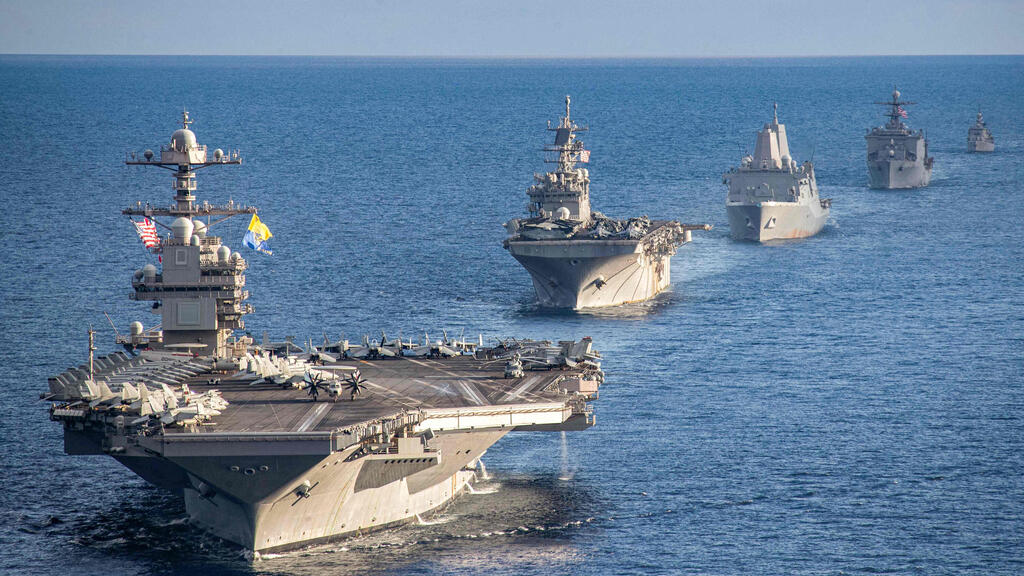
The USS Gerald R. Ford and its strike group
(Photo: Maxwell Orlosky / US DEPARTMENT OF DEFENSE / AFP)
Additional fighter jets required for the broad operation Trump described were stationed at U.S. bases in Europe and the United States. According to three senior U.S. officials who spoke to The New York Times, national security officials persuaded Trump to wait while the Pentagon rebuilt its capacity to attack — and, more importantly, to defend — in 11 countries that could be exposed to an Iranian response.
Over the past three weeks, as talks between Iran and the United States have begun, the Pentagon has been preparing for war. The deployed platforms include not only offensive capabilities but defensive ones, amid assessments that Iran would retaliate. Senior administration officials said Trump has not yet decided whether to strike Iran.
According to the officials, the options under consideration include military action against Iran’s nuclear program and its ballistic missile capabilities. Trump is also weighing the possibility of deploying U.S. commandos to strike specific military targets in Iran. “But before the Pentagon can do that, it needs to be more prepared,” the officials said.
Trump at Fort Bragg
(Video: The White House)
That preparation includes deploying air defense systems at bases hosting U.S. forces in the region — not only at Al Udeid Air Base in Qatar, which Iran targeted last year in response to Operation Midnight Hammer, the U.S. strikes on nuclear facilities in Fordo, Natanz and Isfahan — but also at bases in Iraq, Bahrain, Kuwait and Jordan.
The USS Abraham Lincoln, accompanied by three warships equipped with Tomahawk missiles, is at the center of a naval force of 12 vessels in the region. F-35 stealth fighters and F/A-18 strike aircraft aboard the carrier are within range of targets in Iran. The United States has also sent more than a dozen F-15E fighter jets to the area.
B-2 bombers — the aircraft that struck nuclear sites during the war — and other long-range bombers based in the United States are on higher-than-usual alert after the Pentagon raised readiness levels when Trump requested response options to Iran’s violent suppression of protests.
Military experts note that early signs of major operations include the number of aerial refueling aircraft and EA-18 Growler electronic warfare planes in the region. Such aircraft are aboard the Lincoln, and U.S. Central Command recently deployed several to a base in Jordan. Flight tracking data indicate that the United States is also moving additional aircraft — including tankers and reconnaissance planes — closer to the Middle East.
Another sign of serious offensive planning would be if the U.S. Navy moves a ballistic missile submarine from the Mediterranean to the Red Sea or, more likely, the Arabian Sea, where it would be positioned to strike targets in Iran.
In addition to offensive assets, the Pentagon is deploying Patriot and THAAD air defense systems to the region to help protect U.S. forces from Iranian missiles.
First published: 00:23, 02.14.26