

A Colombian soldier serving with the Ukrainian military recently made a disturbing discovery on the battlefields of Eastern Europe: several fellow Colombians seeking to join the fighting had links to criminal organizations back home.
“After the connections were discovered, they were screened out and sent home,” said Taras Palianytsia, an officer at the Ukrainian Defense Ministry’s recruitment center for foreign volunteers.
But according to a Financial Times report published Thursday, this was not an isolated case.
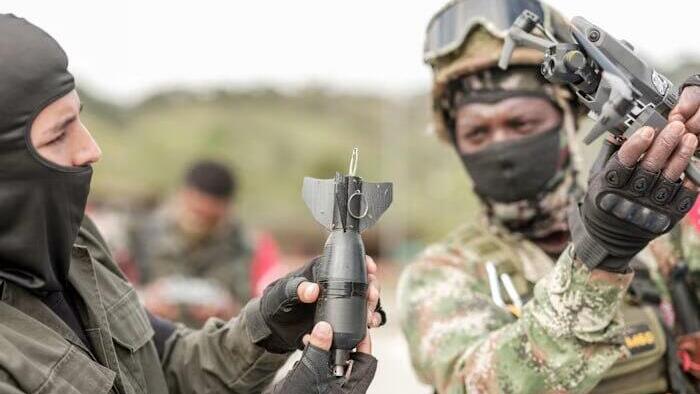
Evidence gathered over the past year indicates that Colombian criminal organizations and illegal armed groups are attempting to send fighters to Ukraine so they can acquire advanced drone-warfare skills and later use them against Colombia’s military.
“The recruitment schemes are highly sophisticated, but what worries me most is the level of professional expertise they are acquiring,” a Colombian aid worker in Ukraine told the newspaper on condition of anonymity.
“Former paramilitaries, former guerrillas and former soldiers are fighting and learning together here how to operate drones.”
The war returns home
Drones have fundamentally transformed the battlefield in Ukraine. They are now beginning to produce a similar transformation in Colombia’s decades-old internal conflict.
In its fight against guerrilla groups and drug cartels operating in remote jungles and mountainous regions, the government in Bogotá could once depend almost entirely on its control of the skies.
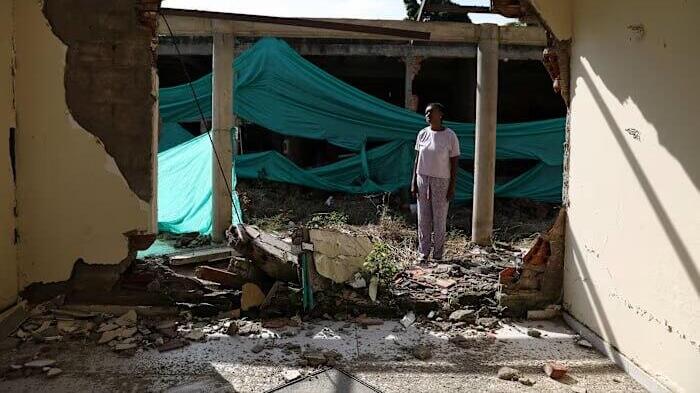
A woman stands amid the ruins of her home after a FARC rebel drone attack in Robles, Colombia
(Photo: Santiago Saldarriaga/AP)
That advantage can no longer be taken for granted.
“The drone industry has exploded, and criminals have adapted the technology for attacks,” said outgoing Colombian Defense Minister Pedro Sánchez, an air force general.
He described the development as a “significant challenge to air superiority on the battlefield.”
According to Colombia’s Defense Ministry, illegal armed groups carried out 264 drone attacks during 2024 and 2025.
Most involved cheap commercial drones modified to carry explosives or drop them on soldiers, military posts and other installations.
The attacks were attributed primarily to the National Liberation Army, known as the ELN, and dissident factions of the Revolutionary Armed Forces of Colombia, or FARC, formerly the country’s largest rebel organization.
Official figures show that 15 soldiers were killed and another 153 wounded in the attacks, many of which occurred in jungle and mountainous areas where coca, the plant used to produce cocaine, is cultivated.
The threat is no longer limited to security forces.
In 2024, a 10-year-old boy was killed and 12 other civilians were wounded when a drone dropped a grenade during a soccer match in Colombia’s Cauca department.
The Guardian reported at the time that it was the country’s first known fatality caused by an armed-drone attack.
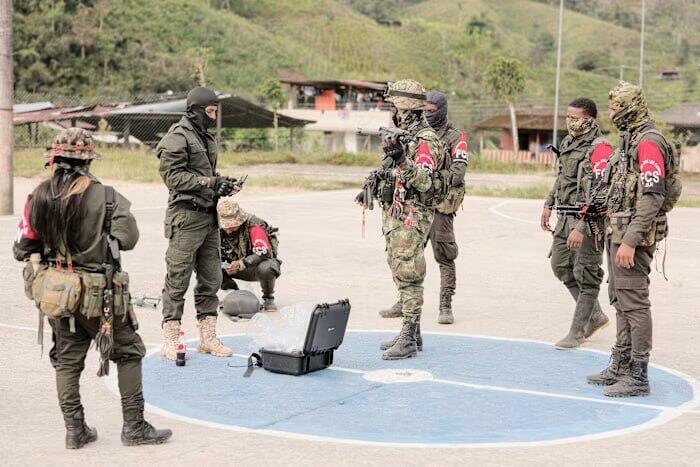
A group of guerrilla fighters in a rebel-held village in southwestern Colombia receives drone training. ‘The drone industry has exploded’
(Photo: Alex Kemman)
In May, one soldier was killed and six others were wounded while patrolling a coca-growing region. A month earlier, drones killed three soldiers near the Ecuadorian border and damaged a military radar system in Cauca.
Seven people were killed in attacks on a military base in December.
“This is a dramatic change that has affected mobility and the chances of survival on the battlefield,” Sánchez said.
He said the Colombian military successfully “neutralized” 96% of attempted drone attacks last year, including through radio-frequency jamming and the physical destruction of the aircraft.
Armed groups, however, are now trying to learn from the Ukraine war how to bypass those defenses.
Cartels seek FPV expertise
A Colombian drone operator fighting in Ukraine said cartel recruiters were searching for people capable of learning how to assemble and operate first-person-view drones.
FPV drones are controlled through cameras that transmit live images to their operators. The small, agile aircraft are generally flown directly into their targets and detonate on impact.
Their speed and maneuverability make them particularly difficult to intercept.
“They are already beginning to use FPV drones in Colombia,” the operator told the Financial Times from the southern front in Ukraine’s Zaporizhzhia region.
“But what they still do not know is how to encrypt the communications between the drone and the person flying it, or how to install the explosive charge the way it is done here in Ukraine.”
Armed groups are also trying to obtain drones connected to their operators through thin fiber-optic cables.
Unlike aircraft controlled through radio signals, fiber-optic drones do not depend on wireless communications and are therefore far more difficult to disrupt through electronic jamming.
The technology expanded rapidly during the Russia-Ukraine war and has since been adopted in other conflicts.
A $1.6 billion drone shield
Colombia’s government has attempted to curb the growing threat by imposing tighter restrictions on drone imports.
In January, it announced plans to establish a $1.6 billion “counter-drone shield” and approved approximately $271 million for the first stage.
The program is expected to include frequency-jamming equipment and fixed and vehicle-mounted detection systems intended to protect security forces and strategic installations.
Experts warn, however, that purchasing defensive technology will not be enough.
They argue that Colombia must also prevent returning fighters from transferring the battlefield knowledge they acquired in Ukraine to cartels and guerrilla organizations.
Colombian military veterans, hardened by decades of internal conflict, have long fought in distant wars, including in South Sudan, Yemen and Ukraine.
An estimated 500 Colombians have been killed in Ukraine during the four years since Russia launched its full-scale invasion.
“Colombians can learn and adapt very quickly and withstand difficult conditions of service,” Palianytsia said.
“They have proven themselves to commanders, who really like these guys.”
‘Cannon fodder’
The involvement of Colombian citizens in the Ukraine war has provoked intense controversy at home.
In October, outgoing President Gustavo Petro claimed that “the Ukrainians treat Colombians as an inferior race” and called on those he described as “cannon fodder” to return home.
In an effort to reduce the financial incentive for joining foreign armies, Petro’s government raised military salaries and ratified a United Nations convention against mercenaries.
Sánchez said the departure of Colombian fighters for distant battlefields was a “sad reality” driven by the gap between the higher wages offered abroad and the comparatively low military pensions available in Colombia.

Abelardo de la Espriella, set to become Colombia’s president Friday. Will the ‘security hawk’ shift the balance of power?
(Photo: Jaime SALDARRIAGA / AFP)
Colombia’s armed forces have battled drug cartels and guerrilla organizations for decades.
The country’s internal armed conflict is estimated to have killed approximately 450,000 people between 1958 and 2016.
FARC disarmed under a 2016 peace agreement, but dissident factions rejected the deal and continued fighting.
Armed groups remain involved in drug trafficking, illegal mining, extortion and other illicit industries.
Their activities expanded during Petro’s presidency, when his government spent roughly three years attempting to negotiate with them under its “total peace” policy before adopting a more aggressive approach near the end of his term.
Petro is due to hand power Friday to right-wing President-elect Abelardo de la Espriella, who has promised a hard-line security policy and the construction of prisons in the jungle. De la Espriella’s inauguration is scheduled for August 7.
Following another drone attack on the military, De la Espriella said his administration would prioritize “restoring state authority in the areas most severely affected by violence.”
But he will inherit a country in which the balance of power has already shifted.
“The number of drones in the possession of these groups could very easily overwhelm any military or civilian target,” warned Elizabeth Dickinson, deputy director for Latin America at the International Crisis Group.
Colombia’s armed forces, she said, have “completely lost their monopoly over the airspace, and that is an enormous strategic shift.”