

Prime Minister Benjamin Netanyahu said Monday that he had vowed there would be no second Holocaust, as Israel marked its annual Holocaust Remembrance Day at a state ceremony held at Yad Vashem in Jerusalem.
Speaking at the prerecorded opening ceremony at Warsaw Ghetto Square, which was held without a live audience due to Home Front Command security restrictions, Netanyahu said Israel has transformed since the Holocaust from a powerless people into a strong and sovereign state capable of defending itself.
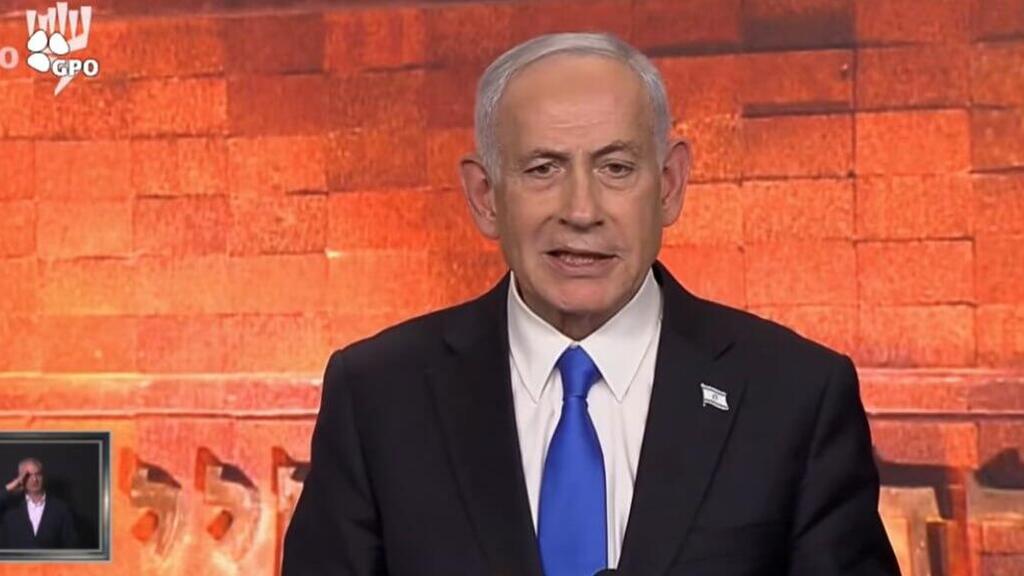
“By virtue of my role as prime minister, I promised — there will be no second Holocaust,” Netanyahu said. “Year after year on Holocaust Remembrance Day, I repeated that commitment. This year, we fulfilled it.”
The ceremony, held under the theme “The Jewish Family in the Holocaust,” included speeches by both Netanyahu and President Isaac Herzog, the lighting of memorial torches by six Holocaust survivors, and prerecorded segments honoring victims and survivors.
Netanyahu used his remarks to contrast the condition of the Jewish people during World War II with the modern State of Israel, saying the country today is “stronger than ever” and capable of responding to existential threats.
During the Holocaust, he said, Jews were “a battered people, crying out in agony,” but today Israel is a “powerful state that roars with strength.”
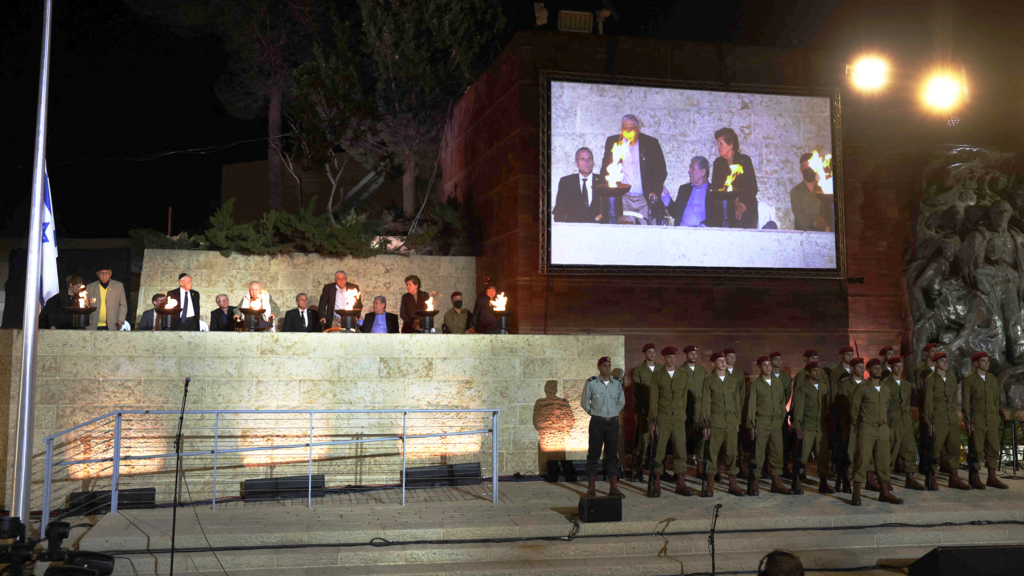
Holocaust survivors light memorial torches at Yad Vashem Holocaust Remembrance Day ceremony
(Photo: Ronen Zvulun/ Reuters)
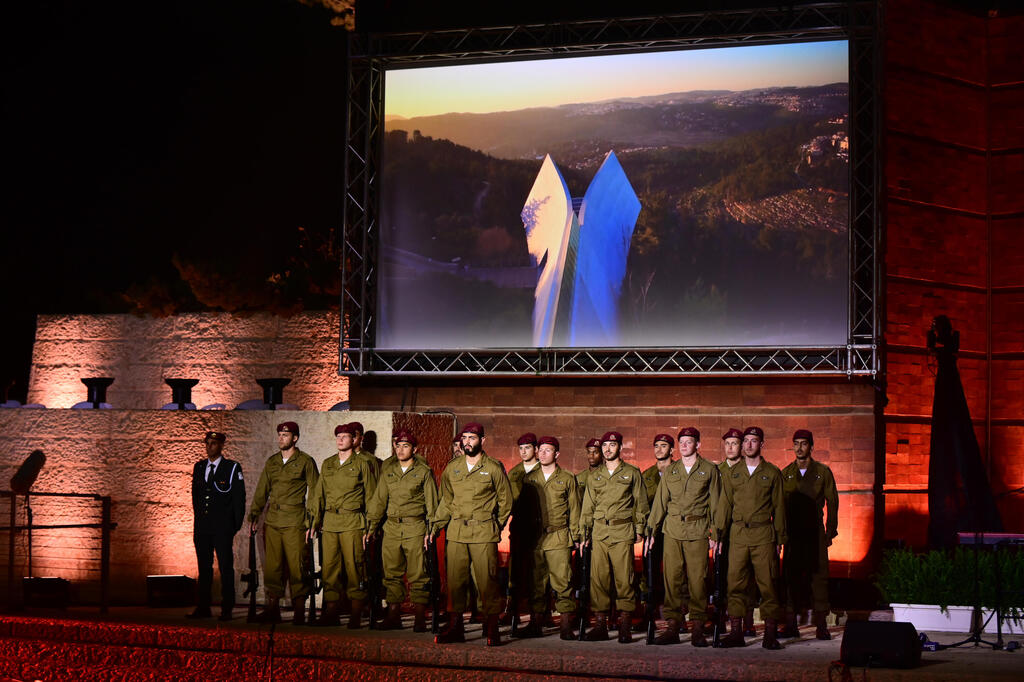
State Opening Ceremony for Holocaust Martyrs’ and Heroes’ Remembrance Day
(Photo: Rafi Ben Hakoon)
A significant portion of Netanyahu’s speech focused on Israel’s ongoing military operations across multiple fronts and its confrontation with Iran and its regional allies. He said Israel, in coordination with the United States, had delivered what he described as one of the most significant blows ever against the Iranian regime.
“We crushed the regime of evil in Iran,” Netanyahu said, adding that Tehran had sought to develop nuclear weapons and tens of thousands of ballistic missiles intended, in his words, to destroy Israel.
He said Iran had also supported regional militant groups aimed at surrounding Israel with what he described as a “ring of fire.”
Netanyahu said Israel’s military actions had systematically weakened Iran’s regional influence and military infrastructure across Gaza, Lebanon, Syria and Yemen. He also referenced the killing of senior militant leaders in recent conflicts, including Hamas military commander Mohammed Deif, Hamas leader Yahya Sinwar, and Hezbollah leader Hassan Nasrallah.
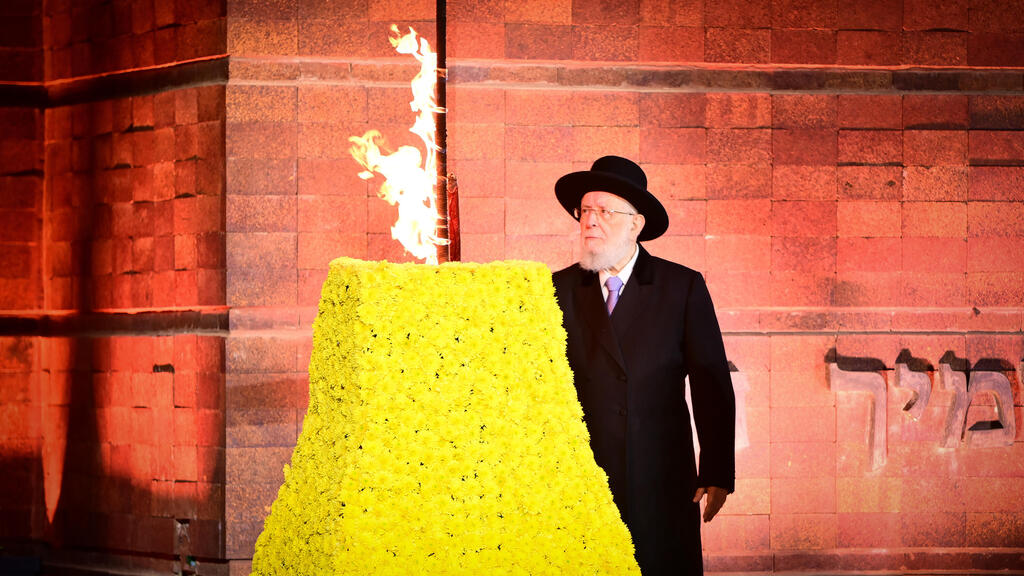
(Photo: Rafi Ben Hakoon)
Addressing Iran’s nuclear facilities, Netanyahu said that without Israeli action, key sites such as Natanz, Fordo, Isfahan and Parchin could have been remembered in the future “like Auschwitz and Treblinka, Majdanek and Sobibor.”
He added that Israel’s strikes had destroyed large portions of Iran’s nuclear, missile and drone programs, as well as naval and air capabilities, saying the country’s military power had been significantly reduced.
Netanyahu also revisited what he described as the central lesson of the Holocaust: the need for decisive action in the present to prevent future catastrophe.
He raised historical counterfactual questions, asking what might have happened if the Jewish people had had a state before the Holocaust, or if European countries had acted earlier against Nazi Germany.
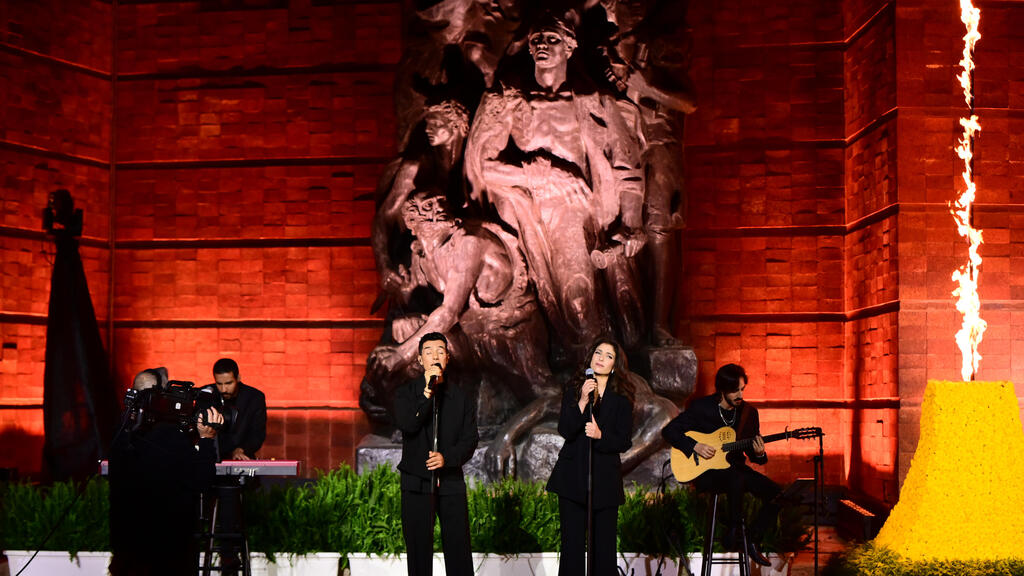
(Photo: Rafi Ben Hakoon)
“But there are no ‘ifs’ in history,” he said. “The terrible disaster happened. Six million of our people were murdered.”
Netanyahu said the international community had failed to respond adequately to the Nazi genocide in real time, but that today Israel must ensure that future generations do not ask similar questions about inaction.
He also directed part of his remarks toward Europe, saying it was “losing control of its identity, its values, and its commitment to defend civilization from barbarism.” He said Israel, together with the United States and other allies, was now helping defend not only itself but also the broader world.
“Unlike the past, those who seek to destroy us today bring destruction upon themselves on a scale they could not have imagined,” he said.
The prime minister concluded by saying Israel’s existence represents a historic reversal of Jewish vulnerability.
“We have changed the course of history,” he said. “The establishment of the State of Israel and the Israel Defense Forces represents the regaining of control over our destiny after centuries of weakness.”
Netanyahu said Israel would continue to be a “beacon of freedom, progress and prosperity,” and praised the Israel Defense Forces as the strongest military force in Jewish history. He ended his remarks with the traditional Hebrew declaration: “Am Yisrael Chai” — the people of Israel live.
President Isaac Herzog also addressed the ceremony, focusing on national unity and the dangers of internal division.
Herzog referenced the Holocaust alongside Israel’s current war, saying the country is again facing a prolonged and painful conflict following the Oct. 7 attacks and the ongoing war in Gaza.
He highlighted the story of Holocaust survivor Magda Baratz and her family's connection to Master Sergeant (res.) Asaf Cafri, an Israeli reservist killed in Gaza, described it as an example of the continuity between generations of Jewish suffering and resilience.
“We did not rise from the ashes of the crematoria to be burned in the fire of internal strife,” Herzog said, warning against deepening polarization in Israeli society.
He also addressed rising global antisemitism, urging world leaders to move beyond statements and take concrete action to protect Jewish communities worldwide.
The ceremony included the lighting of six memorial torches by Holocaust survivors representing different parts of Israeli society. The event was pre-recorded and broadcast nationally in accordance with security guidelines.