

As Israel’s gas exports to Egypt and Jordan have stopped and restarted three times since October 2023, Azerbaijan’s state oil company, known as SOCAR, has moved into every layer of Israel’s energy business at once. SOCAR now runs the largest new exploration zone in Israeli waters, holds 10% of the Tamar gas field, ships roughly three cargoes of liquefied natural gas (LNG) to Egypt each month, partners with a Qatari company to restart power plants in Syria using Azerbaijani gas piped through Turkey, and is in talks to expand further into Egypt and Jordan. No other foreign company holds that many positions in or around Israeli gas.
Those positions came together publicly this week at the 31st Baku Energy Forum and the first Azerbaijan-U.S. Economic Dialogue, held on Tuesday. They provide backup supply when Israeli gas goes offline, as it did for 32 days during the Hormuz war.
Gallery

Azerbaijan’s state oil company, known as SOCAR, has moved into every layer of Israel’s energy business at once
(Photo: Courtesy of The Media Line)
“It is our first East Mediterranean investment, and we are definitely interested in developing it further,” Vitaliy Baylarbayov, SOCAR’s deputy vice president for investments and marketing, said at SOCAR headquarters on Monday, referring to the Tamar stake, which MEES reported was valued at $510 million and which closed in June 2025. The Tamar position is one of five pieces SOCAR has built in or around Israeli gas.
Israeli energy security analyst Elai Rettig of the Begin-Sadat Center at Bar-Ilan University wrote about the pattern in a paper published May 6. The 32-day shutdown of Leviathan and Karish during the Hormuz war was the third major disruption of Israeli gas exports since October 7, 2023.
Jordan, which draws roughly 68% of its electricity from natural gas and gets more than half of that from Israeli pipelines, paid an estimated $2.5 million a day in extra fuel costs during the March-April shutdown. Egypt’s bill for imported LNG tripled in the first quarter of 2026, from $560 million to $1.65 billion. Leviathan resumed exports on April 2, and Karish followed a week later. But the shift is permanent, Rettig told The Media Line. Egypt and Jordan are lining up alternatives in case Israeli gas goes offline again.
The newest piece is Cluster I, a 660-square-mile exploration zone in the northern part of Israel’s waters, next to the Leviathan gas field and west of Energean’s Karish field. Israel’s petroleum commissioner awarded six exploration licenses there in October 2023, weeks after the Hamas attack froze the broader bid round. SOCAR leads the project. BP and NewMed Energy hold the remaining stakes, each at roughly one-third.
Tamar is operated by Chevron, the American oil major that also operates Leviathan, the field shut for 32 days during the Hormuz war. Chevron took over both fields in 2020 with its purchase of Noble Energy and approved the Leviathan expansion in January. SOCAR’s 10% Tamar stake puts the Azerbaijani state company inside a Chevron-run field. On Tuesday in Baku, SOCAR and Chevron signed a joint study agreement to assess oil and gas potential in the Middle Caspian
Basin, one of two cooperation tracks with American majors that Baylarbayov flagged Monday, alongside ExxonMobil. Both American majors are now tied to SOCAR’s portfolio while operating Israeli production.
Mubadala Energy of Abu Dhabi holds 11% of Tamar, bought from Delek in 2021 in the largest commercial deal after the UAE-Israel normalization agreement. Combined with Chevron’s 25% and SOCAR’s 10%, foreign ownership of Tamar now stands at 46%, split across an American operator and Emirati and Azerbaijani partners.
The same Gulf-Azerbaijan business ties run in the other direction. ADNOC International holds 30% of the Absheron gas field, where SOCAR, TotalEnergies, the Abu Dhabi National Oil Company, and BOTAŞ signed a 15-year, 33 billion-cubic-meter supply agreement with Turkey on Tuesday. Masdar, the Abu Dhabi state renewables developer, operates a 230-megawatt solar plant at Garadagh and broke ground in 2024 on another gigawatt of solar and wind capacity. SOCAR holds an upstream stake in the SARB and Umm Lulu fields off Abu Dhabi. The Israel-Azerbaijan partnership sits inside a wider Gulf-Azerbaijani business web from the Abraham Accords era.
Beyond the exploration deals, SOCAR’s trading business had been supplying LNG to Egypt for nine months before SOCAR and the Egyptian General Petroleum Corporation signed a framework agreement in Cairo on March 31, according to AZERTAC, Azerbaijan’s state news agency. Egypt has sharply increased LNG imports this year as pipeline flows declined, and SOCAR is among the suppliers in its expanded procurement network.
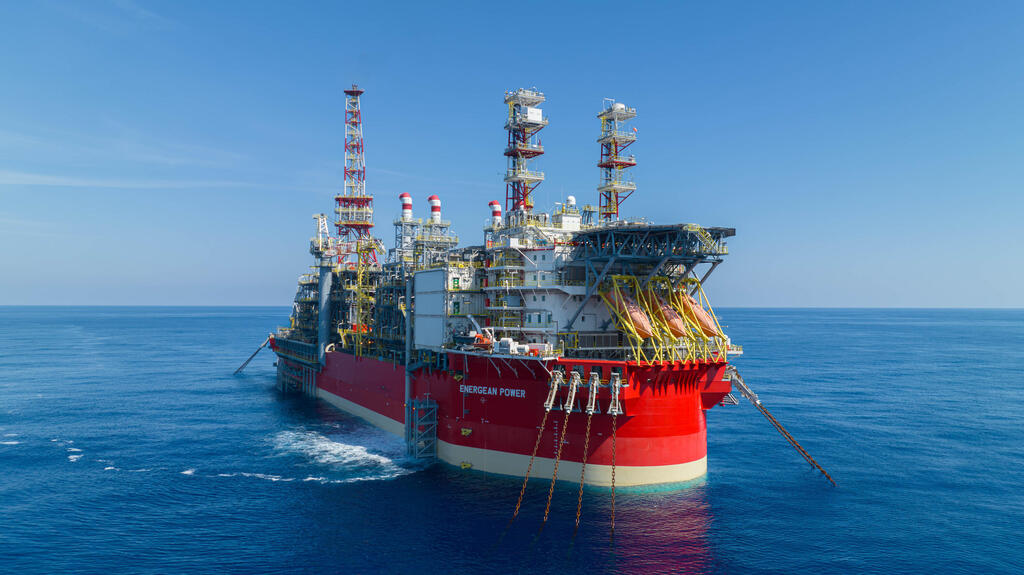
Gas carrier
(Photo: Courtesy of Energean)
Egyptian lawmaker Mohamed Fouad, who sits on the Economic Affairs Committee of the House of Representatives in Cairo, said SOCAR is meant to supplement Israeli pipeline gas, not replace it. Egypt’s December 2025 agreement with Israel for 130 billion cubic meters of pipeline gas over 15 years, worth roughly $35 billion, remains “structurally irreplaceable” in Cairo’s calculus, Fouad said. What SOCAR provides instead is what Fouad calls “resilience engineering around Leviathan dependence.”
SOCAR Trading ships more cargoes when Israeli production drops or summer demand peaks, and fewer when Israeli supplies return to normal. SOCAR shipped three cargoes worth about $146.5 million to Egypt in March, Fouad said, placing it alongside Hartree and IRH among Egypt’s largest LNG suppliers. Fouad estimates Egypt’s basic need at two to four cargoes per month, with more in summer. Egypt’s own gas production was still falling through March 2026, down to about 3.80 billion cubic feet per day.
Cairo does not treat SOCAR and ExxonMobil as competitors. ExxonMobil is the long-term play, drilling new gas off Cyprus. SOCAR is the short- and medium-term backup, providing cargoes when Israeli supply drops. The two could overlap later, Fouad noted, if Egyptian production recovers and Cypriot exports move forward.
Egypt and ExxonMobil put that arrangement in writing at Egypt’s energy conference earlier this year. John Ardill, ExxonMobil’s vice president for global exploration, said at the Baku Convention Center on Tuesday that the company signed a preliminary agreement with Egypt’s petroleum ministry to ship Cypriot gas through Egypt’s existing LNG terminals rather than build new export terminals.
ExxonMobil has finished evaluating its Glaucus gas find off Cyprus and is wrapping up Pegasus. ExxonMobil holds 60% of the block, and QatarEnergy holds 40%. ExxonMobil recently confirmed that the gas is commercial. Ardill said moving from discovery to actual production typically takes five to 10 years. “Rather than building all of this from scratch, that would let us move more quickly and more cost-effectively,” Ardill said. The same Egyptian terminals SOCAR uses for backup cargoes today will, by the early 2030s, handle Cypriot gas Egypt has helped develop.
Turkey is building its own version, outside the East Mediterranean Gas Forum, whose members include Cyprus, Egypt, France, Greece, Israel, Italy, Jordan, and Palestine, with the European Union and the United States as observers. Turkey is not at the table. On the sidelines of the Baku Forum on Monday, Bayraktar met Egyptian Petroleum Minister Karim Badawi to discuss cooperation on oil, gas, and mining, building on talks held in Istanbul in April. The two countries deal directly, outside the forum.
Turkish Energy Minister Alparslan Bayraktar delivered President Recep Tayyip Erdoğan’s opening message at the Baku Forum on Monday and laid out what he called “the electricity version of TANAP,” a power line running through Azerbaijan, Georgia, and Bulgaria to southeast Europe. In April, during the worst of the Hormuz war, Bayraktar called the global crisis “the mother of all crises” in an Al Jazeera Arabic interview, arguing that it would force the world to rethink how energy moves.
Bayraktar’s plans include a 60-mile underwater pipeline announced in May between southern Turkey and northern Cyprus, set to begin operation by 2028. The pipeline can carry gas in either direction. The Republic of Cyprus learned about it from the media. Bayraktar also proposed a Qatar-to-Turkey pipeline routed through Saudi Arabia, Jordan, and Syria, a route that would compete directly with Israeli pipeline gas reaching Egypt and Jordan today.
Behind Turkey’s plans sits the deepest bilateral energy relationship in the region. Turkey is the largest single buyer of Azerbaijani gas and the destination for SOCAR’s biggest foreign investment.
The Azerbaijani state oil company is Turkey’s largest international investor, with $19.5 billion deployed since 2008 across the STAR refinery at Aliağa, the Petkim petrochemical complex, the SOCAR Terminal container port, and a majority stake in the Trans-Anatolian Natural Gas Pipeline (TANAP), which carries Shah Deniz gas across Turkey.
American private equity firm Apollo Global Management expanded its TANAP financing to $300 million on Monday. The Absheron supply agreement, signed on Tuesday, extends that integration with another 15-year delivery commitment. That depth is what makes the Turkey-Azerbaijan-Syria gas-to-power link work in practice, while Bayraktar’s proposals for northern Cyprus and Qatar remain on paper.
Rauf Mammadov of Fuld + Company says Turkey’s hub ambitions, Israel’s production base, and Egypt’s LNG infrastructure “could just as easily form parts of a broader regional system as compete in a winner-takes-all struggle.”
Yet all of this sits inside an Iranian threat.
Iranian drones reached Azerbaijan’s Nakhchivan exclave in March. Azerbaijani security services announced the next day that they had disrupted an Iranian plot targeting the Baku-Tbilisi-Ceyhan pipeline. That pipeline carries nearly half of Israel’s oil, a $2.5 billion annual flow similar to Israeli gas exports to Egypt and Jordan. Separate Iranian plots targeted the Israeli Embassy and a synagogue in Baku. Iran “never achieved in Azerbaijan what it achieved in Syria, Lebanon, or Yemen,” according to a former senior U.S. official. The Israel-Azerbaijan artificial intelligence cooperation agreement, signed on February 3, covers the surveillance and coordination required for this kind of operation.
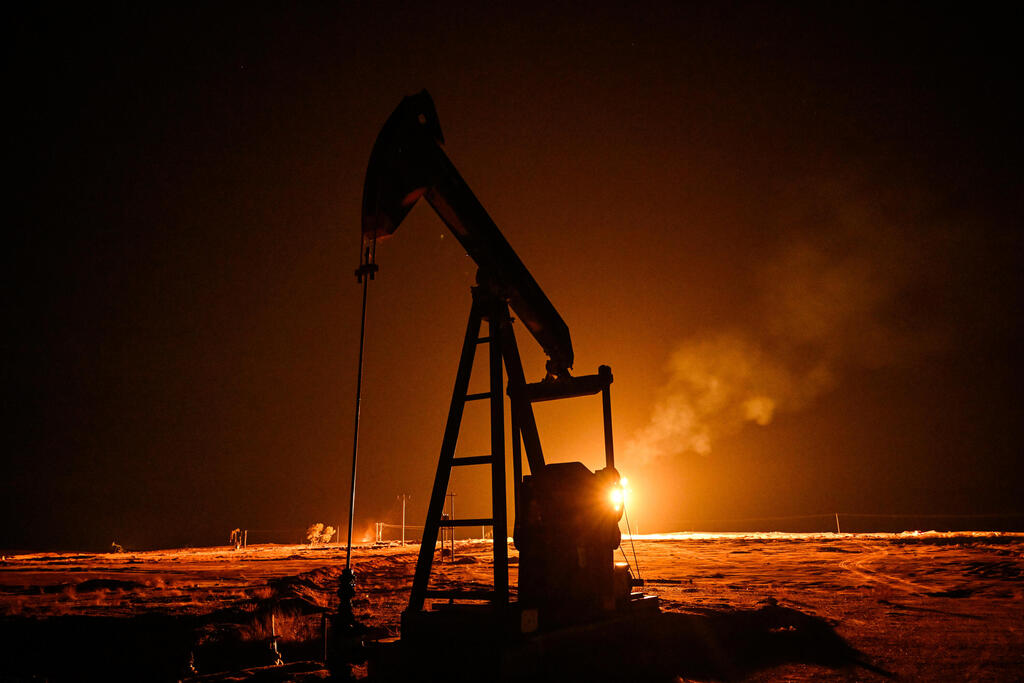
An oil facility in northeastern Syria
(Photo: Abdulmonam Eassa/Getty Images)
In Syria, SOCAR has partnered with the Qatari company UCC Holding and Turkey’s BOTAŞ to supply natural gas from the Caspian’s Shah Deniz field across Turkish territory to power plants in Damascus, Homs, and Aleppo, restored under the post-Assad reconstruction beginning in August 2025. Initial delivery is 1.2 billion cubic meters annually. “We are bringing light, if you wish,” Baylarbayov said.
That same corridor could one day carry Israeli gas in the opposite direction, Rettig told The Media Line. He said SOCAR’s presence in Israeli waters could add a commercial intermediary to future regional gas trade, though any such arrangement remains speculative. SOCAR has not said it intends to market Israeli-produced gas as Azerbaijani or use its position to overcome political resistance to direct purchases from Israel.
Rettig pointed to oil as an example of how energy trade can survive political strain. Azerbaijani crude has reached Israel through Turkey via the Baku-Tbilisi-Ceyhan pipeline for nearly two decades, even during periods of diplomatic rupture between Ankara and Jerusalem. But that precedent does not mean SOCAR is currently rebranding Israeli gas or has agreed to serve as a political shield for Israeli exports.
Asked whether SOCAR’s investments hurt Israel, Rettig said no. The East Mediterranean is a gas-hungry region, in his view, and having multiple suppliers benefits Israel as much as it guards against Israeli supply disruptions. “SOCAR is considered a supplement rather than a competitor,” he said.
In a region where gas rarely moves without politics attached, that may be the point.