

The United States is preparing to bring a new resolution to the UN Security Council that would establish an international stabilization force in the Gaza Strip. But in the latest draft, Washington also emphasizes the possibility of what it calls “a credible path to self-determination and a Palestinian state.”
The draft is based on the 20-point plan presented by President Trump and on his “Declaration for Peace and Sustainable Prosperity,” signed by the president and regional leaders at the Sharm el-Sheikh summit. It states that the United States will “create a dialogue between Israel and the Palestinians to agree on a political horizon for prosperous coexistence.”

According to the draft, a “Board of Peace” would serve as Gaza’s transitional governing body until the Palestinian Authority completes its reform program and is able to assume control “safely and effectively.” The draft adds that once the PA fulfills the reform plan and Gaza’s development advances, “conditions may finally be in place for a credible path to self-determination and a Palestinian state.”
Criteria for IDF withdrawal
The proposal also details conditions for the withdrawal of the IDF from areas it currently controls in Gaza. “When the stabilization force (ISF) achieves control and stability, the IDF will withdraw from the Gaza Strip based on standards and timelines related to disarmament agreed upon by the ISF, the guarantor states and the United States.”
The IDF would maintain a perimeter around Gaza, described as a “peripheral security presence,” until the territory is “properly secured against any renewed terrorist threat.”
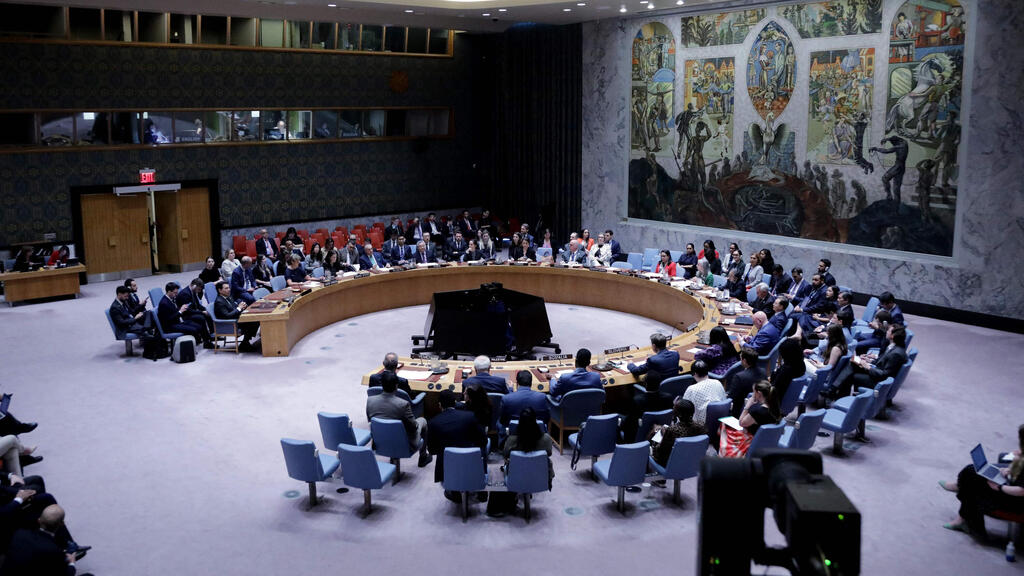
The United Nations Security Council
(Photo: Leonardo Munoz / AFP)
The draft outlines the mandate of the proposed ISF, which would operate under unified command endorsed by the Board of Peace and coordinated with Israel and Egypt. It would be funded by donor states and dedicated financing mechanisms under the Board of Peace.
The force would be authorized to secure border areas; stabilize the security environment in Gaza; disarm militant groups, including through the destruction and prevention of reconstruction of terror infrastructure; and dismantle “non-state armed organizations” such as Hamas. The force would also train and support Palestinian police units and be responsible for civilian protection, including facilitating humanitarian operations.
The mandate of the Board of Peace and associated security forces would run through the end of 2027, with the option for extension subject to Security Council approval.
If no significant objections emerge, the resolution may be brought to a Security Council vote as early as Friday or Monday. The United States has already circulated a comprehensive draft for establishing a transitional international administration in Gaza and a stabilization force to operate in coordination with Israel, Egypt and the Palestinian Authority, but that earlier document never reached a vote.
The previous proposal
That earlier draft, also rooted in the 20-point plan and Trump’s Sharm el-Sheikh declaration, stated that the situation in Gaza “threatens regional peace and security” and outlined practical steps for rehabilitation and stabilization, though it did not invoke Chapter 7 of the UN Charter, meaning it did not authorize binding military force.
Key elements of the earlier proposal included formal endorsement of the political plan and a call for all parties to implement it fully; the creation of an international transitional body known as the Board of Peace to administer Gaza, oversee reconstruction funds and prepare for the transfer of authority to the Palestinian Authority once reforms are completed; the full resumption of humanitarian aid under UN, Red Cross and Red Crescent coordination with safeguards against diversion by armed groups; and reconstruction funding through an international trust managed by the World Bank and donor nations.