

Prime Minister Benjamin Netanyahu met with Shas chairman Aryeh Deri and Knesset Member Moshe Gafni, with the three agreeing at the end of the meeting on a package of bills to be approved before the Knesset is dissolved.
The Haredi parties gave up on passing the daycare subsidy bill in the current Knesset. In exchange, they are expected to receive passage of Basic Law: Torah Study in three readings, as well as the bill preventing the arrest of draft evaders and the kashrut bill.
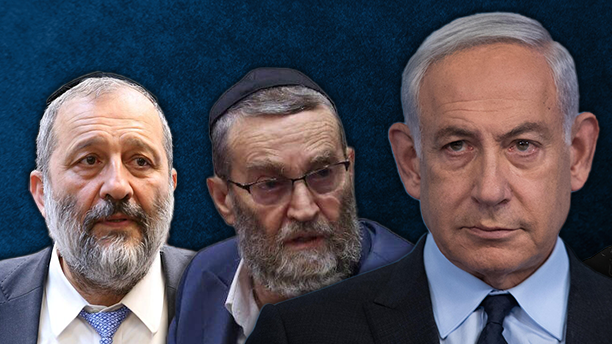
Aryeh Deri, Moshe Gafni and Benjamin Netanyahu
(Photo: Yoav Dudkevitch, Alex Kolomoisky, Noam Moskowitz)
For their part, the Haredi parties will support the bill splitting the role of the attorney general, which is now expected to pass in its second and third readings. They will also back legislation to establish a political commission of inquiry into the Oct. 7 massacre.
Following the understandings, which mean the Haredi parties will not support dissolving the Knesset, the emerging new election date is Oct. 20.
The Knesset is still expected to dissolve by July 17. That leaves 17 parliamentary workdays starting Wednesday, meaning only bills that are already at an advanced stage can be promoted.
Against the backdrop of Netanyahu’s meeting with Deri and Gafni, coalition chairman Ofir Katz held talks with all party leaders in an effort to formulate a legislative package agreed upon by the entire coalition.
Degel HaTorah officials said after the agreement: “The election will be held on the date Netanyahu wants if we receive what was agreed. If they give, they’ll get. If they don’t give, they won’t get.”