

For the ninth consecutive Saturday, Safed’s central square became the scene of confrontation between ultra-Orthodox protesters opposing public transportation on the Sabbath and secular residents protesting in response.
The demonstrations have now continued for roughly two months around Egged Square, where ultra-Orthodox activists, many arriving from outside the city, gather each Sabbath to protest buses operated by Nativ Express that transport soldiers and civilians around Safed.
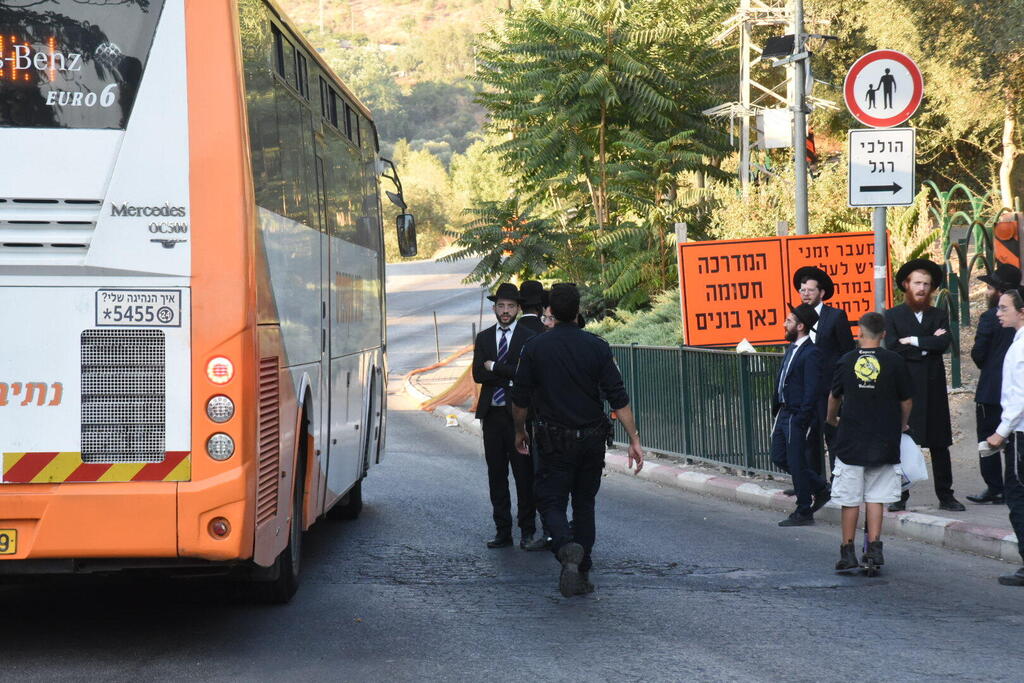
About 100 ultra-Orthodox demonstrators took part in Saturday’s protest, alongside several dozen secular counterprotesters.
Safed police, led by Superintendent Haim Biton, worked to prevent road blockages and limit disruption to residents. Despite attempts by some protesters to stop traffic, buses were able to continue operating.
Police also detained an ultra-Orthodox man whom Biton recognized as being under a court order barring him from the area following disturbances several Saturdays earlier.
The protests have begun to spread beyond Safed. Similar demonstrations have reached the central square in Meron, where ultra-Orthodox protesters have also objected to buses operating over the weekend.
In Safed itself, one neighborhood in the southern part of the city, Tzahal-Ma’or Haim, is predominantly ultra-Orthodox. Vehicles do not enter the neighborhood and public transportation does not pass through it on the Sabbath.

(Photo: Avihu Shapira)
The broader dispute has sharpened political tensions inside the city.
Secular residents have expressed concern over the tenure of ultra-Orthodox Mayor Yossi Kakon, even though he has tried in recent weeks to prevent the demonstrations.
Ultra-Orthodox activists have accused Kakon in wall posters of acting against religion, while secular residents blame him for what they see as the increasing ultra-Orthodox character of Safed.
In response to the protests, groups of secular residents have organized their own demonstrations and vehicle convoys through the city, playing music on the Sabbath.
Their message, according to participants, has been simple: “If you disturb us, we’ll disturb you.”