

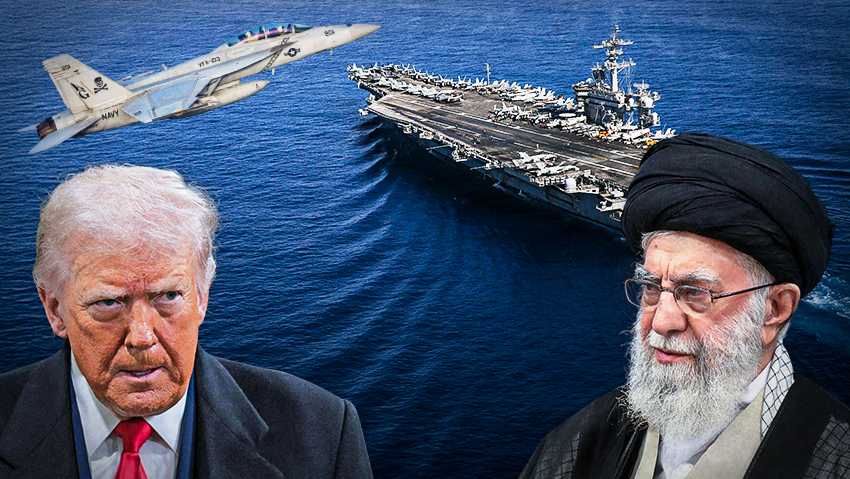
U.S. President Donald Trump on Sunday responded to a warning by Iran’s Supreme Leader Ayatollah Ali Khamenei that a U.S. attack on Iran would ignite a regional war, saying he hoped negotiations would succeed but making clear that military force remains an option.
“Why wouldn’t he say that? Of course he’d say that,” Trump told reporters at his Mar-a-Lago estate in Florida when asked about Khamenei’s remarks. “We have the biggest and strongest ships there, very close. They’ll be ready within days. I hope we make a deal. If we don’t make a deal, we’ll find out.”
Trump: ‘I hope we make a deal, if not, we’ll find out’


Trump’s comments came amid peak tensions between Washington and Tehran, as the United States continues to reinforce its military presence across the Middle East while parallel diplomatic efforts seek to prevent escalation.
A ‘big armada’ in the region
Trump has repeatedly referred in recent days to a “big armada” being sent toward Iran. According to U.S. media reports, the deployment includes the aircraft carrier USS Abraham Lincoln and eight U.S. Navy destroyers now operating across key maritime zones.
The Wall Street Journal reported that two destroyers are positioned near the Strait of Hormuz, three are operating in the northern Arabian Sea alongside the carrier, one recently arrived in the Red Sea near Eilat, and two more are stationed in the eastern Mediterranean.
Fox News identified the vessels as USS Michael Murphy, USS Frank E. Petersen Jr. and USS Spruance accompanying the carrier, USS McFaul and USS Mitscher near Hormuz, USS Delbert Black in the Red Sea, and USS Roosevelt and USS Bulkeley in the Mediterranean.
The U.S. has also reinforced air defense systems in the region, including THAAD batteries, to protect American forces, regional allies and Israel.
Tehran backs away from planned drill
Alongside the military buildup, Iran appeared on Sunday to soften its posture.
A senior Iranian official denied reports that the Revolutionary Guards planned to conduct a two-day live-fire exercise in the Strait of Hormuz, contradicting earlier reports published by Iranian media.
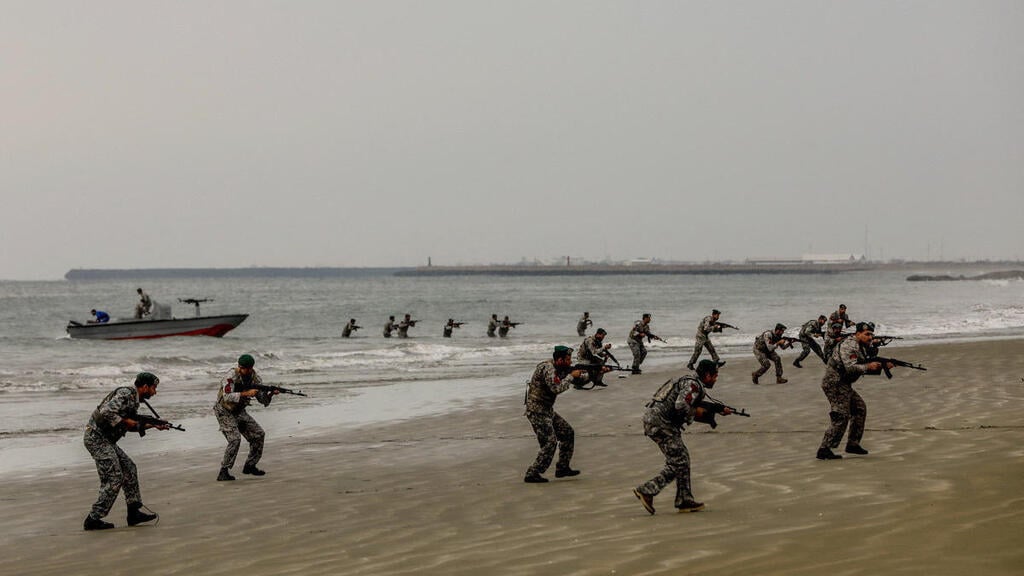
Iranian military drill, archive
(Photo: Reuters/ Iranian Army/WANA)
“There was no plan for such exercises, and no official announcement was made,” the official told Reuters.
The denial followed a rare public warning issued over the weekend by U.S. Central Command, which urged Iran to conduct any military activity in the strait “responsibly” and without endangering freedom of navigation.
Iran’s apparent retreat from the exercise was widely interpreted as an attempt to avoid further escalation at a critical moment.
Signs of diplomatic movement
Despite the escalating rhetoric, Trump said overnight that Iran is already engaged in what he described as “serious talks” with Washington and expressed hope that an agreement could be reached on “something acceptable.”
In Tehran, senior Iranian figures echoed cautious optimism. Ali Larijani, a close adviser to Khamenei, said progress had been made toward a “framework” for negotiations following meetings with Qatari Prime Minister Sheikh Mohammed bin Abdulrahman Al Thani.
Qatar maintains close ties with both Tehran and Washington and hosts the Al Udeid Air Base, the largest U.S. military installation in the Middle East.
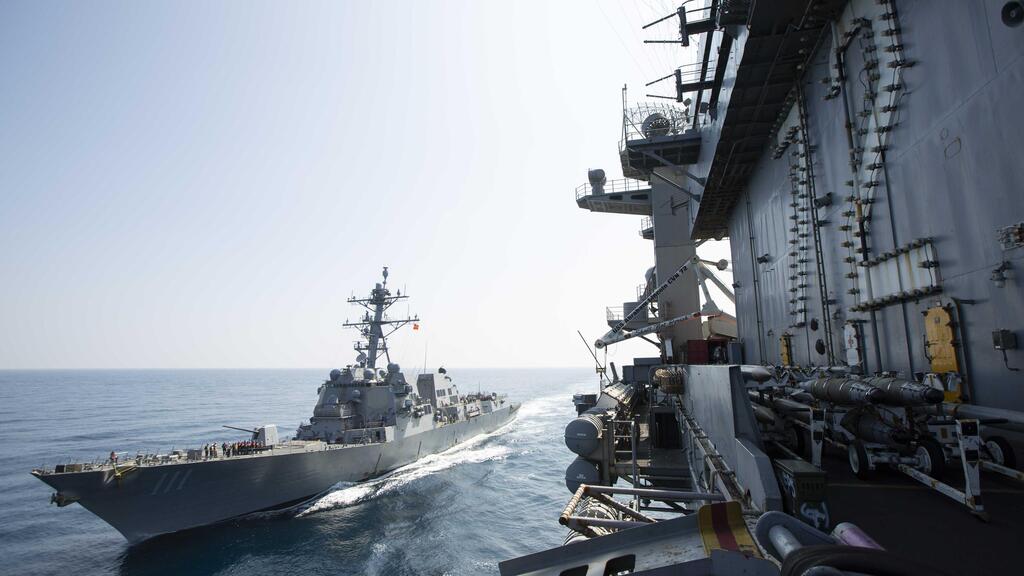
The destroyer Spruance accompanying the aircraft carrier Lincoln
(Photo: US Navy)
Protester released amid pressure
Another development seen as a possible conciliatory signal was the release of Erfan Soltani, an Iranian protester who had become a symbol of the recent wave of demonstrations.
Soltani, from Karaj near Tehran, was freed on bail of about $12,000, according to his lawyer. His case had drawn international attention after reports that Iranian authorities planned to execute him in a fast-track trial.

Erfan Soltani
(Photo: Anonymous/Getty Images)
During the height of the protests, Trump publicly warned Iran against executing demonstrators and later claimed U.S. pressure had led to the cancellation of hundreds of executions — a claim Tehran has denied.
Human rights groups say at least 6,700 protesters were killed during the crackdown, with the true number potentially far higher. Iranian authorities dispute those figures.
Iran’s red lines
In an interview with CNN, Iranian Foreign Minister Abbas Araghchi said indirect talks via regional mediators could still be “productive,” even as he accused Washington of no longer being a reliable negotiating partner.
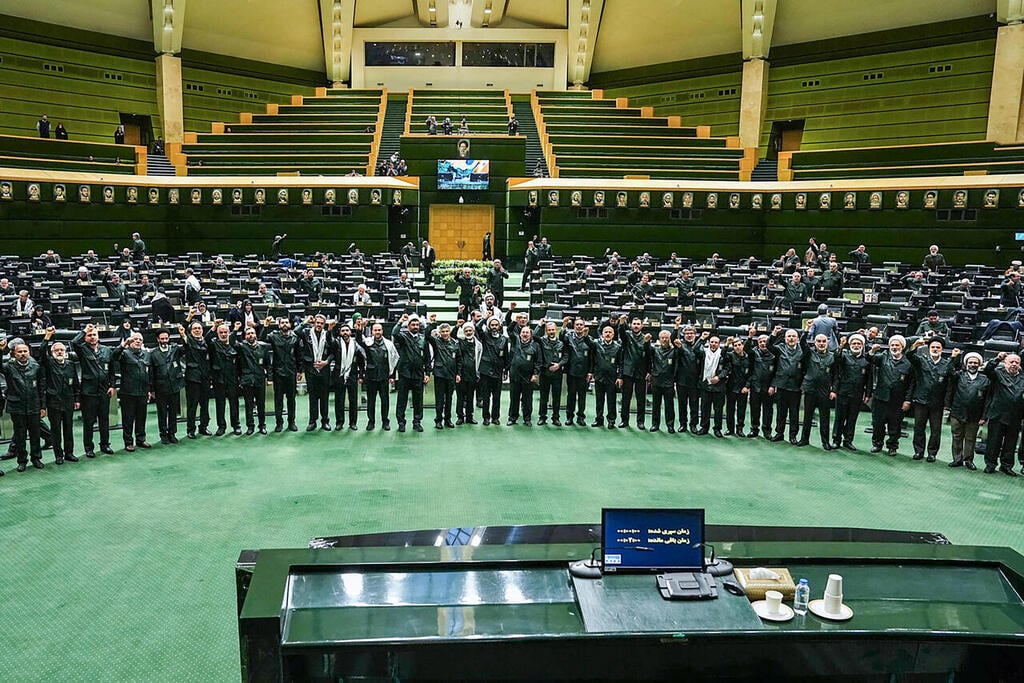
Members of parliament in Tehran chant 'Death to America!' this morning, wearing Revolutionary Guard uniforms
(Photo: AFP/ HO /ISLAMIC CONSULTATIVE ASSEMBLY (ICANA))
He said Iran could reach an agreement ensuring it does not develop nuclear weapons, but rejected U.S. demands for a total ban on uranium enrichment and refused to negotiate Iran’s ballistic missile program.
“Let’s not talk about impossible things,” Araghchi said when asked about missiles.
He warned that if talks collapse, Iran is “ready for war,” adding that any conflict would expand beyond Iran’s borders and become a regional war — a scenario he described as “a disaster for everyone.”
Israel prepares for spillover
As tensions rise, Israel has stepped up its preparations.
IDF Chief of Staff Lt. Gen. Eyal Zamir held intensive talks last week in Washington with senior U.S. military officials, including Chairman of the Joint Chiefs of Staff Gen. Dan Caine. Israeli officials say the meetings focused on coordination ahead of potential Iranian retaliation.
After returning to Israel, Zamir met with Defense Minister Israel Katz to review operational readiness. Prime Minister Benjamin Netanyahu later convened a security meeting with Katz, Zamir and Mossad chief David Barnea to receive updates on U.S.-Iran developments.
Israeli officials have warned that any Iranian attack on Israel in response to U.S. action would be met with a severe Israeli response.
‘Negotiations over negotiations’
For now, Washington and Tehran appear locked in what Israeli analysts describe as “negotiations over negotiations,” with military preparations advancing alongside diplomatic feelers.
Trump has not publicly confirmed whether he has set a deadline for talks, though he warned last week that “time is running out” and said any future strike would be “much tougher than the last one.”
As regional and international mediators continue their efforts, uncertainty dominates. The U.S. armada remains in place, Iran’s rhetoric oscillates between threat and restraint, and Israel braces for the possibility that diplomacy could yet give way to confrontation.