

Women leaders from Lebanon, Israel, Australia and the United States called for greater people-to-people engagement between Lebanese and Israelis, arguing that any future diplomatic agreement between the neighboring countries would need support from civil society to develop into a lasting peace.
The discussion took place during a Sept. 15 webinar organized by Women Champions for Change, or WCC, a regional network that brings together women from across the Middle East and North Africa. Participants included figures involved in political advocacy, security policy, interfaith dialogue, civil society and public communications.
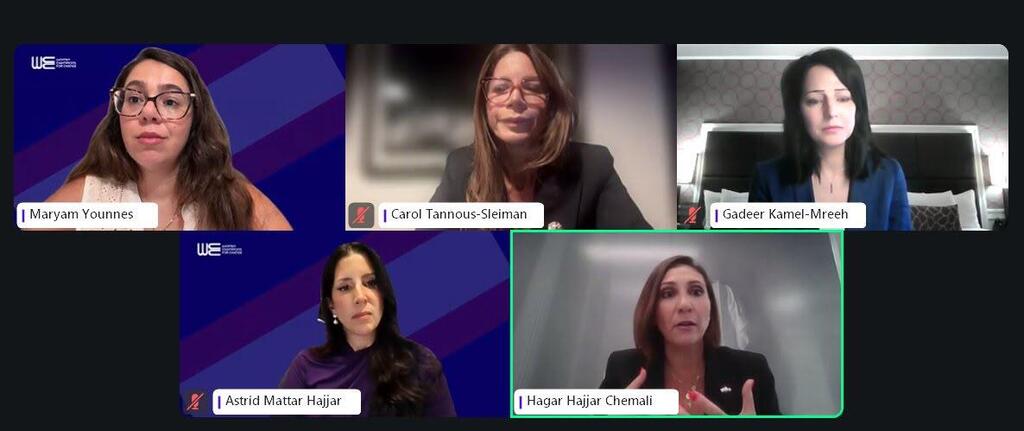
The webinar was hosted by Women Champions for Change and supported by WCC co-founders Danny Hakim OAMand Ayelet Mavo
Speakers acknowledged the significant political and security obstacles separating Israel and Lebanon but expressed cautious optimism that conditions could provide an opening for a different relationship.
The webinar was part of WCC’s Women of the Middle East Briefing Series, which the organization says is intended to give women with direct experience of the region a greater role in diplomatic and policy discussions.
‘Peace must be built between people’
Maryam Younnes, a peace activist, content creator and WCC’s social media lead, moderated the discussion.
“WCC is bringing together women who are not waiting for the region to become uncomplicated before they act,” Younnes said. “We are creating a space for women with direct experience of the region to bring perspectives that often do not make it into traditional diplomatic or policy conversations.”
A central theme was the argument that any eventual peace agreement should extend beyond formal relations between governments and foster direct ties between Lebanese and Israeli society.
Gadeer Kamal-Mreeh, the first Druze woman elected to Israel’s parliament, the Knesset, and now a strategic adviser on U.S.-Israel and Middle East affairs, warned against a “cold peace” limited largely to political leaders and official institutions.
“We should not wait for governments. We must push governments towards peace through a creative, bottom-up and people-first approach,” Kamal-Mreeh said. “The people are ahead, pushing, ready and asking for peace before their governments.”
Kamal-Mreeh said meetings in Washington and other international settings can provide opportunities for Lebanese and Israeli figures to move beyond narrow national perspectives and discuss shared interests including peace, democracy, equality and regional stability.
Israel and Lebanon have no diplomatic relations and technically remain in a state of war. Decades of conflict, including repeated confrontations between Israel and the Iran-backed Hezbollah group, have left relations between the countries deeply hostile. Against that backdrop, direct civil society engagement between Lebanese and Israelis remains politically sensitive.
From political opening to lasting agreement
Hagar Hajjar Chemali, co-founder of the Lebanon-Israel Peace Alliance and a former U.S. government official who served at the White House, Treasury Department and National Security Council, focused on the political and security conditions she believes would be necessary for progress.
Chemali identified Hezbollah’s refusal to disarm as the leading obstacle to an agreement. She argued that the Lebanese government must give the Lebanese Armed Forces a clear mandate to assert state authority, while Washington must remain diplomatically engaged and Israel must continue participating in the process.
“The train has left the station, and it is headed towards peace,” Chemali said. “The process will have its ups and downs, but all three parties must do their job simultaneously. The United States must keep this a priority, Lebanon must make the political decision to disarm Hezbollah, and Israel must remain committed to working with Lebanon every step of the way.”
Chemali said the Lebanon-Israel Peace Alliance seeks to promote an eventual agreement through policy advocacy, coalition-building and efforts to reshape public discussion around what its members see as the benefits of peace.
Her comments reflected the speakers’ advocacy rather than a consensus within Lebanon, where the future of Hezbollah’s weapons and relations with Israel remain deeply contentious political issues.
‘You have to speak up’
Carol Tannous Sleiman, the Australia-based founder of Brave Voices, discussed the role she believes non-Jewish communities should play in confronting antisemitism and defending democratic values.
Brave Voices brings together Jewish and non-Jewish Australians for discussions aimed at helping participants challenge hatred and misinformation. Sleiman said people do not need extensive knowledge of Middle East geopolitics to speak out.
“You cannot only speak up behind a keyboard. You have to speak up and do something,” Sleiman said. “People are willing to speak, but they need tools, encouragement and inspiration. When one person finds the courage to speak, it gives courage to others.”
Sleiman, a Lebanese Maronite Christian, said her background often opens conversations with people who assume Lebanese and Israelis are natural enemies. She said her work attempts to turn that curiosity into dialogue and practical engagement.
Women and the foundations of peace
Astrid Mattar Hajjar, co-founder of the Abraham Women’s Alliance, said women can help create environments in which participants initially encounter one another as individuals rather than primarily as representatives of political, national or religious groups.
The alliance brings together Jewish, Muslim and Christian women through dialogue, storytelling, film and collaborative projects.
Hajjar described a gathering in Beirut at which women discussed their fears, hopes and views of peace and found common ground on issues including family, dignity, security, faith and their children’s futures.
“Trust does not require agreement. It requires a willingness to remain in a relationship despite disagreement,” Hajjar said. “If we want sustainable peace between Lebanon and Israel, we must build peace not only between governments, but between people, and women must be at the centre of that work.”
She said dialogue should eventually translate into practical cooperation in education, economic development, women’s leadership, humanitarian issues, environmental challenges and violence prevention.
The participants concluded that any sustainable Israeli-Lebanese peace would require a combination of formal diplomacy and security arrangements with longer-term efforts to develop relationships between the two societies.
WCC said the webinar was intended to bring policy specialists, political figures, interfaith advocates and community organizers together to explore ways civil society could complement official diplomatic efforts.
The event was hosted by Women Champions for Change and supported by the organization’s co-founders, Danny Hakim and Ayelet Mavor.
Women Champions for Change describes itself as a regional network connecting women leaders across the Middle East and North Africa and promoting relationships across national, religious and cultural divides. The organization says it supports initiatives aimed at advancing dialogue, cooperation and social change.