

A day after U.S. President Donald Trump canceled a planned trip to Pakistan by his envoys for negotiations — Steve Witkoff and Jared Kushner — he said Sunday in an interview with Fox News that the United States will no longer hold talks with Iran in Pakistan.
“If they want to talk, they can come to us, or they can call us. You know, there is a telephone. We have nice, secure lines,” Trump said.
Trump talks about Iran


In the interview, Trump again underscored his red lines in negotiations with Iran: “They know what has to be in the agreement. It's very simple: they cannot have a nuclear weapon, otherwise there's no reason to meet.”
Trump announced Saturday that Witkoff and Kushner would not travel to Islamabad, after Vice President JD Vance’s planned visit to the Pakistani capital had already been canceled. Speaking with reporters in Florida, Trump said that “within 10 minutes of the cancellation, we received a new offer, much better.”
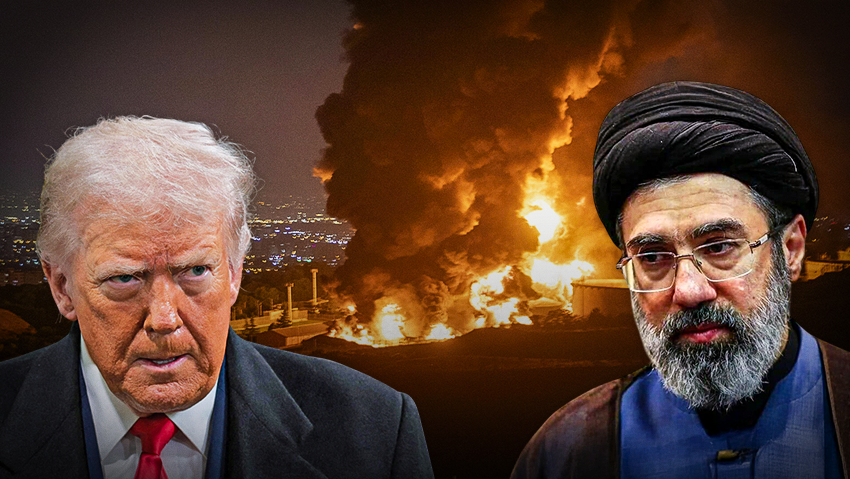
Writing on his Truth Social platform, Trump said: “I just cancelled the trip of my representatives going to Islamabad, Pakistan, to meet with the Iranians. Too much time wasted on traveling, too much work! Besides which, there is tremendous infighting and confusion within their “leadership.” Nobody knows who is in charge, including them,” he continued. “Also, we have all the cards, they have none! If they want to talk, all they have to do is call!!!”
“I told my people, as they were preparing for the flight — you’re not going to fly 18 hours. All the cards are in our hands. They can call us whenever they want, but you’re not going to fly 18 hours to sit and talk about nothing,” Trump told Fox News White House correspondent Aishah Hasnie.
At the same time, Trump told Axios that canceling the trip does not necessarily mean a return to fighting. Asked about that possibility, he replied: “No, that’s not what it means. We haven’t thought about that yet.”
Earlier, The Washington Post reported that Vance would also not travel to Pakistan, in part to avoid embarrassment if the round of talks failed. Other sources told the newspaper that the decision to keep Vance on standby aligns with diplomatic protocol, under which the vice president would attend talks only if they were held at a parallel level. Accordingly, Iran did not send its parliament speaker, Mohammad Bagher Ghalibaf, who led its delegation in the previous round.
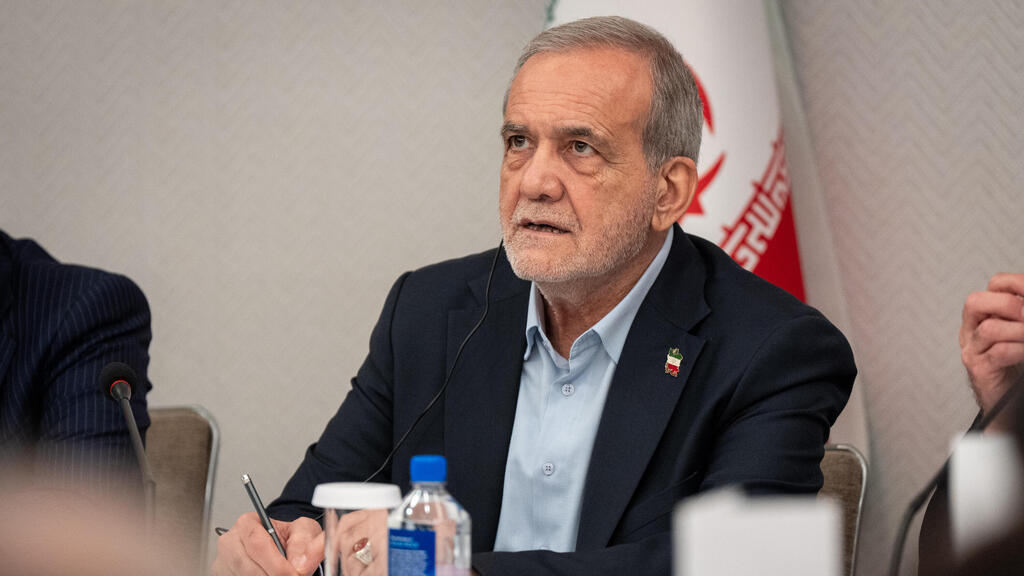
Iranian President Masoud Pezeshkian
(Photo: AP Photo/Angelina Katsanis)
Iranian Foreign Minister Abbas Araghchi also left Pakistan for Oman on Saturday without meeting U.S. representatives. Araghchi met in Pakistan with Prime Minister Shehbaz Sharif and with Pakistan’s army chief, Asim Munir, and according to reports delivered Tehran’s response to the latest proposal to end the war. He left Islamabad shortly afterward, and Ebrahim Azizi, head of the Iranian parliament’s National Security and Foreign Policy Committee, said the visit was intended only for discussions on “mutual relations.”
The New York Times reported Saturday, citing Iranian state television, that Iranian President Masoud Pezeshkian said in a phone call with Pakistan’s prime minister that Iran would not return to negotiations with the United States as long as a naval blockade remains in place in the Strait of Hormuz on vessels entering or leaving Iranian ports.
“We will not enter negotiations under pressure, threats and a blockade,” Pezeshkian was quoted as saying. He added that the U.S. naval blockade “has sown distrust among Iran’s leaders and undermined America’s stated willingness to engage diplomatically.”